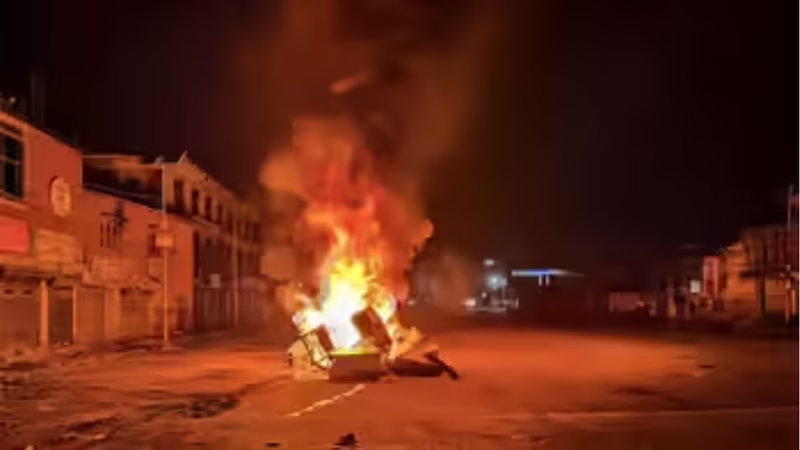
The Manipur violence that has torn apart India’s northeastern state for over two years has just entered a critical new phase. In a landmark move, the Supreme Court of India has ordered a full forensic probe into a purported 48-minute voice recording of former Chief Minister N. Biren Singh. This decision, stemming from a petition alleging his direct role in the violence against the Kuki-Zo community, could be a pivotal moment in the quest for accountability .
Table of Contents
- What is the Supreme Court’s Order?
- The Manipur Violence: A Context You Must Understand
- What is Forensic Audio Analysis? How it Works in India
- Why This Order Matters for Justice and Accountability
- What Comes Next in the Investigation?
- Conclusion
- Sources
What is the Supreme Court’s Order?
The apex court has directed the government to submit the entire 48-minute audio clip for a thorough forensic examination . This is a significant escalation from previous hearings, where only parts of the recording may have been considered. The court tasked the National Forensic Sciences University (NFSU) with the complex job of analyzing the recording’s authenticity, integrity, and content .
The petition that triggered this order claims that the audio recording contains conversations where Biren Singh is heard discussing strategies that directly contributed to the targeted violence against the Kuki-Zo community . The Supreme Court’s directive is a clear signal that it is taking these serious allegations with the utmost gravity.
The Manipur Violence: A Context You Must Understand
To grasp the weight of this forensic probe, one must understand the backdrop of the Manipur violence. The conflict erupted on May 3, 2023, following a controversial High Court order that suggested granting Scheduled Tribe (ST) status to the Meitei community, the majority in the Imphal Valley .
This decision was fiercely opposed by the tribal communities, primarily the Kuki-Zo people in the hill districts, who feared it would dilute their existing ST rights and lead to a loss of land and political representation .
The ensuing violence has been devastating:
- Duration: The conflict has raged for well over two years, with a recent deadline for a central inquiry commission extended to May 2026 .
- Casualties and Displacement: Over 230 people have been killed, and more than 60,000 have been displaced from their homes, living in relief camps .
- Ongoing Tensions: Despite efforts at peace, violence flares up periodically, with curfews imposed as recently as November 2025 in multiple districts .
Against this grim reality, any evidence that could point to a deliberate orchestration of violence is of paramount importance.
What is Forensic Audio Analysis? How it Works in India
For many, the term forensic audio analysis might sound like something from a spy movie. But it’s a legitimate and highly scientific field within forensic science. In simple terms, it’s the process of collecting, analyzing, and evaluating sound recordings to be used as admissible evidence in a court of law .
The NFSU will likely conduct a multi-faceted investigation to answer critical questions:
What Will the Forensic Experts Be Looking For?
- Authentication: Is the recording a single, unedited piece, or has it been spliced or manipulated? This checks the recording’s integrity .
- Speaker Identification: Can they scientifically confirm that the voice on the recording is indeed that of N. Biren Singh? This involves comparing the audio to known voice samples .
- Content Enhancement: The recording may be of poor quality. Experts can use software to reduce background noise and enhance speech to make the dialogue clearer .
- Environmental Analysis: Can they determine where the recording was made—a phone call, a meeting room, or a phone’s voicemail? This helps establish context .
The findings from this analysis will be crucial in determining the evidentiary value of the recording. A confirmed, unaltered audio clip could have profound legal and political consequences.
Why This Order Matters for Justice and Accountability
This isn’t just another procedural step. The Supreme Court’s intervention cuts through the political noise that has often surrounded the Manipur violence. It represents a direct, judicial pathway to uncover the truth. For the thousands of victims and displaced families from both the Meitei and Kuki-Zo communities, this probe offers a sliver of hope for justice.
By ordering a forensic examination of the complete 48-minute clip, the court is ensuring a holistic view of the alleged conversation, preventing any out-of-context interpretations that could skew the narrative. This move strengthens public trust in the institution’s ability to be an impartial arbiter in a deeply polarized situation.
What Comes Next in the Investigation?
The ball is now in the court of the forensic experts. The process of audio analysis is meticulous and can take several weeks or even months to complete. Once the NFSU submits its detailed report to the Supreme Court, the following scenarios could unfold:
- If the recording is proven to be authentic and its contents are incriminating, it could lead to further legal action against the former CM and others potentially involved.
- If the recording is found to be fabricated or heavily edited, it would severely undermine the petition and the specific allegations it made.
- The report’s findings will also feed into the broader investigation by the Commission of Inquiry, whose final report is now expected by May 2026 .
The entire nation, and especially the people of Manipur, will be watching this process with bated breath.
Conclusion
The Supreme Court’s order for a forensic probe into the voice recordings of ex-CM Biren Singh is a defining moment in the painful saga of the Manipur violence. It moves the discourse from speculation and political rhetoric to the realm of scientific evidence. While the forensic process will take time, it represents a crucial, objective step towards uncovering the truth behind one of India’s most devastating recent conflicts. For the sake of the victims and for the future of Manipur, a transparent and just conclusion is not just needed—it’s essential.