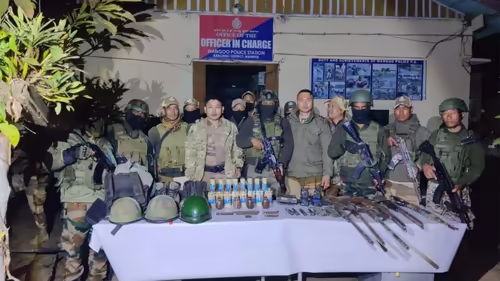
Just days before India celebrates its 77th Republic Day, a tense calm has settled over Manipur, punctuated by a series of critical security breakthroughs. In a dramatic turn of events, security forces have successfully recovered a massive arms cache and neutralised multiple Improvised Explosive Devices (IEDs) across several districts, effectively dismantling a potential major threat to the national holiday. This intense activity underscores the complex and volatile security landscape that defines the state’s approach to such significant national events.
Table of Contents
- The Republic Day Security Blitz: Operation Details
- What Was Found? A Look at the Seized Arsenal
- The Shadowy Players: Banned Outfits Behind the Threat
- Multi-Layered Security for a Fragile Peace
- Conclusion: A Temporary Victory in a Long Conflict
- Sources
The Republic Day Security Blitz: Operation Details
The intelligence-driven combing, cordon, and search operations were not isolated incidents but a coordinated, multi-pronged assault on suspected militant hideouts. Spanning from January 24th to 25th, 2026, these operations covered a wide arc of vulnerable and fringe areas, including Imphal East, Imphal West, Thoubal, Kakching, Churachandpur, and the sensitive Tengnoupal district along the Indo-Myanmar Border .
The primary objective was clear: to pre-empt any attempts to disrupt the Republic Day celebrations through acts of violence or terror. The strategy involved joint efforts from various central and state forces, creating a formidable security net across the state .
What Was Found? A Look at the Seized Arsenal
The results of these operations have been nothing short of alarming, revealing the scale of the threat that was brewing. Security forces have recovered a substantial cache of arms, ammunition, and explosives. Reports confirm the seizure of rifles, revolvers, and a significant quantity of ammunition from Imphal East alone .
Perhaps even more concerning was the discovery and successful neutralisation of three IEDs right at the Indo-Myanmar Border in the Moreh area of Tengnoupal district on January 24th . This highlights the porous nature of the border and its use as a conduit for smuggling deadly materials. The total haul is described as “substantial” and “massive,” indicating a well-resourced network intent on causing chaos [[7], [8]].
Key Recoveries at a Glance
- Weapons: Rifles, revolvers, and other small arms.
- Ammunition: A large quantity of live rounds.
- Explosives: Multiple IEDs, including three neutralised at the Indo-Myanmar border .
- Arrests: Several individuals linked to extortion and banned outfits were apprehended during the operations .
The Shadowy Players: Banned Outfits Behind the Threat
While specific attribution for this particular cache is still under investigation, the modus operandi points squarely towards the numerous banned insurgent groups that operate in the region. Manipur is home to a complex web of nearly 30 Kuki insurgent groups and several Meitei extremist outfits, many of which are proscribed under the Unlawful Activities (Prevention) Act (UAPA) [[13], [18]].
These groups often rely on extortion networks to fund their activities and have been known to source weapons from across the Myanmar border . The Indian National Investigation Agency (NIA) has previously alleged that leaders of these Myanmar-based insurgent groups actively recruit members and orchestrate destabilising activities within India [[11], [18]]. The recent seizures are a stark reminder of their continued operational capacity.
Multi-Layered Security for a Fragile Peace
In direct response to these findings and as a general precaution, a comprehensive, multi-layered security arrangement has been put in place for the Republic Day celebrations across all eight northeastern states, with Manipur being a primary focus [[19], [26]].
This security blanket involves a joint effort from the district police, the Rapid Action Force (RAF), the Central Reserve Police Force (CRPF), and the Assam Rifles . Enhanced patrolling, especially in border areas, has been mandated, with the state’s Director General of Police (DGP) confirming “joint patrolling in entire border areas” despite there being no specific, named threat at the moment .
For the public, this means heightened vigilance. Authorities have advised passengers at Imphal Airport to arrive early and carry valid identification due to the enhanced security checks . These measures are designed to ensure that the solemnity of the national day is not marred by violence, allowing citizens a space to celebrate, however cautiously.
Conclusion: A Temporary Victory in a Long Conflict
The successful recovery of the arms cache and the neutralisation of IEDs represent a significant tactical victory for the security forces. It demonstrates their intelligence capabilities and their ability to act swiftly to protect national interests. However, it would be naive to see this as anything more than a temporary setback for the entrenched networks of insurgency in Manipur. The root causes of the conflict—historical grievances, ethnic tensions, and cross-border dynamics—remain largely unaddressed. For now, the Republic Day celebrations in Manipur will proceed under a heavy, but hopefully effective, security shield. The long-term peace, however, remains a distant and complex goal. For more on the historical context of the region’s instability, see our deep dive on [INTERNAL_LINK:manipur-insurgency-history].
Sources
- Times of India: Republic Day alert in Manipur: Security forces recover arms cache, neutralise IEDs
- South Asia Terrorism Portal (SATP): Terrorist / Insurgent Groups – Manipur
- Ministry of Home Affairs (MHA): Official Statements on UAPA Bans