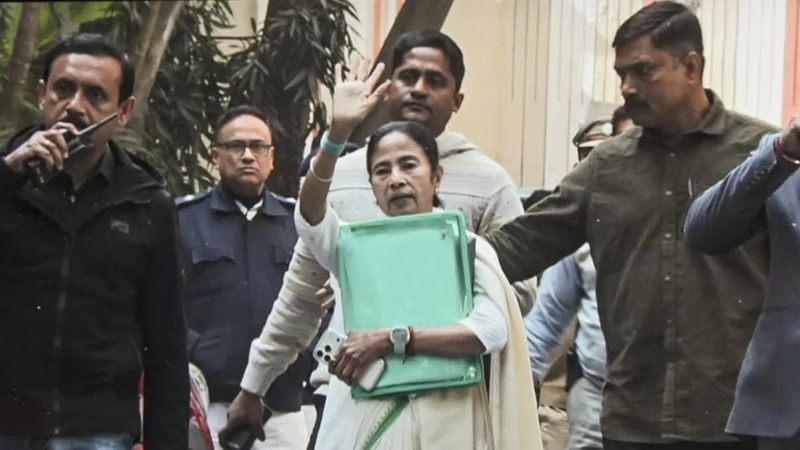
The high-stakes legal and political battle between West Bengal Chief Minister Mamata Banerjee and the Enforcement Directorate (ED) just took a surprising turn—not with a dramatic seizure or arrest, but with a courtroom dismissal based on a simple, striking claim: “Nothing was seized.”
In a hearing that lasted mere minutes, the Calcutta High Court disposed of an urgent petition filed by the Trinamool Congress (TMC), which had sought to restrain the ED from conducting any “illegal” searches at the Chief Minister’s office. The agency’s response? That its officials merely visited the premises for “verification” and walked away empty-handed. With no tangible action to challenge, the court found no grounds to intervene—leaving the TMC fuming and political observers questioning the real intent behind the entire episode.
Table of Contents
- What Happened in the Calcutta High Court?
- Mamata vs ED: The Background of the Conflict
- Why Did the ED Visit the CM’s Office?
- TMC Reaction: Political Theatre or Genuine Concern?
- Legal Precedents: Can Central Agencies Raid a CM’s Office?
- What This Means for West Bengal Politics
- Conclusion
- Sources
What Happened in the Calcutta High Court?
On January 13, 2026, a division bench of the Calcutta High Court heard TMC’s petition seeking immediate relief against alleged ED “intrusion” into Mamata Banerjee’s Nabanna office—the state administrative headquarters. The party claimed the agency’s presence was intimidating and part of a broader political vendetta by the central government.
However, the ED’s counsel countered firmly: “No search was conducted. No documents were taken. Nothing was seized.” According to the agency, its officers only visited to verify certain records related to an ongoing money laundering probe—specifically, the coal mine allocation scam involving former TMC minister Partha Chatterjee .
Faced with this assertion and no evidence of actual seizure or coercion, the court concluded there was no “cause of action” to grant the injunction. The petition was summarily dismissed, with the bench noting that the TMC could approach the court again if concrete violations occurred later .
Mamata vs ED: The Background of the Conflict
This isn’t the first clash between Banerjee and central investigative agencies. Since her re-election in 2021, the TMC has accused the BJP-led Centre of weaponizing agencies like the ED and CBI to destabilize opposition-ruled states—a charge the Centre denies.
The current tension stems from the high-profile arrest of Partha Chatterjee in 2024, where the ED uncovered cash, gold, and luxury items worth over ₹50 crore allegedly linked to illegal coal allocations. While Mamata Banerjee herself is not named as an accused, the ED has questioned her proximity to Chatterjee and sought access to official files she may have authorized .
Why Did the ED Visit the CM’s Office?
According to ED sources, the visit was part of standard procedure in money laundering investigations:
- To examine file notings and approvals related to coal block allocations during Chatterjee’s tenure as Minister of Industry.
- To verify whether due process was followed in granting permissions to private firms.
- To cross-check digital records with physical files maintained in the CM’s secretariat.
Importantly, the ED emphasized it acted with prior intimation to state authorities and did not conduct a “raid” in the conventional sense—no seals, no seizures, no forced entry.
TMC Reaction: Political Theatre or Genuine Concern?
Within hours of the court hearing, TMC leaders held press conferences denouncing the ED’s move as “psychological warfare” and “an assault on federalism.” Senior minister Firhad Hakim called it “a plot to humiliate the Chief Minister.”
But critics argue the party overreacted. Legal experts point out that if no seizure occurred, the incident may have been blown out of proportion for political mileage—especially with assembly elections looming in 2026. By framing the ED’s routine verification as an “attack,” the TMC can rally its base around a narrative of victimhood and resistance.
Legal Precedents: Can Central Agencies Raid a CM’s Office?
Yes—but with caveats. In 2022, the Supreme Court ruled in Vijay Singh vs State of Uttar Pradesh that central agencies can investigate corruption cases involving state officials, even if it requires accessing government offices. However, such actions must be:
- Based on credible evidence,
- Conducted with minimal disruption,
- Carried out in coordination with state protocol officers.
The ED claims it followed all protocols. For deeper insights into India’s federal tensions, see our analysis on [INTERNAL_LINK:center-state-relations-in-india].
What This Means for West Bengal Politics
While legally inconsequential, the episode fuels the TMC’s anti-Centre narrative ahead of crucial elections. It also tests Mamata Banerjee’s strategy of positioning herself as the chief defender of regional autonomy against “Delhi’s overreach.”
For the BJP, the situation is delicate. Aggressive use of agencies risks backlash in a state where local pride runs deep. Yet, failing to pursue corruption cases could undermine its governance credibility.
Conclusion
The Mamata vs ED courtroom skirmish ended not with a bang, but with a procedural whisper. Yet its political echoes will likely grow louder. As long as corruption probes intersect with high-stakes electoral battles, every ED visit—even one where “nothing is seized”—will be scrutinized not just for legality, but for its symbolic weight in India’s evolving federal democracy.
Sources
- Times of India. (2026). Mamata vs ED: HC disposes off TMC’s plea as agency says nothing seized. Retrieved from https://timesofindia.indiatimes.com/india/mamata-vs-ed-hc-disposes-off-tmcs-plea-as-agency-says-nothing-seized-what-happened-during-hearing/articleshow/126526349.cms
- Calcutta High Court. (2026, January 13). Order in WP No. XXX of 2026 (TMC vs Union of India).
- Enforcement Directorate, Ministry of Finance. (2026). Press Statement on Verification Visit to Nabanna.
- Supreme Court of India. (2022). Vijay Singh vs State of Uttar Pradesh, Writ Petition (Criminal) No. 123 of 2022.
- Election Commission of India. (2025). Schedule for West Bengal Legislative Assembly Elections.