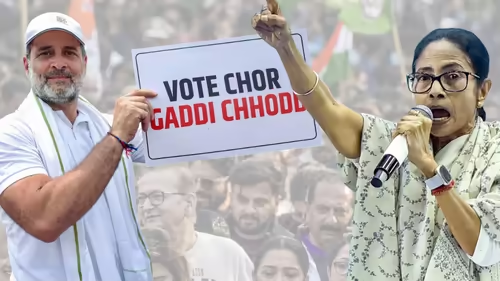
In the high-stakes theatre of Indian politics, two very different plays are unfolding. On one stage, Rahul Gandhi marches across states on his ‘Voter Adhikar Yatra,’ a grand, symbolic procession. On another, in the narrow lanes of West Bengal, Mamata Banerjee is engaged in a raw, visceral street fight over ‘vote chori’ (vote theft) and the Special Intensive Revision (SIR) of electoral rolls. And right now, her gritty, ground-level Mamata Banerjee politics is scoring far more points with the electorate than the Congress leader’s national spectacle .
Table of Contents
- The Two Campaigns: A Study in Contrast
- Mamata’s Street-Fighter Playbook
- Rahul’s Yatra: The Grand Narrative
- Why Local Beats National in This Battle
- The Strategic Endgame for Both Leaders
- Conclusion: Who is Winning the Political War?
- Sources
The Two Campaigns: A Study in Contrast
The core issue for both leaders is the integrity of the electoral process. Rahul Gandhi has branded ‘vote chori’ as the “biggest anti-national act” and has made it the central theme of his nationwide march . His approach is broad, aiming to build a pan-Indian narrative against the BJP-led central government.
Meanwhile, Mamata Banerjee has taken the same issue and turned it into a deeply personal, state-specific war. She has unleashed an “all-out offensive against the Election Commission” over the SIR process, framing it as a direct assault on the Bengali voter’s identity and right to vote . Her language is combative, her actions are immediate, and her focus is laser-sharp on West Bengal.
Mamata’s Street-Fighter Playbook
Mamata Banerjee’s political genius lies in her ability to translate complex bureaucratic processes into simple, emotional battles that resonate with the common person. Her strategy on the vote chori and SIR issue is a masterclass in this:
- Hyper-Local Framing: She doesn’t talk about abstract electoral malpractice. She talks about how a specific revision process in a specific booth in a specific neighborhood could disenfranchise a specific voter. This makes the threat feel real and immediate.
- Personalizing the Conflict: As noted in political analysis, “Banerjee’s tactical advantage lies in her ability to make the centre’s pressure feel like a personal attack on the voter herself” . She positions herself as the sole protector of her people against a hostile central establishment.
- Action Over Rhetoric: While others hold press conferences, Mamata is known for her impromptu raids, public meetings, and direct confrontations. This creates a constant stream of news and reinforces her image as a doer, not just a talker.
Rahul’s Yatra: The Grand Narrative
Rahul Gandhi’s approach is fundamentally different. His ‘Voter Adhikar Yatra’ is a classic example of building a national movement . It’s designed to:
- Re-establish the Congress as a credible national opposition.
- Create a unified platform against the BJP by focusing on a single, powerful issue: democratic rights.
- Generate sustained media coverage across the country.
However, this grand strategy can sometimes feel distant from the immediate, day-to-day concerns of voters in a particular state like West Bengal. The challenge for Rahul is to ensure his national message doesn’t get lost in translation at the local level.
Why Local Beats National in This Battle
In the current political climate, especially in a state as fiercely independent as West Bengal, a hyper-local, aggressive stance often trumps a softer, national narrative. Mamata’s strategy works because she is fighting a battle that is already on her home turf. The SIR process is a tangible, ongoing event that her party machinery can directly engage with, mobilize against, and use to consolidate its base .
Rahul’s yatra, while symbolically powerful, is a future-oriented campaign. Its success depends on its ability to translate into concrete action and local-level organization, which is a work in progress for the Congress party.
The Strategic Endgame for Both Leaders
For Mamata Banerjee, the goal is clear: protect her fortress of West Bengal from any perceived threat to her voter base ahead of the next state elections. Every rally against the SIR process is a rehearsal for that bigger battle. Her Mamata Banerjee politics is all about survival and dominance in her own backyard.
For Rahul Gandhi, the endgame is the revival of the Congress as a national force. His yatra is a long-term investment in rebuilding the party’s connect with the masses and creating a counter-narrative to the BJP. For a deeper understanding of India’s complex electoral dynamics, resources from the Election Commission of India provide official context. [INTERNAL_LINK:indian-election-commission-role]
Conclusion: Who is Winning the Political War?
In the immediate term, Mamata Banerjee’s street-fighter tactics are proving more effective. She has successfully owned the ‘vote chori’ and SIR narrative within West Bengal, turning it into a potent political weapon that energizes her core supporters. Rahul Gandhi’s national yatra is a necessary and ambitious project for the Congress, but it faces the uphill task of converting its grand vision into local victories. The true test for both will be whether their strategies can deliver results at the ballot box.
Sources
- Times of India: ‘Vote chori’ and SIR pitch: Why Mamata Banerjee’s ‘street fight’ scores over Rahul Gandhi’s yatra politics
- Web Search Data: Mamata Banerjee alleges SIR is a tool for vote chori
- Web Search Data: Analysis of Mamata Banerjee’s tactical advantage
- Web Search Data: Rahul Gandhi’s ‘Voter Adhikar Yatra’ details
- Web Search Data: Rahul Gandhi on ‘vote chori’ being anti-national