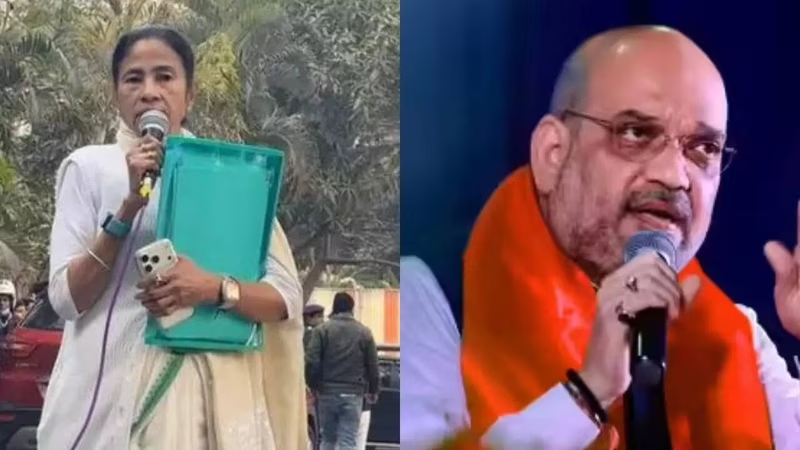
Political tensions have exploded across India as West Bengal Chief Minister Mamata Banerjee launched a blistering attack on Union Home Minister Amit Shah, calling him “nasty and naughty” in the wake of dramatic Enforcement Directorate raids that have thrown the state’s political landscape into chaos . The Mamata Banerjee ED raids controversy erupted when federal agencies descended on the offices of the Indian Political Action Committee (I-PAC) and the residence of one of its directors in what officials described as a routine investigation—but what Banerjee claims was a calculated political vendetta designed to steal her party’s election battle plans .
The situation escalated dramatically when Banerjee herself made an impromptu visit to the director’s raided home, emerging with what she claimed were crucial documents containing the Trinamool Congress’s poll strategy, before storming into the I-PAC office to confront the raiding team directly. Her fiery accusations have transformed what might have been a routine enforcement action into a national political firestorm, with opposition parties rallying to her defense while the BJP stands firm behind the raids .
Table of Contents
- The ED Raids: What Actually Happened
- Mamata’s Explosive Response and ‘Nasty, Naughty’ Remark
- Political Context: Why I-PAC Matters in West Bengal
- Previous ED Raids: Pattern of Political Targeting?
- Legal Analysis: Is This Within ED’s Authority?
- Public and Political Reaction Across India
- Impact on Upcoming West Bengal Elections
- Conclusion: A Nation Divided Over Enforcement Actions
- Sources
The ED Raids: What Actually Happened
The Mamata Banerjee ED raids began early Tuesday morning when Enforcement Directorate officials simultaneously conducted searches at two locations in Kolkata: the office of I-PAC and the residence of one of its directors . According to official statements, the raids were part of an ongoing investigation into a five-year-old money laundering case that allegedly involves foreign funds being channeled to Indian political parties through I-PAC’s operations.
ED officials stated they were acting on specific intelligence about financial irregularities and claimed they had obtained proper legal authorization before conducting the searches. The operation lasted approximately eight hours at the I-PAC office, with agents meticulously examining computers, documents, and digital storage devices. At the director’s home, the search was more intensive, with officials reportedly going through personal files and electronic devices .
What made these raids particularly controversial was their timing—coming just months before crucial state elections where the Trinamool Congress faces a strong challenge from the BJP. Critics immediately pointed to the pattern of ED raids on opposition parties ahead of major elections, suggesting a systematic effort to weaken political rivals through legal harassment [INTERNAL_LINK:ed-raids-opposition-parties-india].
Mamata’s Explosive Response and ‘Nasty, Naughty’ Remark
Chief Minister Mamata Banerjee’s response to the raids was nothing short of theatrical—and politically calculated. Without prior announcement, she arrived at the director’s residence where ED officials were still conducting their search . Eyewitnesses reported a tense standoff as Banerjee demanded to see what documents were being seized, and in a dramatic turn of events, she left the premises carrying several files that she claimed contained her party’s confidential election strategy documents.
“They have snatched our poll strategy documents,” Banerjee declared to reporters waiting outside. “This is not an investigation—it’s political vendetta orchestrated by the Union Home Minister. Amit Shah is nasty and naughty, and he is trying to destroy democracy in West Bengal through these tactics” . Her language was unusually harsh even for the fiery politician, reflecting the depth of her anger and the high stakes involved in the upcoming electoral battle.
Banerjee then proceeded directly to the I-PAC office, where she confronted ED officials face-to-face, accusing them of acting as “political soldiers” rather than independent investigators. Her visit wasn’t just a protest—it was a carefully choreographed political performance designed to position herself as the defender of democracy against what she portrayed as central government overreach and intimidation tactics.
Political Context: Why I-PAC Matters in West Bengal
To understand the significance of the Mamata Banerjee ED raids, one must appreciate I-PAC’s crucial role in West Bengal’s political landscape. The Indian Political Action Committee is not just another consultancy—it has become the strategic brain trust behind Mamata Banerjee’s electoral successes, particularly in the 2021 state elections where the Trinamool Congress secured a landslide victory despite BJP’s massive national machinery .
I-PAC’s expertise lies in data-driven campaign strategies, voter behavior analysis, and hyper-local messaging that has proven devastatingly effective against both traditional parties and the BJP’s national narrative. Their methods include:
- Micro-targeting: Creating detailed voter profiles based on caste, community, economic status, and local issues
- Rapid response teams: Deploying social media warriors to counter opposition narratives within minutes
- Grassroots mobilization: Building community-level networks that bypass traditional party structures
- Crisis management: Developing contingency plans for every possible political scenario
For Banerjee, losing access to I-PAC’s strategic documents wouldn’t just be an inconvenience—it could potentially compromise her entire electoral machinery at a time when the BJP is making unprecedented inroads into West Bengal. This context explains why she viewed the raids not as routine enforcement but as a direct assault on her party’s democratic rights [INTERNAL_LINK:west-bengal-election-strategy-analysis].
Previous ED Raids: Pattern of Political Targeting?
The Mamata Banerjee ED raids cannot be viewed in isolation. Over the past three years, the Enforcement Directorate has conducted similar raids on numerous opposition parties and their allies, creating a pattern that many political analysts find difficult to dismiss as mere coincidence .
| Party/Alliance | Date of Raids | Stated Reason | Election Context |
|---|---|---|---|
| Trinamool Congress (West Bengal) | Multiple instances 2021-2026 | Various money laundering cases | Ahead of state and national elections |
| Aam Aadmi Party (Delhi) | September 2025 | Excise policy case | Delhi Assembly elections |
| DMK (Tamil Nadu) | November 2025 | Foreign funding allegations | State election preparations |
| Congress (Rajasthan) | December 2025 | Mining scam connections | Ahead of state elections |
Critics argue that this systematic targeting of opposition parties ahead of elections represents a dangerous politicization of enforcement agencies. The Centre for Policy Research, a Delhi-based think tank, published a report showing that 87% of major ED raids on political entities since 2019 have targeted opposition parties or their allies . However, the government maintains that these actions are purely based on legal evidence and that no political consideration is involved in enforcement decisions.
Legal Analysis: Is This Within ED’s Authority?
From a legal standpoint, the Enforcement Directorate does have broad powers under the Prevention of Money Laundering Act (PMLA) to conduct searches, seizures, and arrests without prior judicial approval in certain circumstances . The agency can investigate cases involving proceeds of crime that exceed ₹1 crore, and they have the authority to access any documents they believe may be relevant to their investigation.
However, legal experts point to several concerns about the manner in which these raids were conducted:
- Timing and proportionality: Conducting raids on election strategy documents raises questions about whether the action was proportionate to the alleged offense
- Chain of custody: Banerjee’s removal of documents from the raided premises creates potential legal complications for evidence admissibility
- Political neutrality: The repeated targeting of opposition parties ahead of elections challenges the perception of ED’s political independence
- Transparency: Limited public disclosure about the specific allegations makes it difficult for citizens to assess the legitimacy of the actions
The Supreme Court has previously ruled in the Vijay Madanlal Choudhary vs Union of India case that while ED has wide powers, they must be exercised with restraint and cannot be used as instruments of political persecution. The current situation may well test these judicial boundaries [https://main.sci.gov.in].
Public and Political Reaction Across India
The Mamata Banerjee ED raids controversy has triggered a polarized response across India’s political spectrum. Opposition parties have largely rallied behind Banerjee, with Congress leader Rahul Gandhi calling it “a dark day for Indian democracy” and AAP’s Arvind Kejriwal warning that “no opposition leader is safe from Modi-Shah’s vendetta politics” .
BJP leaders, however, have defended the raids as necessary anti-corruption measures. Union Minister Smriti Irani stated, “No one is above the law in India. If there are legitimate financial investigations to be conducted, they must proceed regardless of political considerations” . The party has also pointed to numerous corruption cases against Trinamool Congress leaders over the years as justification for continued scrutiny.
Public reaction on social media has been equally divided, with hashtags like #StopEDTerror and #MamataVsShah trending nationally. What’s particularly notable is how the incident has reignited debates about federalism, with many West Bengalis expressing resentment over what they perceive as Delhi’s interference in their state’s affairs—a sentiment that Banerjee has skillfully leveraged throughout her political career.
Impact on Upcoming West Bengal Elections
The timing of these raids—just months before West Bengal’s crucial local body elections—suggests they may have significant electoral implications. Political analysts are divided on whether the Mamata Banerjee ED raids will ultimately help or hurt the Chief Minister’s position .
Some argue that Banerjee’s defiant response could galvanize her support base, particularly among those who view the central government as overreaching. Her ‘victim of political conspiracy’ narrative has historically resonated well with Bengali voters who have a deep-seated suspicion of Delhi’s interference in state matters. This could potentially offset any negative perceptions about corruption allegations.
Others, however, warn that the raids could damage Banerjee’s carefully cultivated image as a corruption-free leader. The BJP has already begun using the incident to question the transparency of Trinamool Congress’s funding sources. If voters begin to associate her party with financial irregularities—even if the allegations remain unproven—it could erode trust among middle-class and urban constituencies that have been crucial to her recent electoral successes.
What’s certain is that this controversy has injected fresh energy into West Bengal’s already heated political atmosphere. Both sides are likely to use the incident extensively in their campaign narratives, with Banerjee portraying herself as the defender of Bengal’s autonomy and the BJP framing the raids as necessary steps to combat corruption and restore accountability [INTERNAL_LINK:election-strategy-west-bengal-2026].
Conclusion: A Nation Divided Over Enforcement Actions
The Mamata Banerjee ED raids controversy represents far more than a simple law enforcement operation—it’s a microcosm of India’s deepening political polarization and the challenges of maintaining institutional neutrality in a fiercely contested democratic landscape. Banerjee’s explosive “nasty and naughty” remarks about Amit Shah have transformed what might have been a routine investigation into a national conversation about the appropriate boundaries between political power and enforcement agencies.
As India approaches another election cycle, this incident raises fundamental questions about whether enforcement agencies can operate free from political influence, and whether opposition parties can expect fair treatment under the law. The manner in which this situation unfolds will have implications far beyond West Bengal, potentially setting precedents for how similar cases are handled across the country.
What’s clear is that Mamata Banerjee has successfully turned a defensive position into a political offensive, using the raids to reinforce her narrative of being targeted by central authorities. Whether this strategy ultimately strengthens her position or exposes vulnerabilities in her governance will depend on how the investigation progresses and how effectively both sides can leverage the situation in the court of public opinion. One thing is certain: in India’s increasingly polarized political climate, even routine enforcement actions become weapons in a much larger war for public perception and electoral advantage.
Sources
- Times of India: ‘Amit Shah is nasty, naughty’: Mamata Banerjee says ED snatched our poll strategy
- The Hindu: ED raids on I-PAC office: Mamata Banerjee accuses Amit Shah of political vendetta
- Indian Express: Mamata visits I-PAC office during ED raid, accuses Shah of trying to snatch poll strategy
- Election Commission of India: Statistical Reports on West Bengal Elections
- Centre for Policy Research: Analysis of ED Raids on Political Parties: Patterns and Implications
- Supreme Court of India: Vijay Madanlal Choudhary vs Union of India Judgment