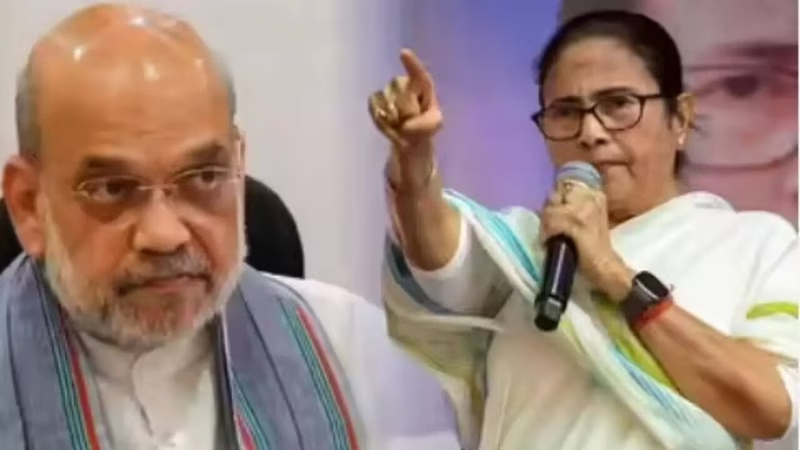
In a dramatic escalation of the already tense political rivalry in West Bengal, Chief Minister Mamata Banerjee has launched a scathing personal attack on Union Home Minister Amit Shah, labeling him as a modern-day Dushasana—the infamous antagonist from the Indian epic, the Mahabharata. This fiery analogy isn’t just political rhetoric; it’s a calculated move in a high-stakes battle over the very soul of Bengal, centered on voter lists, national identity, and the legacy of its people.
The Mamata Banerjee Amit Shah face-off has captured the nation’s attention, revealing deep fractures in India’s political landscape. But what triggered this explosion of ancient mythological parallels in modern politics? Let’s break it all down.
Table of Contents
- The Dushasana Charge: What Did Mamata Say?
- What is the Voter List Revision Controversy?
- Amit Shah’s Accusations Against Mamata Banerjee
- Why the Mahabharata Analogy Matters
- What This Means for West Bengal’s Future
- Summary
- Sources
The Dushasana Charge: What Did Mamata Say?
During a recent public rally, Mamata Banerjee didn’t mince words. She directly called Amit Shah “dangerous” and drew a stark comparison, stating, “You can see Duryodhan, Dushasana in Shah” . In the Mahabharata, Dushasana was the brother of Duryodhana and was infamous for his role in the public humiliation of Draupadi—a symbol of injustice and adharma (unrighteousness).
For Mamata, this isn’t just an insult; it’s a powerful narrative tool. By casting Shah in this light, she positions herself and her party, the Trinamool Congress (TMC), as the defenders of the people’s dignity against a perceived central force trying to disenfranchise them. She warned that she would sit on a dharna (protest) if eligible voters were unlawfully removed from the electoral rolls .
What is the Voter List Revision Controversy?
The immediate trigger for this war of words is the Special Intensive Revision (SIR) of the electoral rolls in West Bengal. The Election Commission of India (ECI) recently released a draft list that removed approximately 58 lakh names . The EC claims these deletions were for valid reasons: death, migration out of the state, or failure to submit enumeration forms .
However, Mamata Banerjee and the TMC see it differently. They allege that the exercise is a thinly veiled attempt by the BJP, in collusion with the EC, to delete the names of millions of legitimate Bengali voters, particularly from minority communities . She has accused the central government of using the SIR process as a weapon for political gain, calling it a “purge” .
Her government claims that the process has been riddled with “gross errors” and that officials who tried to highlight these issues have been unfairly suspended, which she labels as the BJP’s “bonded labourers” being punished for speaking out [[16], [17]].
Key Points of the SIR Controversy:
- Scale of Deletion: Over 58 lakh names removed in the initial draft .
- Government’s Claim: The TMC alleges it’s a targeted disenfranchisement of its voter base.
- EC’s Stance: The deletions are routine and based on verified data, including the removal of 15.53 lakh deceased voters .
- Political Stakes: With future elections looming, control over the voter list is a direct path to power.
Amit Shah’s Accusations Against Mamata Banerjee
This isn’t a one-sided attack. Amit Shah’s initial comments, which drew Mamata’s ire, were equally harsh. He has repeatedly slammed the Mamata Banerjee government, accusing it of being a haven for illegal infiltration from Bangladesh and of actively blocking the fencing of India’s international border [[22], [23]].
Shah has painted a picture of a Bengal in decline under TMC rule, marked by corruption, fear, and a loss of its rich cultural identity. In line with the BJP’s national narrative, he has promised a revival of Bengal’s heritage if his party comes to power, positioning the BJP as the savior of the state’s glorious past . This promise of heritage revival stands in direct contrast to Mamata’s narrative of defending the present-day rights of her citizens.
Why the Mahabharata Analogy Matters
Mamata Banerjee’s choice of Duryodhana and Dushasana is deeply strategic and culturally resonant. In the Indian public consciousness, these characters are the ultimate symbols of greed, arrogance, and the misuse of power. By invoking them, she achieves several things:
- Emotional Connection: It taps into a shared cultural knowledge, making the political conflict feel personal and morally charged.
- Victim Narrative: It casts the people of Bengal as Draupadi—vulnerable and under attack—while she becomes their protector.
- Delegitimization: It attempts to strip Shah of his political legitimacy by framing his actions as fundamentally unrighteous.
This rhetorical move is a classic example of how Indian politics often intertwines mythology with modern-day power struggles.
What This Means for West Bengal’s Future
The Mamata Banerjee Amit Shah clash is more than just a war of words; it’s a proxy battle for the future of West Bengal. The voter list issue is the immediate battleground, but the larger war is about identity, governance, and historical legacy.
The political air in West Bengal is described as being “thick with anxiety” as this SIR exercise devolves into a full-blown political crisis . The outcome of this conflict could significantly impact the balance of power in the state and set a precedent for how electoral processes are managed in politically sensitive regions across India.
For the average citizen, the stakes are incredibly high. The fight is about their right to vote, their place in their own state, and who gets to tell the story of Bengal’s past and future.
Summary
The political drama between Mamata Banerjee and Amit Shah has reached a fever pitch, with the West Bengal CM invoking the Mahabharata villain Dushasana to describe the Union Home Minister. This explosive comment stems from a bitter dispute over the Special Intensive Revision of voter lists, which the TMC claims is a BJP-led effort to disenfranchise its voters. In response, Shah has accused Mamata’s government of enabling illegal immigration and failing Bengal’s heritage. This clash is not just personal; it’s a fundamental struggle over the democratic rights and identity of West Bengal’s populace, with massive implications for India’s political future. The battle lines are drawn, and all of India is watching.
Sources
- Times of India: ‘A Dushasana has come to Bengal’: Mamta Banerjee hits back at Amit Shah
- The Bastion: Gross errors in SIR exercise conducted so far by EC, says Mamata Banerjee
- India Today: Mamata Banerjee Urges Bengal Women To ‘Fight Back’
- Election Commission of India: Official Website on Special Intensive Revision
- [INTERNAL_LINK:west-bengal-politics-guide]
- [INTERNAL_LINK:history-of-tmc-bjp-rivalry]