Table of Contents
- Political Whiplash: The New Normal in Maharashtra
- What Is a Maharashtra Civic Polls Alliance—And Why Should You Care?
- Mumbai (BMC): A Three-Way Battle for India’s Richest Civic Body
- Pune, Thane & Nashik: Where Loyalties Shift Like Monsoon Winds
- Key Players Breakdown: Factions, Flags, and Feuds
- Voter Turnout Trends: What the Numbers Reveal
- What This Alliance Chaos Means for Your Daily Life
- Conclusion: Alliances Are Temporary—Power Is Permanent
- Sources
Political Whiplash: The New Normal in Maharashtra
If you’ve felt dizzy trying to keep up with Maharashtra’s political drama, you’re not alone. Just months after state-level realignments, the same parties are now scrambling to form—or break—new partnerships for the Maharashtra civic polls alliance battle. With results looming for key municipal corporations like Mumbai (BMC), Pune, Thane, and Nashik, every handshake could mean millions in civic funds, control over infrastructure projects, and, most importantly, local legitimacy ahead of the 2029 state elections .
What Is a Maharashtra Civic Polls Alliance—And Why Should You Care?
Unlike national or state elections, civic polls determine who runs your city’s day-to-day affairs: water supply, waste management, road repairs, property taxes, and public health. Winning a majority in bodies like the Brihanmumbai Municipal Corporation (BMC)—Asia’s richest civic body—grants immense administrative and financial clout.
An alliance here isn’t just about sharing seats; it’s a strategic pact to pool voter bases, avoid vote-splitting, and project unity. But in today’s Maharashtra, these pacts are often fragile, built on convenience rather than ideology. That’s why understanding the current Maharashtra civic polls alliance map is crucial—not just for political junkies, but for every resident whose garbage hasn’t been picked up in a week.
Mumbai (BMC): A Three-Way Battle for India’s Richest Civic Body
Mumbai’s civic election is the crown jewel. Here’s how the major camps have aligned:
- Maha Vikas Aghadi (MVA) 2.0? The original MVA—Shiv Sena (UBT), NCP (Sharad Pawar), and Congress—is attempting a revival. However, coordination has been patchy, with seat-sharing disputes in several wards .
- BJP-Shiv Sena (Shinde faction): Once bitter enemies, the BJP and Eknath Shinde’s Shiv Sena are now locked in a formal alliance across most urban centers, including Mumbai. They’re banking on anti-MVA sentiment and strong Hindutva messaging .
- Independent Surge: Dozens of independent candidates, many backed by local business groups or disgruntled party workers, are contesting—further fragmenting the vote.
Pune, Thane & Nashik: Where Loyalties Shift Like Monsoon Winds
The alliance calculus changes dramatically outside Mumbai:
- Pune: BJP and Shinde Sena are together, but face a united opposition from Congress, NCP (SP), and UBT Sena. Voter turnout was notably higher in tech-heavy Hinjewadi and Kharadi wards, suggesting youth engagement .
- Thane: A BJP stronghold, but the Shinde Sena is playing a junior partner. The opposition remains divided, giving the ruling alliance a clear edge.
- Nashik: Here, the Congress and NCP (SP) have joined forces, while UBT Sena is going solo in many areas—a risky move that could split the anti-BJP vote.
Key Players Breakdown: Factions, Flags, and Feuds
Let’s cut through the noise:
Shiv Sena: Two Parties, One Name
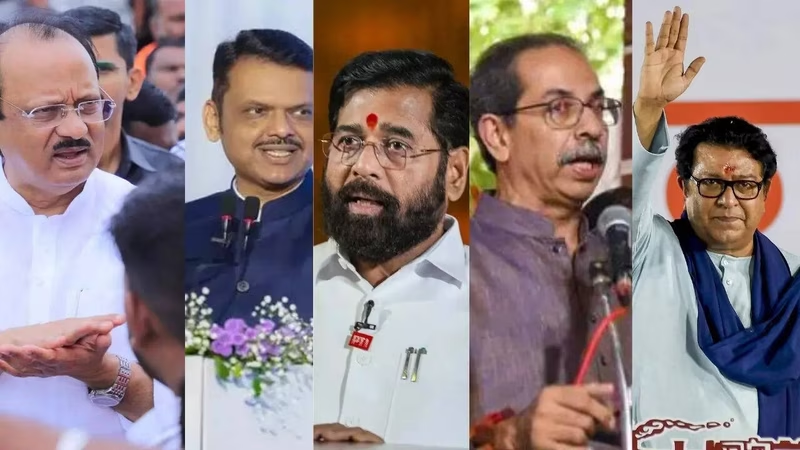
– Shiv Sena (UBT): Led by Uddhav Thackeray. Allied with Congress and NCP (Sharad Pawar). Fighting to reclaim its Marathi identity.
– Shiv Sena (Shinde): Recognized as the “real” Sena by the Election Commission. In alliance with BJP. Emphasizes development and loyalty to the Centre.
NCP: The Great Split
– NCP (Sharad Pawar): Part of the INDIA bloc. Teaming up with Congress and UBT Sena in most cities.
– NCP (Ajit Pawar): Now part of the BJP-led NDA. Its presence in civic polls is minimal, with most local leaders absorbed into the BJP-Shinde fold .
Voter Turnout Trends: What the Numbers Reveal
Early data shows stark contrasts. In Mumbai, affluent South Bombay wards saw turnout below 40%, while working-class areas like Kurla and Ghatkopar crossed 55%. This suggests that civic issues—like housing, sanitation, and local jobs—resonate more deeply in middle- and lower-income neighborhoods. In Pune, IT corridor wards recorded their highest-ever turnout, signaling a new wave of politically aware urban professionals .
What This Alliance Chaos Means for Your Daily Life
Beyond the headlines, these alliances directly impact you:
– If BJP-Shinde wins BMC, expect fast-tracked infrastructure projects but potential hikes in property tax.
– An MVA-style coalition might prioritize affordable housing and public health—but could struggle with bureaucratic delays.
– Fragmented results (no clear majority) could lead to unstable administrations, stalled budgets, and years of civic neglect—just like in the 2017–2022 BMC deadlock .
Conclusion: Alliances Are Temporary—Power Is Permanent
The Maharashtra civic polls alliance landscape is less about ideology and more about survival. As one veteran political strategist told us, “In municipal politics, yesterday’s enemy is today’s co-candidate—if it gets you one more corporator.” While the national narrative focuses on 2029, the real power game is being played right now, ward by ward. Whoever controls the civic bodies will shape Maharashtra’s urban future for the next five years. Keep your eyes on the results—they’ll tell you who truly rules your city.
Sources
- Times of India: A state of shifting loyalties: Who’s with whom in Maharashtra’s civic polls
- Election Commission of India: Official Party Recognition and Symbols
- The Hindu: Maharashtra civic polls: Understanding the new political math
- India Today: Alliance tracker for Maharashtra municipal elections 2026
- [INTERNAL_LINK:mumbai-infrastructure-crisis]
- [INTERNAL_LINK:sharad-pawar-political-legacy]