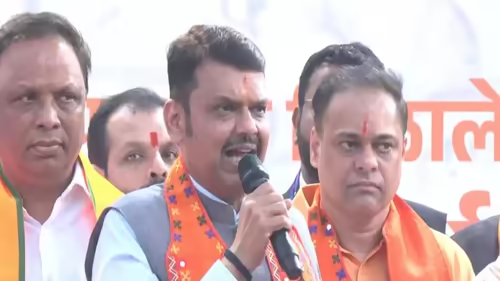
The political landscape of Maharashtra has been redrawn—again. In the recently concluded Maharashtra civic polls 2026, the BJP-led Mahayuti alliance (comprising BJP, Shiv Sena [Eknath Shinde faction], and NCP [Ajit Pawar group]) delivered a thunderous performance, sweeping major municipal corporations including the all-important Brihanmumbai Municipal Corporation (BMC) .
Chief Minister Devendra Fadnavis didn’t mince words in his victory address. Standing before jubilant supporters, he declared: “You cannot differentiate Hindutva from development.” This bold statement has reignited national debate—but for the BJP, it’s a winning formula that clearly resonated with urban voters across the state .
Table of Contents
- Maharashtra Civic Polls 2026: The Results at a Glance
- Fadnavis’ “Hindutva = Development” Narrative
- Why the Mahayuti Alliance Dominated
- BJP to Name 25 Mayors: A Strategic Move
- Opposition in Disarray
- What This Means for National Politics
- Conclusion: A New Urban Mandate
- Sources
Maharashtra Civic Polls 2026: The Results at a Glance
The scale of the Mahayuti victory is staggering. The alliance secured clear majorities in 13 of the 14 key municipal corporations it contested, including:
- Brihanmumbai Municipal Corporation (BMC) – Regained after years of Maha Vikas Aghadi (MVA) control
- Pune Municipal Corporation
- Nagpur Municipal Corporation (CM Fadnavis’ stronghold)
- Thane, Nashik, Aurangabad, Solapur, and Amravati
Early tallies indicate the BJP alone won over 1,800 corporator seats statewide—a historic high for the party in urban local body elections . This landslide wasn’t just about numbers; it was a decisive rejection of the opposition’s fragmented strategy and a strong endorsement of the ruling coalition’s governance model.
Fadnavis’ “Hindutva = Development” Narrative
In his post-victory speech, CM Fadnavis made a striking philosophical claim: that Hindutva and development are inseparable. “Our idea of progress includes cultural pride, national security, and infrastructure—all rooted in our civilizational values,” he stated .
This messaging marks a strategic evolution. Gone is the soft-pedaling of ideology in favor of pure welfare schemes. Instead, the BJP is now confidently weaving its cultural identity into its governance brand. For urban middle-class voters—who care about clean roads, efficient waste management, and smart city projects—this fusion appears to have struck a chord. They see no contradiction between temple renovations and metro expansions; to them, both are signs of a functioning, confident administration.
Why the Mahayuti Alliance Dominated
Several factors contributed to this overwhelming win:
- Unified Front: Unlike the fractured opposition (with Uddhav Thackeray’s Shiv Sena and Sharad Pawar’s NCP fighting separate battles), Mahayuti presented a united ticket, avoiding vote-splitting.
- Modi’s Shadow Campaign: Though not on the ballot, PM Narendra Modi’s image was omnipresent. His recent infrastructure inaugurations—like the Mumbai Coastal Road and Nagpur Metro—were leveraged as proof of “Delhi-Maharashtra synergy.”
- Anti-Incumbency Against MVA: In cities like Mumbai and Pune, residents blamed the previous MVA-led civic bodies for corruption, poor monsoon preparedness, and stalled projects.
- Effective Ground Game: The BJP’s IT cell and booth-level workers ran hyper-local campaigns focused on garbage collection, water supply, and street lighting—issues that matter most in daily life.
BJP to Name 25 Mayors: A Strategic Move
With its massive seat count, the BJP is now poised to appoint mayors in at least 25 municipal councils across Maharashtra—including symbolic wins in traditional opposition bastions .
This isn’t just ceremonial. Mayors control key committees on urban planning, health, and finance. More importantly, they serve as powerful local faces of the party ahead of the 2029 state assembly elections. Expect these new mayors to fast-track BJP-prioritized projects: heritage parks, digital citizen services, and youth employment drives linked to central schemes like PM SVANidhi.
Opposition in Disarray
The results are a brutal blow to the Maha Vikas Aghadi remnants. Uddhav Thackeray’s Shiv Sena (UBT) lost its last urban stronghold—Mumbai—while Sharad Pawar’s NCP (SP) failed to make significant inroads beyond its rural pockets. Their inability to present a coherent alternative narrative, coupled with internal infighting, left voters with little reason to switch allegiance.
Analysts warn this could signal a long-term decline of regional parties in Maharashtra’s urban centers unless they reinvent their messaging beyond nostalgia and identity politics [[INTERNAL_LINK:maharashtra-politics]].
What This Means for National Politics
While civic polls are local by nature, their implications are national. A dominant BJP in Maharashtra—the country’s richest and second-most populous state—strengthens PM Modi’s hand ahead of the 2029 general elections. It also validates the party’s dual-track strategy: combine muscular Hindutva with visible, on-ground development.
As noted by the Economic Times, “Urban India is increasingly voting for competence wrapped in cultural confidence” . The Maharashtra civic polls 2026 may well be remembered as the moment this new political paradigm cemented itself.
Conclusion: A New Urban Mandate
The Maharashtra civic polls 2026 weren’t just an election—they were a referendum on governance style. Voters chose efficiency, unity, and a vision that blends tradition with modernity. For the BJP and CM Fadnavis, it’s a mandate to accelerate their agenda. For the opposition, it’s a wake-up call: in today’s India, emotional appeals alone won’t win city halls.
Sources
- Times of India: ‘Can’t differentiate Hindutva from development’: CM Fadnavis after Mahayuti’s civic poll sweep
- The Economic Times: Analysis on Urban Voting Trends in India
- Election Commission of India: Official Civic Election Data Portal