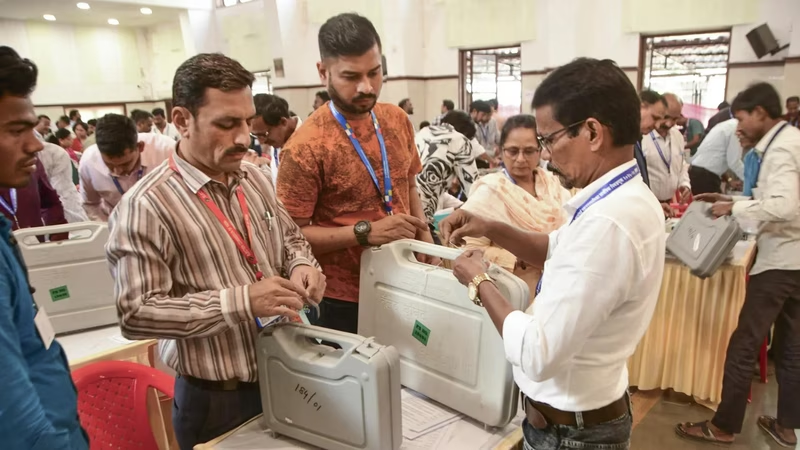
The political buzz across Maharashtra’s rural heartland has gone quiet—at least officially. With the **campaigning period for the Maharashtra civic body polls now concluded**, the State Election Commission (SEC) has fully enforced the Model Code of Conduct (MCC), marking the final countdown to one of the largest grassroots democratic exercises in the country. Set for **February 5, 2026**, these elections for Zilla Parishads (district councils) and Panchayat Samitis (block-level bodies) will shape local governance for the next five years—and could signal broader political trends ahead of state and national contests.
Table of Contents
- Official Election Schedule: Key Dates to Remember
- Why These Local Body Elections Matter
- What the Model Code of Conduct (MCC) Means Now
- Special Arrangements for Inclusive Voting
- Political Stakes for Major Parties
- How Voters Can Verify Their Details
- Conclusion: Democracy at the Grassroots
- Sources
Official Election Schedule: Key Dates to Remember
Following a Supreme Court directive that extended the deadline for holding overdue local body elections, the Maharashtra SEC has released a tight but clear timeline for the Maharashtra civic body polls:
- Nomination Filing: January 15–22, 2026
- Scrutiny of Nominations: January 23, 2026
- Last Date for Withdrawal: January 25, 2026
- Campaigning Period Ends: February 2, 2026 (48 hours before polling)
- Voting Day: February 5, 2026 (7 AM to 5 PM)
- Counting of Votes: February 7, 2026
All 36 districts of Maharashtra will go to polls simultaneously—a massive logistical undertaking involving over 1.2 lakh polling booths .
Why These Local Body Elections Matter
While national headlines often focus on Lok Sabha or Vidhan Sabha battles, the Zilla Parishad and Panchayat Samiti elections are where democracy truly touches everyday life. These bodies control critical functions including:
- Rural infrastructure (roads, water supply, sanitation)
- Primary healthcare centers and school management
- Implementation of central and state welfare schemes
- Local agricultural support and disaster response
For political parties, these polls serve as a vital **organizational test**—especially for newer regional players like the Shiv Sena (Shinde faction) and the Nationalist Congress Party (Ajit Pawar group), both seeking to consolidate their grassroots presence after the 2024 split .
What the Model Code of Conduct (MCC) Means Now
With campaigning officially over as of February 2, the MCC is now in full force. This means:
- No public rallies, speeches, or door-to-door canvassing by candidates.
- Government officials cannot launch new schemes or make policy announcements that could influence voters.
- Use of government machinery for electioneering is strictly prohibited.
- Social media posts by candidates must avoid inflammatory or promotional content.
Violations can lead to complaints to the SEC, which has deployed flying squads and surveillance teams across districts to monitor compliance .
Special Arrangements for Inclusive Voting
The SEC has emphasized **universal accessibility** for the February 5 polls. Key initiatives include:
- Braille ballot guides for visually impaired voters.
- Priority queues for senior citizens, pregnant women, and persons with disabilities.
- Mobile polling booths in remote tribal hamlets of Gadchiroli, Nandurbar, and Palghar.
- Helpline numbers (1950) for voter assistance and grievance redressal.
Voters can also use the **NVSP (National Voter’s Service Portal)** or the **Electoral Search app** to confirm their booth location and voter ID status [INTERNAL_LINK:how-to-check-voter-id-status-online].
Political Stakes for Major Parties
This election is widely seen as a **referendum on coalition stability** in Maharashtra:
- BJP: Aiming to expand its rural footprint beyond traditional strongholds.
- Shiv Sena (UBT):strong> Hoping to prove it remains the dominant Maratha voice despite internal fractures.
- Shiv Sena (Shinde): Seeking legitimacy through electoral wins in western Maharashtra.
- NCP (Sharadchandra Pawar): Fighting to retain its agrarian base amid leadership challenges.
- NCP (Ajit Pawar): Leveraging alliance with BJP to gain administrative visibility.
A strong showing could reshape alliance dynamics ahead of the 2029 state elections.
How Voters Can Verify Their Details
If you’re a registered voter in Maharashtra’s rural constituencies, here’s how to stay prepared:
- Visit electoralsearch.eci.gov.in and enter your EPIC number or name.
- Download the **Voter Helpline App** from Google Play or App Store.
- Call **1950** (toll-free) for assistance in multiple languages.
- Visit your nearest Booth Level Officer (BLO) if your name is missing or details are incorrect.
Remember: **Only original voter ID (EPIC) or Aadhaar-linked documents are accepted** at polling stations.
Conclusion: Democracy at the Grassroots
The Maharashtra civic body polls may not grab international headlines, but they represent the very essence of India’s democratic promise—power flowing from the village upward. As counting begins on February 7, the results will not only determine who manages local schools and roads but also reveal which parties have truly connected with Maharashtra’s rural electorate. In a state where politics is deeply personal and fiercely contested, every vote counts.
Sources
- Times of India: Maharashtra civic body polls: Campaigning ends, SEC enforces MCC
- Maharashtra State Election Commission: Official Notification No. SEC/MH/ZP-PS/2026
- Election Commission of India: Model Code of Conduct Guidelines
- Supreme Court Order Dated Dec 18, 2025: Writ Petition (Civil) No. 1122 of 2024
- [INTERNAL_LINK:maharashtra-political-parties-explained]
- [INTERNAL_LINK:voter-id-application-process-maharashtra]