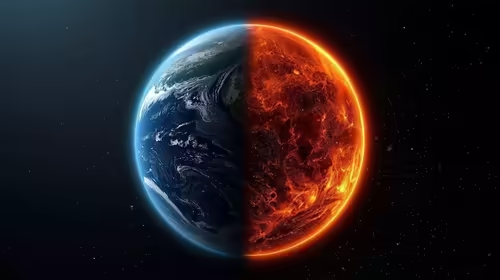
Ocean Worlds or Magma Hells? The Shocking Truth About Distant Planets
For decades, astronomers have scanned the cosmos for signs of water, the key ingredient for life as we know it. When they found distant exoplanets in the “habitable zone”—the region around a star where liquid water could exist—they were often hailed as potential “ocean worlds.” But a revolutionary new study is forcing scientists to rewrite the script. It turns out that many of these promising candidates might not be blue, watery paradises at all. Instead, they could be nightmarish, scorching infernos: magma ocean planets [[1]].
Table of Contents
- The Paradigm Shift: From Water to Magma
- The PROTEUS Model: How Scientists Made the Discovery
- Why Magma Oceans Matter for Habitability
- The Fate of So-Called “Water Worlds”
- Implications for the Search for Extraterrestrial Life
- Conclusion: A Universe More Extreme Than We Thought
- Sources
The Paradigm Shift: From Water to Magma
The discovery centers on a specific class of exoplanets known as sub-Neptunes and super-Earths. These are rocky worlds larger than Earth but smaller than Neptune. Their size and location in their star systems led many to speculate they were covered in deep global oceans. However, the new research suggests a far more violent reality. Using advanced simulations, scientists have shown that the intense heat and pressure within these planets can prevent water from ever forming a stable surface ocean. Instead, any water is likely dissolved into a planet-wide, global sea of molten rock—a magma ocean [[7]].
This isn’t just a minor adjustment; it’s a complete reimagining of these alien worlds. What we thought was a gentle, life-giving ocean might actually be a churning, 2,000-degree Celsius cauldron of silicate magma [[4]].
The PROTEUS Model: How Scientists Made the Discovery
The key to this breakthrough was a sophisticated new computer simulation called the PROTEUS model. This innovative tool is a “coupled interior and climate model,” meaning it doesn’t just look at a planet’s atmosphere or its core in isolation. Instead, it simulates the complex, dynamic interactions between a planet’s deep interior geology and its surface climate over billions of years [[1]].
By running simulations on various planetary compositions and conditions, the PROTEUS model revealed that for many planets in the so-called habitable zone, the internal heat is simply too great. The model showed that magma oceans can persist for incredibly long periods, potentially for the entire lifetime of the planet, effectively locking away any water in a superheated, unusable state [[1]].
Why Magma Oceans Matter for Habitability
The presence of a magma ocean planets scenario has profound implications for whether a world can support life. On the surface, it seems like a death sentence for biology. However, some recent theories suggest these hidden oceans of molten rock might play a surprising role. Deep magma layers could generate powerful magnetic fields, which are crucial for shielding a planet’s surface from harmful cosmic radiation [[6]]. Without such a shield, any atmosphere would be stripped away, making the surface barren.
So, while the surface of these planets is likely a desolate hellscape, the internal dynamo powered by the magma ocean might be a necessary evil for creating a stable environment elsewhere—or at least, for preserving an atmosphere that could be studied for other biosignatures [[5]].
The Fate of So-Called “Water Worlds”
This research directly challenges the popular concept of “water worlds.” Earlier observations, often based on a planet’s density and radius, led to the assumption that a significant portion of its mass was water. But the new models suggest a different interpretation. The water isn’t gone; it’s just in a radically different form. Under the extreme pressures found deep inside these large rocky planets, water molecules can dissolve directly into the molten silicate mantle, creating a hybrid fluid that is neither a classic ocean nor pure magma [[7]].
As one report starkly put it, “Think we found oceans on distant planets? Scientists now say they’re probably magma-filled infernos” [[2]]. This means that the search for truly Earth-like, ocean-covered worlds may be even more challenging than previously thought.
Implications for the Search for Extraterrestrial Life
For astrobiologists, this is a double-edged sword. On one hand, it eliminates a large number of candidate planets from the list of potential abodes for life. On the other hand, it refines the search, pushing scientists to focus on smaller, more Earth-sized rocky planets where the internal pressures are less extreme and true surface oceans are more likely to form and persist [[5]].
It also highlights the importance of next-generation telescopes like the James Webb Space Telescope (JWST). By analyzing the atmospheres of these distant worlds in greater detail, astronomers can look for chemical signatures that might indicate the presence of a magma ocean below, such as specific volcanic gases, helping to confirm or refine these new models [[10]].
Conclusion: A Universe More Extreme Than We Thought
The revelation about magma ocean planets is a powerful reminder of how much we still have to learn about the universe. Our Earth-centric view of what makes a planet habitable is constantly being challenged by the sheer diversity and extremity of worlds out there. While the dream of finding a twin Earth remains alive, this study shows that the path to finding it is paved with unexpected, fiery obstacles. The cosmos, it seems, is far more dramatic and volatile than our imaginations had allowed.
Sources
- [[1]] Times of India: Distant planets once linked to oceans may be full of magma
- [[2]] Daily Galaxy: 98% of “Water Worlds” Might Actually Be Lava Planets
- [[4]] Phys.org: Hidden magma oceans could shield rocky exoplanets from harmful radiation
- [[5]] Futura Sciences: Astronomers finally find an atmosphere around a rocky exoplanet
- [[6]] Astrobiology.com: Hidden Magma Oceans Could Shield Rocky Exoplanets From Harmful Radiation
- [[7]] AAS Nova: Modeling Magma Ocean Exoplanets
- [[10]] ScienceDirect: Lava worlds: From early earth to exoplanets