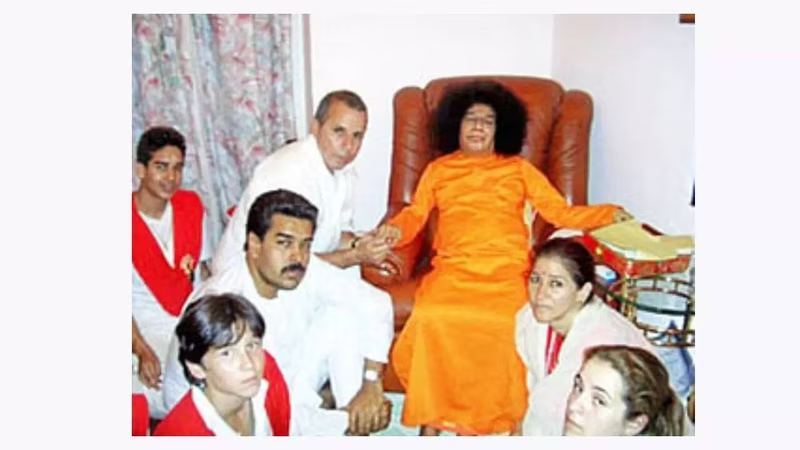
In a moment of high-stakes political drama, Venezuelan leader Nicolas Maduro did something unexpected: he invoked God in a courtroom. But this wasn’t just any divine reference. For Maduro, the spiritual figure who has profoundly shaped his worldview is the Indian guru, Sri Sathya Sai Baba. From a prominent portrait in the presidential palace to his own public declarations of faith, Maduro’s connection to this controversial spiritual leader reveals a fascinating and largely untold story of cross-cultural religious influence. How did a man from the village of Puttaparthi in Andhra Pradesh, India, become a household name in Caracas, Venezuela?
Table of Contents
- Maduro’s Deep Devotion and the Palace Portrait
- The Global Reach of Sri Sathya Sai Baba
- Why Venezuela Embraced the Guru
- The Controversial Legacy of the ‘Miracle Worker’
- Conclusion: The Enduring Mystique
- Sources
Maduro’s Deep Devotion and the Palace Portrait
Maduro’s connection to Sri Sathya Sai Baba isn’t a recent political ploy; it’s a decades-long personal faith. It’s widely reported that he and his wife, Cilia Flores, were ardent followers of the guru long before he assumed the presidency . Their devotion was so profound that a large, framed photograph of Sai Baba was displayed prominently in Maduro’s private office within the Miraflores Palace, the official residence of Venezuela’s head of state . This wasn’t just a decorative choice; it was a constant, public testament to his spiritual guide.
For Maduro, Sai Baba represented a source of moral and ethical grounding. In a region often torn by political and economic turmoil, the guru’s central tenet of “Love All, Serve All” likely offered a powerful counter-narrative of compassion and service. This personal faith became so integral to his identity that he felt comfortable invoking a higher power in a legal setting, a move that speaks volumes about the depth of his belief.
The Global Reach of Sri Sathya Sai Baba
Sri Sathya Sai Baba’s influence extended far beyond the borders of India, inspiring a vast global community dedicated to spiritual growth and humanitarian work . His charismatic presence and simple yet powerful message of universal love and selfless service resonated with millions across continents, from Hollywood celebrities to world leaders.
His movement is organized in over 113 countries, with nearly 2,000 centers worldwide . The guru’s appeal lay in his synthesis of teachings from all major world religions, promoting a universal spirituality that transcended specific dogma. He built a massive charitable infrastructure, including free hospitals and educational institutions in India, which further cemented his image as a man of action and compassion for his global followers.
Why Venezuela Embraced the Guru
Venezuela is home to one of the largest Sai Baba devotee communities in Latin America . The movement’s roots in the country stretch back to 1974 with the opening of the first Sai Center in Caracas . Over the decades, it has grown significantly, reportedly amassing a following of over 200,000 people .
Several factors likely contributed to this deep penetration. The movement’s emphasis on community service, moral education, and a message of hope would have been particularly appealing during Venezuela’s periods of intense social and economic upheaval. The Sai Organization in Venezuela has been active in organizing public meetings and educational programs in numerous cities, steadily building a grassroots network . For many Venezuelans, Sai Baba offered a spiritual sanctuary and a framework for ethical living that was separate from the nation’s fraught political landscape. The connection of a powerful figure like Maduro only served to bring the guru’s name into the mainstream national conversation.
The Controversial Legacy of the ‘Miracle Worker’
Despite his widespread popularity and philanthropic works, Sri Sathya Sai Baba’s legacy is deeply complex and marred by serious, persistent allegations. He was famously known as a “miracle worker” for his demonstrations of producing sacred ash (vibhuti) and small trinkets from thin air—a practice many critics have dismissed as sleight of hand .
Far more disturbing are the decades-long accusations of sexual abuse, primarily involving young male devotees . Though he was never criminally charged, these allegations have been the subject of numerous investigations and media exposés, casting a long shadow over his spiritual empire . This duality—of a beloved spiritual leader accused of heinous acts—creates a profound tension that his followers, including figures like Maduro, must navigate.
For many devotees, the accusations are dismissed as slander against a holy man, while for critics, they are an inseparable part of his story. This controversy is a crucial part of understanding the full picture of the guru who captured Venezuela’s presidential palace.
Conclusion: The Enduring Mystique
The story of Sri Sathya Sai Baba‘s influence in Venezuela is a powerful testament to the global reach of spiritual movements in the modern age. It’s a tale of personal faith for a world leader, a community’s search for meaning, and the enduring, yet deeply contested, mystique of a 20th-century guru. Maduro’s devotion, symbolized by the portrait in his office, is just one thread in a much larger tapestry that connects a small Indian village to the heart of South American politics. The guru’s simple message of love and service continues to resonate, even as his legacy remains a subject of intense debate and scrutiny.
Sources
- Times of India: How Maduro’s ‘guru’ Sri Sathya Sai Baba became a household name in Venezuela
- The New York Times: A Follower of an Indian Guru, in Line to Lead Venezuela
- Sathya Sai International Organization: Official Website
- The Guardian: Guru Sai Baba’s legacy: Death threats and scandal