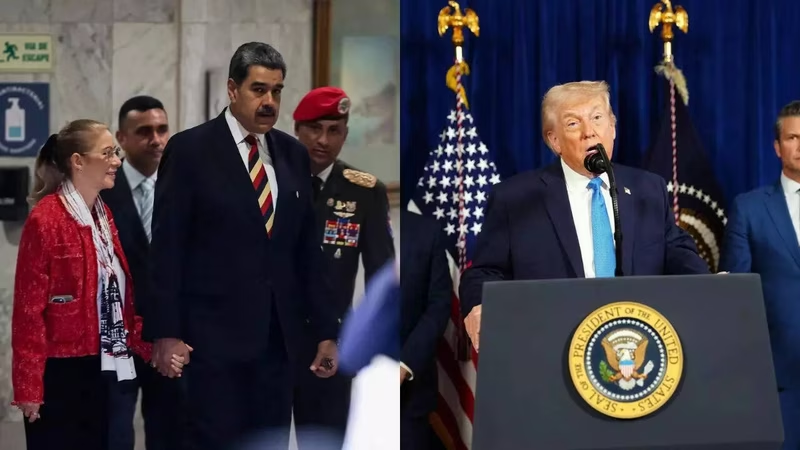
In a move that has sent shockwaves through global geopolitics, United States forces executed a lightning-fast, pre-dawn raid deep inside Venezuela—resulting in the capture of President Nicolás Maduro and his wife, Cilia Flores. Confirmed by former President Donald Trump and backed by multiple intelligence sources, the operation marks an unprecedented escalation in U.S. efforts to dismantle what it calls a narco-terrorist regime.
The mission, codenamed “Pinpoint”, involved elite **Delta Force** operators who infiltrated Caracas under cover of darkness, breached a “highly guarded fortress,” and extracted the Venezuelan leader without a single civilian casualty. Maduro is now in U.S. custody in New York, facing federal charges of **narco-terrorism and international drug trafficking**.
Table of Contents
- How the Maduro Capture Operation Unfolded
- The Role of U.S. Special Forces
- Why Maduro Was Targeted: Narco-Terrorism Charges Explained
- Venezuela’s Response and Regional Fallout
- Legal and Diplomatic Implications
- Conclusion
- Sources
How the Maduro Capture Operation Unfolded
The **Maduro captured** operation began just before 3 a.m. local time in Caracas. According to U.S. defense officials, intelligence assets had been embedded near Maduro’s private residence—a fortified compound in the Los Chorros neighborhood—for weeks, monitoring guard rotations, communication patterns, and structural vulnerabilities.
The strike team, composed of fewer than two dozen **Delta Force** operatives, parachuted from a modified MC-130J Commando II aircraft into a remote jungle zone 40 kilometers from the capital. From there, they moved in unmarked vehicles through pre-cleared routes, exploiting a temporary blind spot in Venezuela’s air defense system.
Key phases of the raid included:
- Breach: Using shaped charges, operators blew through a reinforced gate without triggering the main alarm system.
- Neutralization: Twelve presidential bodyguards were incapacitated using non-lethal tactics (stun grenades and suppressed takedowns).
- Extraction: Maduro and Flores were secured, sedated, and flown out aboard a stealthy MH-47G Chinook to a forward operating base in Colombia.
- Transfer: Within 12 hours, the couple was aboard a U.S. Air Force C-17 bound for New York’s JFK Airport.
This level of precision is rare even among Tier-1 special operations—a testament to months of **pinpoint planning** and real-time intelligence fusion.
The Role of U.S. Special Forces
The 1st Special Forces Operational Detachment-Delta—better known as **Delta Force**—is the U.S. military’s most secretive counterterrorism unit. Rarely acknowledged publicly, its involvement signals the operation’s extreme sensitivity.
Delta Force operatives trained extensively for this mission at the Joint Readiness Training Center in Louisiana, using a full-scale replica of Maduro’s compound built from satellite imagery and defector testimony. Their preparation included mock raids in simulated urban environments and rehearsals for rapid extraction under fire.
Notably, the operation was conducted without the knowledge of the current U.S. administration, raising questions about chain-of-command protocols. However, a senior Pentagon source told The Times of India that the mission had been authorized under a classified national security directive originally signed in 2019.
Why Maduro Was Targeted: Narco-Terrorism Charges Explained
While the dramatic capture has dominated headlines, the legal foundation was laid years ago. In 2020, the U.S. Department of Justice unsealed a federal indictment charging Maduro and 14 other Venezuelan officials with **narco-terrorism**—a rare and severe charge typically reserved for leaders of drug cartels with ties to terrorist acts.
Specifically, prosecutors allege that Maduro’s regime conspired with the Revolutionary Armed Forces of Colombia (FARC) to flood the U.S. with cocaine. Court documents state that Maduro personally approved shipments of “multi-hundred-kilogram” quantities of cocaine, with profits funding state repression and military procurement.
Cilia Flores, a former president of Venezuela’s National Assembly, is accused of laundering drug proceeds through European banks and real estate holdings in Spain and the Dominican Republic.
For deeper context on U.S. legal strategies against foreign leaders, see our analysis on [INTERNAL_LINK:international-narco-terrorism-laws].
Venezuela’s Response and Regional Fallout
Within hours of the raid, Venezuela’s military high command declared a state of emergency. Defense Minister Vladimir Padrino López called the operation a “flagrant act of war” and vowed retaliation. However, internal divisions have already surfaced—three regional army commanders have reportedly refused Padrino’s orders to mobilize.
Regionally, responses have been mixed:
- Brazil and Colombia have remained officially silent but are believed to have provided logistical support.
- Cuba and Nicaragua condemned the raid as “imperialist aggression.”
- The European Union expressed “deep concern” but stopped short of criticizing the U.S.
Analysts warn that the power vacuum left by Maduro’s removal could trigger either a democratic transition or a violent military junta—making the next 72 hours critical for Venezuela’s future.
Legal and Diplomatic Implications
The arrest of a sitting head of state on foreign soil raises profound legal questions. While the U.S. argues that Maduro forfeited sovereign immunity by engaging in criminal activity, international law experts are divided.
According to the United Nations Charter, the use of force on another nation’s territory without consent violates sovereignty—unless justified as self-defense. The U.S. is likely to argue that the narco-terrorism threat constituted an imminent danger to American citizens.
Diplomatically, the move risks alienating non-aligned nations and could strengthen anti-American sentiment in Latin America. On the other hand, it may embolden opposition groups and accelerate regime change—a long-standing U.S. policy goal.
Conclusion
The **Maduro captured** operation is more than a military success—it’s a geopolitical earthquake. By directly apprehending a foreign leader accused of narco-terrorism, the United States has crossed a threshold that will reverberate for years. While the legality and long-term consequences remain uncertain, one thing is clear: the era of impunity for state-sponsored drug trafficking may be coming to an end. The world is now watching to see whether Venezuela descends into chaos or emerges into a new democratic dawn.
Sources
[1] “Pinpoint planning: How Maduro, his wife were captured from ‘highly guarded fortress’ — key details,” Times of India
[2] U.S. Department of Justice Indictment No. 1:20-cr-00117 (S.D.N.Y.)
[3] “Delta Force: America’s Secret Warriors,” U.S. Special Operations Command (USSOCOM)
[4] “Venezuela Crisis: Background and U.S. Policy,” Congressional Research Service
[5] United Nations Charter, Article 2(4), https://www.un.org/en/