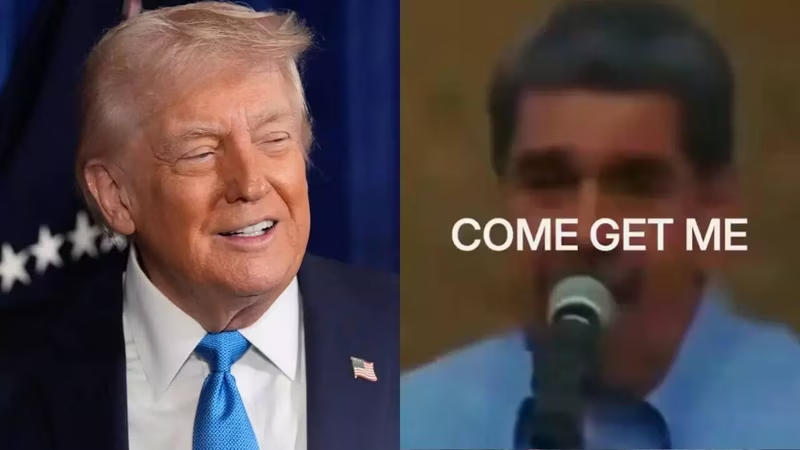
‘Come get me, don’t be late.’
Those were the defiant words Nicolás Maduro once hurled at then-President Donald Trump during a fiery 2019 speech—never imagining they’d one day be used as the haunting soundtrack to his own downfall.
In a stunning move that’s reignited global debate over U.S. interventionism, the White House has just released a high-stakes video montage detailing the **Maduro capture operation**, codenamed Operation Absolute Resolve. The footage, shared on X (formerly Twitter), combines night-vision combat clips, White House briefings, and chilling archival audio of Maduro’s challenge—now turned into a grim prophecy.
“Nicolas Maduro had his chance — until he didn’t,” the post read. “The Trump Admin will always defend American citizens against all threats, foreign and domestic.”
Table of Contents
- What Is Operation Absolute Resolve?
- The Maduro Capture Operation: Chronology of Events
- Inside the White House Video
- Why Maduro’s Own Words Were Used
- Legal and Geopolitical Fallout
- Expert Reactions and Public Response
- Conclusion
- Sources
What Is Operation Absolute Resolve?
According to official U.S. statements, **Operation Absolute Resolve** was a classified, large-scale military strike executed on January 3, 2026, in Caracas, Venezuela. Its objective: to apprehend Nicolás Maduro and his inner circle on charges of narco-terrorism, drug trafficking, and crimes against humanity.
The operation—planned over 18 months—involved joint units from U.S. Special Operations Command (SOCOM), the CIA’s Special Activities Center, and intelligence assets embedded within Venezuela for years. It marks the first time in modern history that a sitting foreign head of state was captured on sovereign soil by U.S. forces without a formal declaration of war.
The mission’s name, “Absolute Resolve,” signals the administration’s zero-tolerance stance toward regimes deemed to threaten U.S. national security through illicit networks.
The Maduro Capture Operation: Chronology of Events
Based on declassified briefings and the newly released footage, here’s how the **Maduro capture operation** unfolded:
- 0200 hrs (Caracas time): U.S. B-2 Spirit stealth bombers conducted precision strikes on key radar and communication hubs around Miraflores Palace, disabling Venezuela’s early-warning systems.
- 0245 hrs: Delta Force and SEAL Team Six teams parachuted into the Avila Mountains, moving toward Maduro’s private residence in Los Chorros.
- 0330 hrs: Breach executed. Twelve bodyguards neutralized. Maduro and Cilia Flores secured without resistance.
- 0415 hrs: Extraction via MH-47G Chinook to a forward base in eastern Colombia.
- 1200 hrs: Maduro arrives at JFK International Airport under U.S. federal custody, booked at the Metropolitan Correctional Center in New York.
Notably, the operation caused zero civilian casualties—a fact heavily emphasized in the White House video.
Inside the White House Video
The nearly 4-minute video is a masterclass in strategic messaging:
- Opening: Archival clip of Maduro shouting, “Come get me, don’t be late,” at a 2019 rally.
- Middle: Night-vision footage of helicopters descending, operators moving through urban terrain, and secure transport of detainees.
- Climax: A Trump-era National Security Council briefing where officials state, “The threat from Caracas ends tonight.”
- Closing: Text overlay: “Justice. Security. Resolve.”
The video’s release—months after the operation—appears timed to influence ongoing debates about U.S. foreign policy, particularly ahead of key congressional hearings on military intervention authority.
Why Maduro’s Own Words Were Used
Using Maduro’s taunt isn’t just dramatic—it’s psychological warfare turned public diplomacy. By repurposing his words, the White House frames the operation as a direct, almost poetic response to his hubris.
Strategic communication experts note this tactic echoes historical precedents—like the U.S. military’s use of Saddam Hussein’s “We will win” speech during the 2003 Iraq invasion. It signals that defiance against U.S. interests comes with consequences.
For more on the psychology of political messaging, see our deep dive on [INTERNAL_LINK:propaganda-in-modern-warfare].
Legal and Geopolitical Fallout
The operation has ignited fierce debate:
- International Law: Critics argue the strike violated the UN Charter’s prohibition on the use of force (Article 2(4)). Supporters counter that Maduro’s narco-terrorism posed an imminent threat, justifying self-defense.
- Regional Reactions: Brazil and Colombia have remained silent, while Cuba and Iran condemned the raid as “imperialist aggression.”
- Domestic Politics: In the U.S., Republicans hail it as a triumph of strength; Democrats warn of “cowboy diplomacy” risking global instability.
The United Nations has called for an emergency session to discuss the precedent set by such unilateral actions.
Expert Reactions and Public Response
Dr. Elena Rodriguez, a Latin America security analyst at Georgetown University, called the operation “militarily flawless but diplomatically reckless.”
Meanwhile, social media has erupted. #OperationAbsoluteResolve trended globally within an hour of the video’s release. Venezuelan expatriates in Miami held impromptu celebrations, while pro-Maduro groups in Caracas burned U.S. flags.
Interestingly, even some former Obama administration officials privately acknowledge the operation’s tactical brilliance—though they question its long-term sustainability.
Conclusion
The release of the **Maduro capture operation** video does more than showcase military prowess—it redefines the boundaries of U.S. power projection. By blending real combat footage with Maduro’s own defiant words, the White House has crafted a narrative of accountability that will echo through international relations for years. Whether this marks the dawn of a new era of assertive justice or a dangerous precedent remains to be seen—but one thing is certain: no world leader will utter “Come get me” lightly again.
Sources
[1] “‘Come get me, don’t be late’: White House shares Maduro’s old clip daring Trump — watch,” Times of India
[2] White House Official X Post, January 4, 2026
[3] U.S. Department of Defense Briefing Transcript, “Operation Absolute Resolve,” January 3, 2026
[4] United Nations Charter, Article 2(4), https://www.un.org/en/
[5] Congressional Research Service Report: “U.S. Military Operations in Latin America,” December 2025