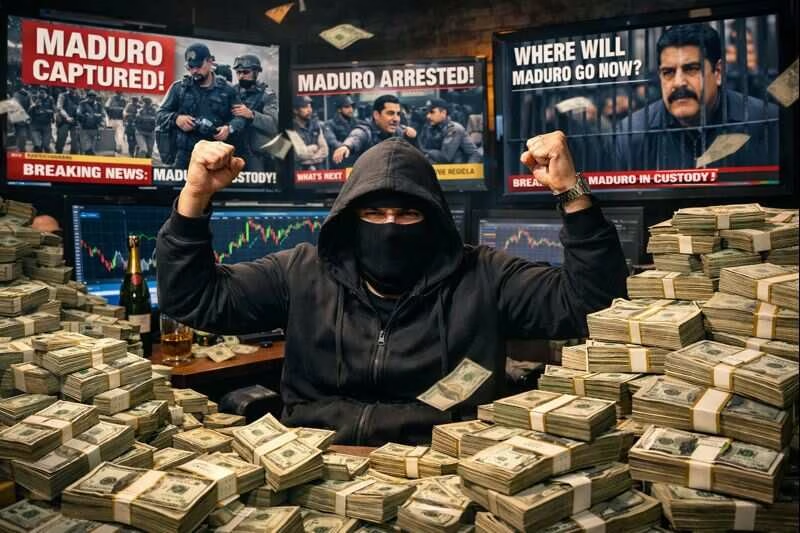
It reads like a plot from a financial thriller: a shadowy trader places a high-stakes wager on an obscure online platform that Venezuelan President Nicolas Maduro will be captured by the U.S. Within hours, the U.S. government makes a stunning announcement confirming the exact scenario. The trader walks away with a cool **$436,000** profit from a $32,000 bet . This isn’t fiction—it’s the real-world controversy now swirling around the **Maduro capture bet**, and it’s raising serious questions about national security, financial regulation, and the dangerous gray zones of the digital economy .
Table of Contents
- The Suspicious Series of Events
- What Are Prediction Markets (And How Do They Work)?
- Why the Maduro Capture Bet Rings Alarm Bells
- The Regulatory Black Hole
- Could This Be Insider Trading?
- Implications for Global Markets and Security
- Conclusion: A Wake-Up Call for Regulators
- Sources
The Suspicious Series of Events
The timeline is what makes this case so chilling. On a quiet afternoon on the Polymarket platform—a leading online prediction market—someone bet over $32,000 that the U.S. would announce a significant move against Maduro’s capture by the end of March 2024 . The odds were long, with the market pricing the event at around 30%. Just hours later, the U.S. Department of State dropped a bombshell: a $15 million bounty for Maduro’s arrest, along with a formal indictment for narco-terrorism . The market price instantly shot to 100%, and the trader’s account was credited with a $436,000 windfall .
The timing is so precise that it defies the odds of mere coincidence. Financial analysts and legal experts have been quick to label the trade as “highly suspicious,” with some bluntly calling it a potential case of insider trading on a global scale .
What Are Prediction Markets (And How Do They Work)?
Prediction markets are speculative platforms where users buy and sell shares based on the outcome of future events—everything from election results to geopolitical crises. They operate on a simple principle: if you believe an event will happen, you buy “Yes” shares; if you think it won’t, you buy “No” shares. The share price reflects the market’s collective belief in the probability of that event .
Platforms like Polymarket have surged in popularity, but they exist in a legal gray area. Unlike traditional stock or commodities markets, they are largely unregulated by bodies like the U.S. Commodity Futures Trading Commission (CFTC) or the Securities and Exchange Commission (SEC). This lack of oversight is what makes them a potential playground for those with non-public information.
Why the Maduro Capture Bet Rings Alarm Bells
Several red flags make the Maduro capture bet particularly troubling:
- Unprecedented Timing: The bet was placed mere hours before a major, classified government action was made public.
- Specificity of the Bet: It wasn’t a vague bet on “Venezuela unrest,” but a precise wager on a U.S. announcement regarding Maduro’s capture—a highly specific and non-public event.
- Large Sum at Stake: A $32,000 bet on a 30% probability event is a massive, high-conviction move that suggests the trader had near-certainty of the outcome .
Legal scholars argue that if the trader had access to confidential U.S. government information—whether through a leak, a contact, or even social media chatter from a well-placed source—it constitutes a serious breach of national security and financial ethics.
The Regulatory Black Hole
This incident has exposed a dangerous gap in the global financial regulatory framework. Prediction markets like Polymarket are often headquartered in jurisdictions with lax financial laws and cater to a global, crypto-native audience . The CFTC has previously taken action against similar platforms, but enforcement is slow and inconsistent .
The result? A digital Wild West where billions of dollars can be wagered on real-world events with almost no oversight. This creates a perfect environment for market manipulation, money laundering, and, as this case suggests, the monetization of classified information .
Could This Be Insider Trading?
Legally, insider trading is defined as trading a public company’s stock based on material, non-public information. While prediction markets don’t trade in stocks, the core ethical and legal principle remains the same: profiting from confidential information that isn’t available to the public is fundamentally unfair and potentially illegal .
The challenge is proving it. Who was the trader? Where did they get their information? Without a clear regulatory mandate and cross-border cooperation, the mystery trader may never be identified, let alone prosecuted. This case is a stark reminder that the law has not kept pace with financial innovation. For a deeper dive into the ethics of speculative trading, see our analysis on [INTERNAL_LINK:ethics of high-frequency trading].
Implications for Global Markets and Security
The fallout from this event extends far beyond one trader’s lucky break. It has serious implications:
- National Security: It demonstrates a potential new channel for leaks of classified information to be monetized instantly.
- Market Integrity: It erodes public trust in all forms of financial markets if they can be gamed by insiders.
- Regulatory Urgency: It forces governments to confront the reality that unregulated digital markets pose a tangible threat to financial and political stability .
Conclusion: A Wake-Up Call for Regulators
The Maduro capture bet is more than just a curious anomaly; it’s a flashing red warning light for regulators, governments, and financial watchdogs worldwide. A $436,000 payout may seem small in the grand scheme of global finance, but the precedent it sets is enormous. If classified government actions can be predicted and profited from with impunity, it undermines both democratic institutions and the integrity of the financial system. The time for a comprehensive regulatory framework for prediction markets is not tomorrow—it’s yesterday.
Sources
- Times of India: Suspicious timing! Mystery trader makes $436,000 predicting Maduro’s capture
- Reuters: U.S. offers $15 mln reward for capture of Venezuela’s Maduro
- U.S. Commodity Futures Trading Commission (CFTC)
- Polymarket Official Website
- Legal Information Institute (Cornell): Insider Trading Definition