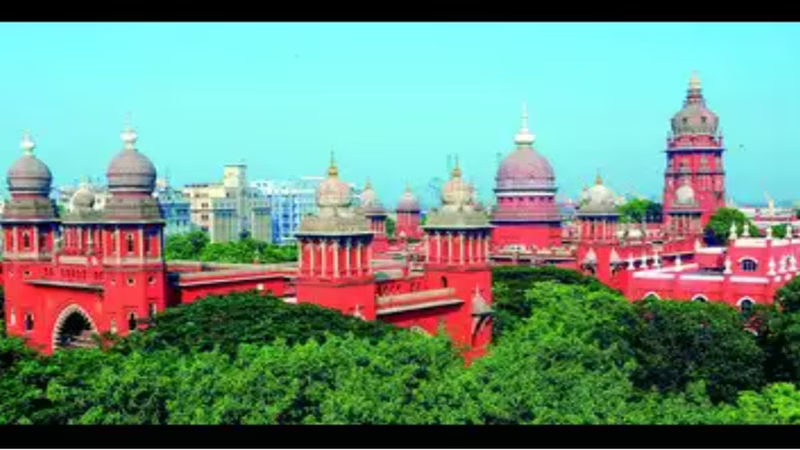
The age-old tension between the right to free speech and the need to uphold the dignity of public institutions has erupted in Tamil Nadu, with the Madras High Court taking the extraordinary step of banning a book. The court has prohibited the publication, sale, and circulation of a Tamil publication that contains what it described as “highly abusive and scandalous” content directed at Justice G R Swaminathan, a sitting judge known for his landmark rulings .
This isn’t just a simple censorship order; it’s a full-blown legal confrontation. The court has also initiated suo motu (on its own motion) contempt proceedings against the publisher, Keezhaikaatru Publishers. This case has instantly become a flashpoint in the national debate over where to draw the line when criticizing the judiciary—a pillar of India’s democracy.
Table of Contents
- The Incident: What Triggered the Madras High Court Book Ban?
- Who is Justice G R Swaminathan? The Target of the Attack
- The Publishers in Hot Water: Suo Motu Contempt Proceedings
- The Legal Battle Ground: Contempt of Court in India
- Freedom of Speech vs. Judicial Integrity: The Core Debate
- Historical Precedents: Other Book Bans and Court Clashes
- Conclusion: A Delicate Balance in a Democracy
- Sources
The Incident: What Triggered the Madras High Court Book Ban?
The controversy centers on a recently published Tamil book whose title and specific contents have not been widely disclosed in initial reports, likely to prevent further circulation. However, the Madras High Court, in its order, was unequivocal in its assessment of the content. A division bench, upon reviewing the material, found the language used against Justice Swaminathan to be far beyond legitimate criticism.
Instead of reasoned argument or critique of a judgment, the court found the text to be a personal, vitriolic attack filled with “scandalous” and “abusive” language. This, the court ruled, was not protected speech but a direct assault on the institution of the judiciary itself—a threat that could undermine public confidence in the legal system .
Who is Justice G R Swaminathan? The Target of the Attack
Justice G R Swaminathan is not just any judge. He is a prominent and often polarizing figure on the Madras High Court bench, known for his sharp intellect and landmark, sometimes controversial, judgments. He has delivered significant verdicts on issues ranging from the Deepam newspaper case (which is referenced in the original article title) to matters of free speech, public morality, and religious practices .
His high-profile decisions have made him a target for both praise and criticism. However, the court’s ban suggests that the book in question crossed a line from criticizing his judgments into a deeply personal and defamatory realm, which the judiciary is legally empowered to defend against.
The Publishers in Hot Water: Suo Motu Contempt Proceedings
The court’s action against Keezhaikaatru Publishers is particularly significant. By initiating suo motu contempt proceedings, the court is acting as both the complainant and the adjudicator. This power, granted under the Contempt of Courts Act, 1971, allows the judiciary to protect its own authority without waiting for a formal complaint from an aggrieved party.
The publisher now faces a serious legal battle. If found guilty of criminal contempt, they could be liable for fines, imprisonment, or both. The court has also mandated the immediate seizure of all existing copies of the book to prevent its further dissemination.
The Legal Battle Ground: Contempt of Court in India
The Contempt of Courts Act, 1971, is the primary legislation governing this area in India. It defines criminal contempt as the publication of any matter that “scandalizes or tends to scandalize, or lowers or tends to lower the authority of, any court” .
However, the law also provides a crucial defense: “fair comment” on the conduct of a judge or a case, as long as it is made in good faith. The central question in this case will be whether the book’s content can be construed as such “fair comment” or if it was, as the court has initially ruled, a malicious and scandalous attack. The Supreme Court of India has, in past judgments, attempted to narrow the scope of “scandalizing the court” to protect free speech, but the line remains blurry and highly subjective [INTERNAL_LINK:india-contempt-of-court-landmark-cases].
Freedom of Speech vs. Judicial Integrity: The Core Debate
This case sits at the heart of a fundamental democratic dilemma. Article 19(1)(a) of the Indian Constitution guarantees the right to freedom of speech and expression. But this right is not absolute and is subject to “reasonable restrictions” under Article 19(2), which includes contempt of court.
Critics of the ban argue that it sets a dangerous precedent, potentially chilling legitimate criticism of the judiciary. They fear that any harsh critique could be labeled “scandalous” and lead to censorship. Supporters, however, contend that without the power to defend its dignity, the judiciary—a non-elected body—would be vulnerable to baseless attacks that could erode its moral authority and, by extension, the rule of law itself.
Historical Precedents: Other Book Bans and Court Clashes
This is not the first time an Indian court has banned a book. Notable examples include the ban on Salman Rushdie’s “The Satanic Verses” and various bans on books deemed offensive to religious sentiments. However, a ban specifically for attacking a sitting judge is less common and carries its own unique set of legal and ethical complexities. The outcome of this case could set a significant new precedent for how Indian courts handle similar situations in the future.
Conclusion: A Delicate Balance in a Democracy
The Madras High Court book ban is far more than a local legal skirmish. It is a microcosm of the ongoing struggle to balance two essential pillars of a healthy democracy: the citizen’s right to speak freely and the judiciary’s need to maintain its dignity and authority. The court’s initial order is a strong assertion of its power to protect itself. Now, the coming legal proceedings will be a critical test of whether that power was exercised justly, or if it has inadvertently silenced a voice that, however harsh, was part of a necessary public discourse.
Sources
- Times of India: Madras HC bans book with ‘scandalous’ remarks against Deepam judge
- The Contempt of Courts Act, 1971: Full Text
- Supreme Court of India: Official Website
- Constitution of India, Article 19: Fundamental Rights