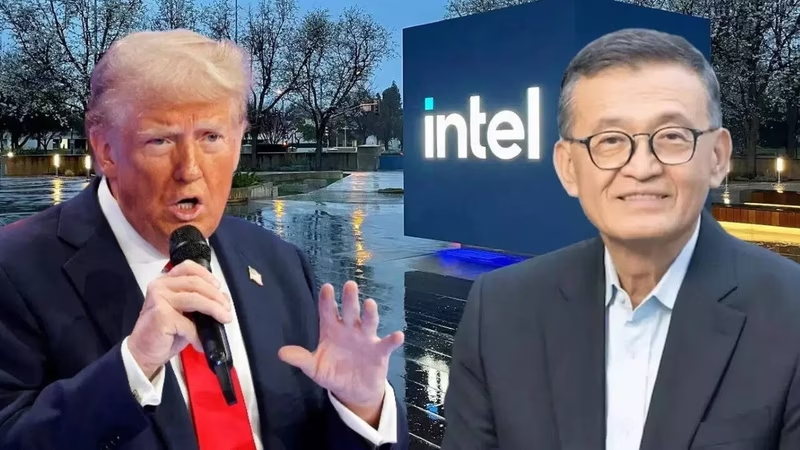
In a move that blends patriotism, cutting-edge engineering, and political savvy, Intel CEO Lip-Bu Tan has delivered a powerful response to former President Donald Trump’s call for American tech self-reliance. Days after Trump posted about reviving U.S. chip dominance, Tan unveiled Intel’s newest breakthrough: the first-ever sub-2 nanometer CPU processors—designed, fabricated, and packaged entirely within the United States.
Dubbed the Core Ultra Series 3, these chips aren’t just a technical marvel—they’re a symbolic declaration that America is reclaiming its leadership in semiconductor innovation. And with AI capabilities baked into every core, they’re poised to redefine what consumer laptops can do in 2026 and beyond.
Table of Contents
- Intel CEO Responds to Trump on ‘Made in America Chips’
- The Tech Behind the Core Ultra Series 3
- Why Sub-2nm Matters: A Giant Leap for US Semiconductors
- AI at the Edge: How These Chips Change Laptops
- The Political and Strategic Stakes of Domestic Chip-Making
- What Comes Next for Intel and US Tech Sovereignty
- Conclusion: More Than Silicon—a Statement of Resilience
- Sources
Intel CEO Responds to Trump on ‘Made in America Chips’
Former President Trump recently took to social media urging American companies to bring chip production back home, warning that reliance on foreign foundries poses national security risks. In a rare public reply, Intel’s newly appointed CEO Lip-Bu Tan didn’t just agree—he showed proof.
“We hear you, Mr. President,” Tan wrote in a LinkedIn post accompanied by images of gleaming wafers from Intel’s Arizona and Ohio fabs. “These chips are 100% Made in America—from design to final packaging. This is our commitment to U.S. innovation and resilience.”
The message was clear: Intel isn’t waiting for policy—it’s building the future on American soil .
The Tech Behind the Core Ultra Series 3
The Core Ultra Series 3 represents Intel’s most advanced consumer processor to date, built on the company’s “Intel 18A” process node—its branding for sub-2nm technology. Key features include:
- Dedicated Neural Processing Unit (NPU): Optimized for on-device AI tasks like real-time translation, photo enhancement, and voice recognition—without cloud dependency.
- Energy Efficiency: Up to 40% lower power consumption than previous gen, enabling all-day battery life in thin-and-light laptops.
- Performance Gains: 35% faster multi-threaded performance, ideal for creators, gamers, and professionals.
Unlike competitors who outsource manufacturing to TSMC or Samsung, Intel produced these chips end-to-end in its U.S. facilities—a feat made possible by over $20 billion in recent investments backed by the CHIPS and Science Act .
Why Sub-2nm Matters: A Giant Leap for US Semiconductors
For years, the U.S. led chip design but lost ground in manufacturing—especially at the most advanced nodes. Taiwan’s TSMC and South Korea’s Samsung now dominate sub-3nm production, creating supply chain vulnerabilities exposed during the pandemic and geopolitical tensions.
Intel’s sub-2nm breakthrough changes that narrative. It proves the U.S. can not only compete but lead in next-gen fabrication. As the Semiconductor Industry Association notes, “Onshoring advanced logic production is critical for economic and national security” .
AI at the Edge: How These Chips Change Laptops
2026 is the year AI moves from the cloud to your lap. The Core Ultra Series 3’s integrated NPU enables “AI PC” functionality that works offline—critical for privacy, speed, and reliability.
Imagine:
- Real-time background blur in Zoom calls without internet lag;
- Automatic transcription of meetings with speaker identification;
- Smart photo editing that understands context (“remove the tourist, keep the monument”).
Microsoft, Dell, HP, and Lenovo have already confirmed devices featuring these chips will ship starting late January 2026—just in time for the back-to-school and enterprise refresh cycles.
The Political and Strategic Stakes of Domestic Chip-Making
Intel’s announcement lands amid intense bipartisan support for semiconductor independence. The CHIPS Act allocated $52 billion to boost U.S. manufacturing, with Intel receiving the largest single grant to date.
By tying its product launch to Trump’s “Made in America” rhetoric—even as a Democrat-led administration funds its expansion—Intel is playing a masterstroke of nonpartisan tech diplomacy. It positions itself not as a political actor, but as a national asset.
What Comes Next for Intel and US Tech Sovereignty
This is just the beginning. Intel plans to ramp up sub-2nm production throughout 2026, with server-grade variants expected by Q4. The company also aims to offer foundry services to other U.S. firms—potentially breaking TSMC’s near-monopoly on advanced chips for companies like NVIDIA and AMD.
If successful, this could catalyze a full renaissance of American hardware innovation—turning “Made in America chips” from a slogan into a sustainable reality.
Conclusion: More Than Silicon—a Statement of Resilience
Lip-Bu Tan’s reply to Trump is more than corporate PR—it’s a milestone in America’s quest for technological sovereignty. The Core Ultra Series 3 isn’t just faster or smarter; it’s a symbol of what’s possible when public policy, private investment, and engineering excellence align. As global supply chains remain fragile, Intel’s fully domestic chip offers not just performance, but peace of mind. For deeper insights into the future of computing, explore [INTERNAL_LINK:future-of-ai-pcs].
Sources
- Times of India: Intel CEO Lip-Bu Tan replies to Donald Trump’s post on ‘Made in America’ chips
- Intel Newsroom: Core Ultra Series 3 Technical Brief
- Semiconductor Industry Association (SIA): CHIPS Act Impact Report 2025
- U.S. Department of Commerce: CHIPS Program Office Updates
- [INTERNAL_LINK:intel-vs-tsmc-2026]