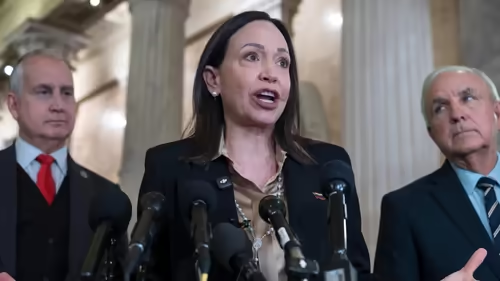
In a statement that’s ricocheting across the globe, Venezuelan opposition leader and 2025 Nobel Peace Prize winner Maria Corina Machado declared a bold vision for Latin America: “Venezuela will be free. And once we liberate Venezuela, we will keep working and we will have a free Cuba and a free Nicaragua” .
On the surface, it sounds like a hopeful rallying cry for democracy. But critics have seized on the word “liberate,” interpreting it as a dangerous call for military force—prompting the sarcastic backlash: “Let’s bomb more countries!” This intense controversy has placed Machado Cuba Nicaragua at the center of a fierce debate about sovereignty, intervention, and the future of the region.
Table of Contents
- What Did Machado Really Say?
- The Nobel Laureate Behind the Headlines
- Why the Phrase ‘Liberate’ Sparked a Firestorm
- Current US Policy on Cuba and Nicaragua
- The New Venezuela Context (Post-Maduro)
- Conclusion: Words Have Power
- Sources
What Did Machado Really Say?
The core of the controversy lies in a direct quote from Machado herself. Speaking with conviction, she stated her goal was not just for her home country but for its neighbors: a “free Cuba and a free Nicaragua” following Venezuela’s own liberation . Her supporters argue this is purely a political and democratic aspiration, a call for popular uprisings and international pressure to end authoritarian regimes in Havana and Managua, much like the one she has fought against in Caracas for years.
However, the choice of the word “liberate” carries heavy historical baggage. In the context of 21st-century geopolitics, it’s often associated with military invasions, from Iraq to Libya. This linguistic ambiguity is what has fueled the intense backlash and the fear that her vision could be used to justify a more aggressive, even violent, US foreign policy in the region.
The Nobel Laureate Behind the Headlines
To understand Machado’s stance, it’s crucial to know who she is. In October 2025, the Norwegian Nobel Committee awarded her the Nobel Peace Prize “for her tireless work promoting democratic rights for the people of Venezuela” . This prestigious recognition cemented her status as a leading global voice for democracy, not just in Venezuela but across the world.
Her journey has been marked by immense personal risk. She was barred from running in Venezuela’s 2024 elections and has faced constant threats and persecution from the Maduro regime. Her advocacy is rooted in a deep, personal fight for freedom, which informs her broader regional vision. You can learn more about the complex history of the [INTERNAL_LINK:venezuela-political-crisis] on our dedicated page.
Why the Phrase ‘Liberate’ Sparked a Firestorm
The backlash to Machado’s statement isn’t just about semantics; it’s about historical trauma and geopolitical reality. For many in Latin America, the idea of an external power “liberating” a nation is a euphemism for imperialism. The region has a long and painful history of US-backed coups and interventions.
Critics argue that even if Machado’s intent is peaceful, her words can be easily co-opted by hardliners in Washington who favor a more hawkish approach. The sarcastic retort, “Let’s bomb more countries!”, perfectly captures this fear—that her noble goal of freedom could become a pretext for destructive military action that would only bring more suffering to the very people she aims to help.
Current US Policy on Cuba and Nicaragua
Understanding the current US stance is key to this debate. The Biden administration has taken a multi-pronged approach to both nations, which are led by authoritarian governments.
On Cuba: The US has imposed targeted sanctions on Cuban security officials for human rights abuses . In a significant move just last year, the Biden administration removed Cuba from its list of state sponsors of terrorism , a step seen as opening a path for potential dialogue. It has also restored some flights and remittance channels .
On Nicaragua: The US has levied extensive sanctions on the Ortega regime and its associates. It has also included Nicaraguans in a humanitarian parole program alongside citizens from Cuba, Haiti, and Venezuela, allowing a pathway for legal entry into the US .
This policy framework shows a preference for diplomatic and economic pressure over military solutions. However, Machado’s comments have reignited the debate on whether this approach is sufficient.
The New Venezuela Context (Post-Maduro)
The timing of Machado’s statement is critical. As of January 2026, Venezuela is in a state of unprecedented flux. In a stunning turn of events, former President Nicolás Maduro was captured by US special forces in a pre-dawn raid in Caracas on January 3rd, 2026 .
This dramatic event has left a power vacuum and created a new, uncertain political landscape . With the primary symbol of Venezuela’s authoritarianism now in US custody, Machado and the opposition are positioned to lead a transition. Her call to then “free” Cuba and Nicaragua appears to be a declaration of intent to use Venezuela’s potential democratic rebirth as a catalyst for a wider regional movement. An analysis of the [INTERNAL_LINK:us-foreign-policy-latin-america] provides further context on these ambitions.
Conclusion: Words Have Power
The controversy surrounding the Machado Cuba Nicaragua statement is a powerful reminder that words matter immensely in geopolitics. While her ultimate goal of a democratic, free Latin America is one many share, the language used to describe that path can either build bridges or ignite conflicts. Her Nobel Prize underscores her moral authority, but it also places a greater burden on her to choose her words with extreme care. The world will be watching closely to see how her vision unfolds—not through bombs, but through the harder, more patient work of building genuine democratic institutions.
Sources
- Times of India: ‘Let’s bomb more countries!’: Row over Machado saying Cuba and Nicaragua will be ‘freed’
- Nobel Prize Organization: The Nobel Peace Prize 2025
- Reuters: Former Venezuelan President Nicolas Maduro was extracted from Caracas by US soldiers
- Council on Foreign Relations: Latin America and the Caribbean: U.S. Policy Overview