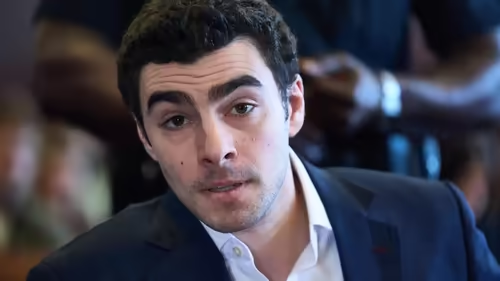
In a courtroom decision that has sent ripples through legal circles and the public alike, U.S. District Judge Victor Marrero has ruled that Luigi Mangione—the 26-year-old accused of assassinating UnitedHealthcare CEO Brian Thompson in broad daylight—will **not face the death penalty**.
The ruling, issued in Manhattan federal court on January 30, 2026, marks a pivotal moment in a case that has gripped the nation since Thompson was gunned down outside a Midtown hotel on December 4, 2025. While Mangione remains charged with first-degree murder and could still receive a life sentence without parole, the exclusion of capital punishment significantly alters the stakes of the upcoming trial.
Table of Contents
- Why the Judge Ruled Out the Death Penalty
- Background: The Brian Thompson Assassination
- Who Is Luigi Mangione?
- The Federal Death Penalty Process Explained
- Public and Political Reactions
- What Happens Next in the Case?
- Conclusion: A Landmark Decision in a High-Stakes Trial
- Sources
Why the Judge Ruled Out the Death Penalty
Although federal prosecutors initially signaled their intent to seek the death penalty—a rare move in New York, where state law abolished capital punishment in 2007—Judge Marrero concluded that the aggravating factors required under federal law were insufficient to justify it.
According to court documents, the judge weighed several considerations:
- Lack of prior violent criminal history: Mangione had no felony convictions or history of violence.
- Mental health evaluations: Early psychiatric assessments suggested possible underlying psychological conditions, though not rising to the level of legal insanity.
- Nature of the crime: While premeditated, the act did not involve torture, multiple victims, or terrorism—factors that often trigger federal death penalty eligibility.
- Prosecutorial discretion limits: The Department of Justice has tightened guidelines for seeking capital punishment under the Biden administration, emphasizing its use only in “most egregious” cases [[1]].
The ruling aligns with a broader national trend: federal death penalty prosecutions have plummeted in recent years, with only three executions carried out since 2020—all under the Trump administration.
Background: The Brian Thompson Assassination
Brian Thompson, 50, was shot multiple times in the back as he walked toward a Times Square hotel just before dawn. Surveillance footage showed a masked gunman fleeing on foot. The brazen attack—captured on multiple cameras—sparked a citywide manhunt.
Mangione, a University of Pennsylvania graduate with a master’s in computational biology from Columbia, was arrested days later in Baltimore after police traced a discarded bicycle and DNA evidence to him. Investigators found a cache of weapons, encrypted notes referencing healthcare industry grievances, and a detailed timeline of Thompson’s movements in his apartment [[2]].
While no direct link to any organization has been established, authorities believe Mangione may have targeted Thompson due to frustrations over insurance denials—a theory supported by online posts under pseudonyms matching his digital footprint.
Who Is Luigi Mangione?
Described by acquaintances as brilliant but socially isolated, Mangione grew up in Towson, Maryland. He excelled academically but reportedly struggled with anxiety and disillusionment with corporate America. Friends say he became increasingly critical of the healthcare system after a family member faced treatment delays.
Notably, Mangione had no known ties to activist groups or extremist ideologies. His alleged motive appears rooted in personal grievance rather than political ideology—making the case distinct from acts of domestic terrorism [INTERNAL_LINK:domestic-terrorism-vs-lone-actor-crimes].
The Federal Death Penalty Process Explained
Under U.S. federal law, capital punishment is reserved for specific crimes, including murder of a federal official, terrorism, or killings during drug trafficking. For a death sentence to be imposed, a jury must unanimously agree that:
- The defendant committed the crime beyond a reasonable doubt.
- At least one “aggravating factor” (e.g., heinousness, multiple victims) outweighs any “mitigating factors” (e.g., youth, mental illness, remorse).
Given New York’s strong anti-death-penalty sentiment, securing a unanimous jury for execution would have been extremely difficult—even if the option had remained on the table.
Public and Political Reactions
Reactions to the ruling have been mixed:
- Victim advocates expressed disappointment, calling Thompson’s killing a “corporate assassination” deserving of the harshest penalty.
- Death penalty opponents, including the ACLU, praised the decision as “a step toward ending a barbaric practice.”
- Healthcare industry leaders voiced concern about rising threats to executives, urging enhanced security protocols [INTERNAL_LINK:executive-security-in-healthcare].
President Biden, a long-time critic of capital punishment, has not commented publicly, but his administration’s policy shift likely influenced the prosecution’s limited pursuit of the death penalty.
What Happens Next in the Case?
With the death penalty off the table, the focus now shifts to trial preparation. Key upcoming milestones include:
- Suppression hearings: Defense may challenge the legality of evidence seized during Mangione’s arrest.
- Insanity defense evaluation: Court-ordered psychiatric exams are ongoing.
- Jury selection: Expected to begin in late 2026, likely moved outside Manhattan due to pretrial publicity.
If convicted, Mangione faces **life in federal prison without parole**—a sentence that, in practice, is nearly as severe as execution given the conditions of federal supermax facilities.
Conclusion: A Landmark Decision in a High-Stakes Trial
The ruling on Luigi Mangione death penalty eligibility reflects deeper currents in American justice: declining appetite for capital punishment, heightened scrutiny of mental health in criminal culpability, and the complex interplay between personal grievance and systemic critique.
While Brian Thompson’s family may not see the ultimate punishment they sought, the case will undoubtedly fuel national debates about healthcare accountability, executive safety, and the limits of retributive justice. One thing is certain: this trial will be watched not just for its verdict, but for what it reveals about America’s soul.
Sources
- Times of India: Luigi Mangione won’t face death penalty for killing of UnitedHealthcare CEO
- U.S. Department of Justice: Federal Death Penalty Protocol (2023 Update)
- Federal Bureau of Prisons: Life Without Parole Sentencing Guidelines
- ACLU: Position on the Death Penalty