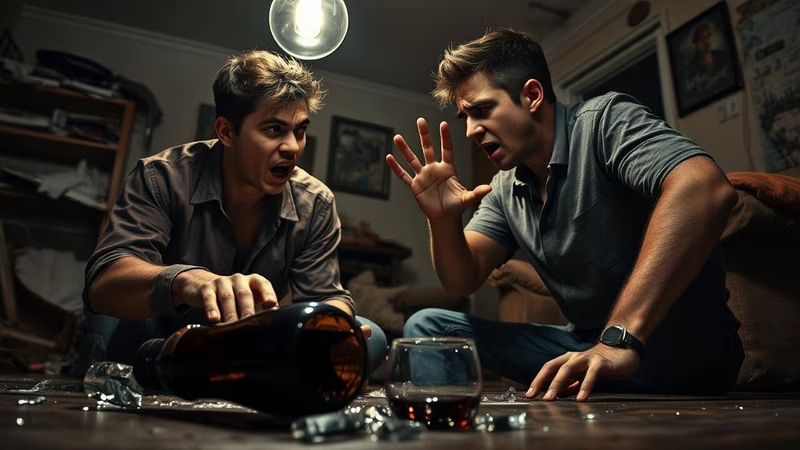
It started with a simple question: “Who’s getting the liquor?”
For most friends, it’s a harmless debate settled with a coin toss or a round of jokes. But in a dimly lit room in Lucknow on a cold January night in 2026, that question sparked a chain of events so brutal it defies belief. Within hours, 28-year-old Sachin Tiwari was dead—his throat slit, his body doused in kerosene, and set ablaze in a desperate attempt to erase the crime. The perpetrators? His own friends.
This isn’t fiction. It’s the chilling reality of the Lucknow murder over liquor that has sent shockwaves through Uttar Pradesh and reignited debates about alcohol-fueled violence, toxic masculinity, and the fragility of trust among so-called companions.
Table of Contents
- The Crime: From Argument to Arson
- How Lucknow Police Cracked the Case in 72 Hours
- Who Are the Accused?
- The Dangerous Link Between Alcohol and Violent Crime
- What Charges Do They Face?
- Conclusion: A Tragic Reminder of Impulse and Rage
- Sources
The Crime: From Argument to Arson
According to police reports, the incident occurred in the Gomti Nagar area of Lucknow on the night of January 12, 2026 . Sachin Tiwari had gathered with two close friends—identified as Rahul Singh (29) and Vikas Yadav (31)—for what was supposed to be a casual evening of drinking.
But tensions flared when the group ran out of alcohol. An argument erupted over who should go out to buy more. What began as shouting quickly turned physical. In a fit of rage, the accused allegedly assaulted Tiwari, striking him repeatedly before slashing his throat with a sharp weapon .
Fearing consequences, the duo then dragged Tiwari’s body to a secluded spot behind a nearby building, poured kerosene over it, and set it on fire—hoping the flames would consume all traces of their crime.
How Lucknow Police Cracked the Case in 72 Hours
The charred remains were discovered by a municipal worker early the next morning. Initial suspicion pointed to accidental death or suicide, but forensic examination revealed deep ligature marks and a fatal neck wound inconsistent with self-harm .
Using CCTV footage from nearby shops and mobile tower pings, the Special Task Force (STF) of Lucknow Police zeroed in on Rahul and Vikas within 24 hours. Their suspicious behavior—deleting call logs, changing SIM cards, and avoiding family—raised red flags.
During interrogation, both broke down and confessed. “They admitted the murder was impulsive but premeditated in its cover-up,” said Deputy Commissioner of Police (East), A.K. Sharma . The duo was arrested on January 15, just 72 hours after the crime.
Who Are the Accused?
Rahul Singh, a delivery executive, and Vikas Yadav, a part-time mechanic, were known to Tiwari for over five years. All three hailed from the same neighborhood and were often seen together at local bars. Neighbors described them as “rowdy but not violent”—a grim reminder that brutality can hide behind ordinary faces.
Notably, both accused have prior records: Rahul for public intoxication in 2023, and Vikas for a minor assault case in 2024. Neither had any known enmity with the victim—making the motive even more disturbingly trivial.
The Dangerous Link Between Alcohol and Violent Crime
This case is not isolated. Studies consistently show a strong correlation between alcohol consumption and interpersonal violence. According to the National Crime Records Bureau (NCRB), over 32% of violent crimes in India involve alcohol as a contributing factor .
Alcohol impairs judgment, lowers inhibitions, and amplifies aggression—especially in individuals with underlying anger issues or poor emotional regulation. In group settings, it can turn minor disagreements into life-or-death confrontations.
As Dr. Meena Kapoor, a forensic psychologist at King George’s Medical University (KGMU), explains: “When intoxicated, the brain’s prefrontal cortex—the seat of rational decision-making—shuts down. What remains is raw emotion. And in some, that emotion is rage.”
What Charges Do They Face?
Rahul and Vikas have been booked under multiple sections of the Indian Penal Code (IPC):
- Section 302: Punishment for murder (life imprisonment or death penalty)
- Section 201: Causing disappearance of evidence (up to 7 years imprisonment)
- Section 34: Acts done by several persons in furtherance of common intention
Given the brutality and attempted destruction of evidence, prosecutors are likely to seek the maximum sentence. The case will be fast-tracked under Uttar Pradesh’s stringent anti-crime protocols.
Conclusion: A Tragic Reminder of Impulse and Rage
The Lucknow murder over liquor is more than a crime story—it’s a cautionary tale about how quickly camaraderie can curdle into carnage under the influence. Sachin Tiwari didn’t die over politics, money, or betrayal. He died because his friends couldn’t handle a moment of frustration.
In a society where binge drinking is often glamorized, this case forces us to confront the dark side of intoxication: the loss of control, the erosion of empathy, and the irreversible cost of a single bad decision. As authorities push for stricter enforcement of liquor laws and better mental health awareness, one truth remains: no bottle of alcohol is worth a human life.
For more on crime prevention and social responsibility, see our feature on [INTERNAL_LINK:alcohol-abuse-and-public-safety-in-india].