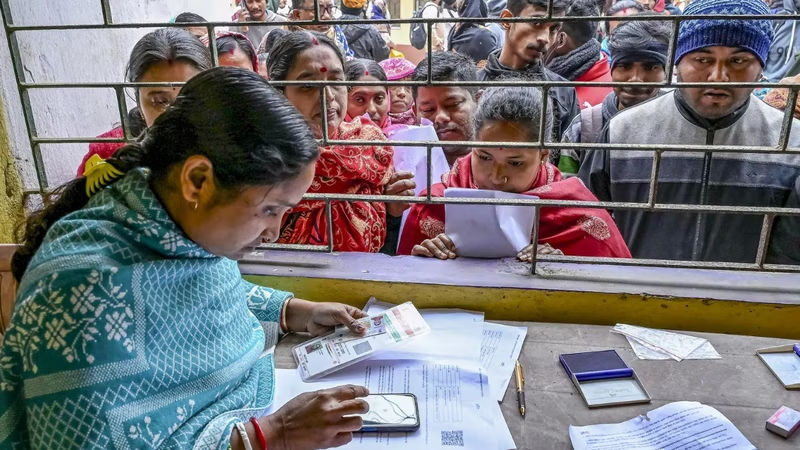
Imagine waking up one morning to discover your name has vanished from the electoral rolls—not because you moved, not because you’re ineligible, but because a system flagged you as ‘unverified.’ For over **1 crore Indian voters**, this isn’t a hypothetical scenario. It’s reality.
As part of a nationwide voter list cleanup ahead of the 2026 state and 2029 general elections, the Election Commission of India (ECI) has placed more than 10 million citizens in an ‘unmapped’ category, requiring them to submit fresh documentation to retain their voting rights. And nowhere is this purge more intense than in **Lucknow**, the capital of Uttar Pradesh, which now holds the dubious distinction of reporting the **highest voter deletion rate in the country—30%**.
This unprecedented scale of **voter deletions** has ignited a fierce debate: Is this a necessary housekeeping exercise or a threat to inclusive democracy?
Table of Contents
- Lucknow Leads the Nation in Voter Deletions
- What Are ‘Unmapped Voters’—And Why It Matters
- Official Reasons Behind the Mass Deletions
- State-by-State Comparison: How Lucknow Stands Out
- Enumeration Deadline Extended—Twice
- Criticism from Opposition and Civil Society
- How to Check Your Voter Status & What to Do Next
- Conclusion: Balance Between Accuracy and Inclusion
- Sources
Lucknow Leads the Nation in Voter Deletions
According to internal Election Commission data cited by the Times of India, **30% of registered voters in Lucknow** have been marked for deletion or placed in the ‘unmapped’ category. That means nearly one in three voters in the city—home to over 2.5 million registered electors—must now prove their residential address and identity to stay on the rolls.
While voter list revisions happen regularly, the scale and speed of this exercise are extraordinary. In Lucknow, the primary reason cited is ‘permanently shifted’—a classification used when voters are believed to have moved out of their constituency permanently without updating their address.
What Are ‘Unmapped Voters’—And Why It Matters
‘Unmapped voters’ are individuals whose residential details could not be verified during the door-to-door enumeration process conducted by Booth Level Officers (BLOs). This typically happens when:
- The voter isn’t found at their registered address during verification visits.
- Neighbors or building managers report the person has moved away.
- No one responds to the verification notice.
Being labeled ‘unmapped’ doesn’t mean immediate deletion—but it’s the first step toward removal. These voters will now receive formal notices asking them to submit proof of residence (like an electricity bill, Aadhaar, or passport) within a stipulated period. Failure to respond could lead to permanent removal from the electoral roll.
Official Reasons Behind the Mass Deletions
The Election Commission insists this is a routine, technical exercise aimed at ensuring ‘accuracy and integrity’ of the electoral rolls. Key justifications include:
- Migration tracking: Urban centers like Lucknow have seen massive internal migration. The EC aims to remove voters who no longer reside in the constituency.
- Duplicate entries: Some voters are registered in multiple locations, which violates electoral law.
- Deceased voters: Despite efforts, thousands of deceased individuals remain on rolls and must be purged.
Notably, the EC claims that in Lucknow, the proportion of ‘permanently shifted’ voters is **nearly double that of Bihar**, another state with high internal migration—suggesting localized administrative or demographic factors are at play.
State-by-State Comparison: How Lucknow Stands Out
While voter deletions are happening nationwide, Lucknow’s 30% rate is an outlier:
- Bihar: ~16% marked as shifted.
- West Bengal: ~12% in major urban wards.
- Delhi: ~9–11% in constituencies like East Delhi.
Experts point to Lucknow’s rapid urbanization, real estate boom, and high tenant turnover as possible explanations. “In cities with fluid populations, verification becomes extremely challenging,” notes Dr. Anupama Roy, a political scientist at Jawaharlal Nehru University who studies citizenship and voting rights .
Enumeration Deadline Extended—Twice
Originally, the deadline for completing the final voter list was set for November 2025. However, due to the overwhelming number of exclusions and public outcry, the **Election Commission extended the enumeration deadline twice**—first to December 2025, and then to January 2026.
This delay underscores the logistical burden of verifying over a crore voters. Booth Level Officers across India are now conducting follow-up visits and setting up help desks to assist citizens in restoring their names.
Criticism from Opposition and Civil Society
Opposition parties and civil society groups have raised serious concerns:
- Disproportionate impact: Deletions appear concentrated in opposition-held or marginal constituencies.
- Lack of transparency: Many voters claim they never received verification visits or notices.
- Risk of disenfranchisement: Poor, elderly, and migrant workers—who may lack formal address proofs—are most vulnerable.
“Cleaning rolls is necessary, but not at the cost of excluding legitimate voters,” said a statement from the All India People’s Resistance Forum. The Association for Democratic Reforms (ADR) has called for an independent audit of the deletion process [[INTERNAL_LINK:india-electoral-reforms-2026]].
How to Check Your Voter Status & What to Do Next
If you’re a voter in Lucknow or any other affected area, act now:
- Visit the National Voter’s Service Portal: https://www.nvsp.in/
- Use the ‘Search Your Name in Electoral Roll’ feature.
- If your status shows ‘unmapped’ or ‘objection raised,’ download Form 6/8.
- Submit proof of residence at your local Electoral Registration Officer (ERO) office or online.
The ECI has also launched a helpline and mobile app to assist voters during this period.
Conclusion: Balance Between Accuracy and Inclusion
The **voter deletions** in Lucknow and across India highlight a fundamental tension in electoral management: the need for clean, accurate rolls versus the imperative to include every eligible citizen. While the Election Commission’s intent may be administrative, the consequences are deeply political and social.
As the deadline looms, millions of Indians must navigate a bureaucratic process to reclaim a basic democratic right. The true test of this exercise won’t be how many names are removed—but how many legitimate voters are able to stay on the list, ensuring that democracy remains as inclusive as it is efficient.
Sources
- Times of India. “At 30%, Lucknow reports highest per cent of deletions.” https://timesofindia.indiatimes.com/…
- Election Commission of India. “Frequently Asked Questions on Electoral Rolls.” https://eci.gov.in/
- Association for Democratic Reforms (ADR). “Electoral Roll Integrity and Voter Inclusion.” https://adrindia.org/