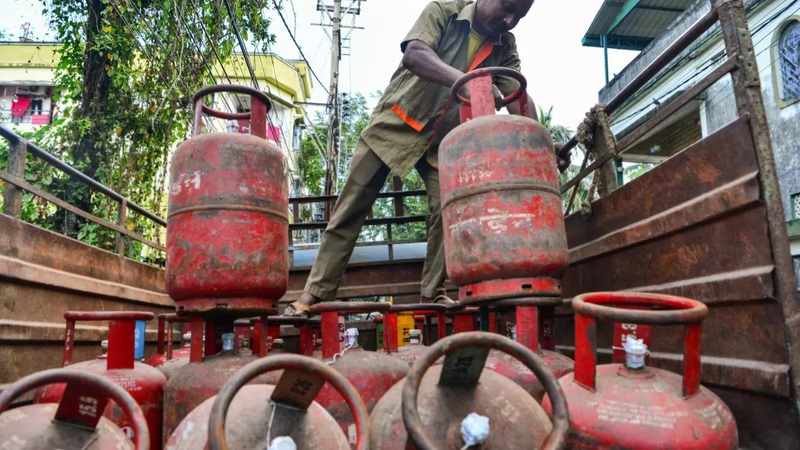
If you run a restaurant, a small dhaba, or any business that relies on cooking gas, brace yourself. The latest LPG price hike has just landed—and it’s a big one. Commercial LPG cylinders are now ₹111 more expensive, a jump that’s bound to squeeze profit margins already under pressure from inflation and rising input costs .
This isn’t just a minor adjustment. It’s a substantial increase that will ripple through the food service industry, from street vendors to high-end hotels. While domestic LPG users (those with subsidized cylinders) have been spared this round of increases, the commercial sector is bearing the full brunt of volatile international fuel markets. Let’s break down what’s changed, where, and what it means for your wallet.
Table of Contents
- The New LPG Price Hike: What Are the Numbers?
- City-by-City Breakdown of Commercial LPG Prices
- Why Is This LPG Price Hike Happening?
- Domestic vs. Commercial LPG: A Growing Gap
- Impact on Small Businesses and the Economy
- What Business Owners Can Do to Adapt
- Conclusion: Navigating the Fuel Cost Squeeze
- Sources
The New LPG Price Hike: What Are the Numbers?
The state-owned oil marketing companies—Indian Oil Corporation (IOCL), Bharat Petroleum (BPCL), and Hindustan Petroleum (HPCL)—have announced a uniform increase in the price of non-subsidized, 19-kg commercial LPG cylinders .
The hike is a flat ₹111 across the board. This means the new price for a commercial cylinder is now in the range of ₹2,050 to ₹2,150, depending on your city’s local taxes and logistics costs. For a small eatery that might use two or three cylinders a week, this translates to an extra monthly expense of roughly ₹900 to ₹1,300—a significant sum for a tight-margin business.
City-by-City Breakdown of Commercial LPG Prices
The new LPG rates have taken effect from January 1, 2026. Here’s a snapshot of the updated commercial cylinder prices in some of India’s major metropolitan areas :
| City | New Commercial LPG Price (₹) |
|---|---|
| Delhi | 2,093 |
| Mumbai | 2,102 |
| Kolkata | 2,118 |
| Chennai | 2,105 |
| Bangalore | 2,099 |
| Hyderabad | 2,095 |
As you can see, while the base price hike is uniform, the final cost to the consumer varies slightly due to state-level VAT and transportation expenses. Businesses in eastern and southern cities appear to be paying a marginal premium.
Why Is This LPG Price Hike Happening?
The primary driver behind this latest LPG price hike is the global market. India imports over 60% of its LPG requirements, making domestic prices highly sensitive to international crude oil and LPG benchmarks .
Several factors are at play:
- Rising International LPG Prices: Global LPG prices have been on an upward trend due to increased demand from industrial sectors in Asia and supply constraints.
Seasonal Demand: The winter months in the Northern Hemisphere typically see a spike in LPG demand for heating, pushing global prices higher. - Currency Fluctuations: A weaker Indian Rupee against the US Dollar also makes imports more expensive.
Oil marketing companies revise commercial LPG prices on a monthly basis to reflect these international cost changes, and this month’s revision is one of the steepest in recent times.
Domestic vs. Commercial LPG: A Growing Gap
It’s important to note that this price increase applies only to the non-subsidized, 19-kg commercial cylinders. The price of the standard 14.2-kg domestic LPG cylinder, which is partially subsidized by the government for eligible households, has remained unchanged .
This policy creates a widening gap between the two segments. The government aims to shield common households from global fuel volatility, but the burden is shifted entirely onto the commercial sector—small business owners who are also citizens facing the same economic pressures. This dichotomy is a growing point of discussion among economists and industry bodies.
Impact on Small Businesses and the Economy
For a small restaurant owner or a catering service, energy is a major operational cost. A sudden 5-6% increase in their LPG bill can be the difference between a modest profit and a loss for the month.
The likely consequences are a difficult choice: either absorb the cost, which hurts their bottom line, or pass it on to consumers through higher menu prices. The latter could lead to a reduction in customer footfall, especially in a price-sensitive market like India. In the worst case, it could force some of the smallest operators out of business, contributing to a larger informal sector contraction—a concerning trend for the overall health of the Indian economy .
What Business Owners Can Do to Adapt
While they can’t control global oil prices, businesses can take proactive steps to manage this new reality:
- Energy Efficiency Audits: Check stoves and pipelines for leaks. A simple maintenance check can save significant gas.
- Explore Alternatives: Investigate if switching to piped natural gas (PNG) or even induction cooking is a viable, long-term option in your location.
- Negotiate with Suppliers: If you use a large volume of cylinders, try to negotiate a better rate or a longer-term contract to lock in prices.
- Budget and Plan Ahead: Factor in this new cost into your financial projections to avoid future cash flow surprises.
Conclusion: Navigating the Fuel Cost Squeeze
The latest LPG price hike is a stark reminder of how global economic forces can directly impact local businesses. While the government’s decision to protect household consumers is understandable, the commercial sector is left to navigate this challenging landscape on its own. For small business owners, adaptability and efficiency will be key to weathering this storm. As the year 2026 begins, managing operational costs like fuel will be more critical than ever for survival and growth. Stay informed and plan wisely. For more on managing business expenses, see our guide on [INTERNAL_LINK:small-business-cost-saving-tips].
Sources
- Times of India: LPG price hike: Commercial cylinder becomes Rs 111 costlier — check new prices
- Ministry of Petroleum and Natural Gas, Government of India: Official Website
- World Bank Commodity Markets Outlook: Global LPG Price Trends
- Reserve Bank of India (RBI) Bulletin: Impact of Fuel Prices on Inflation and Small Businesses