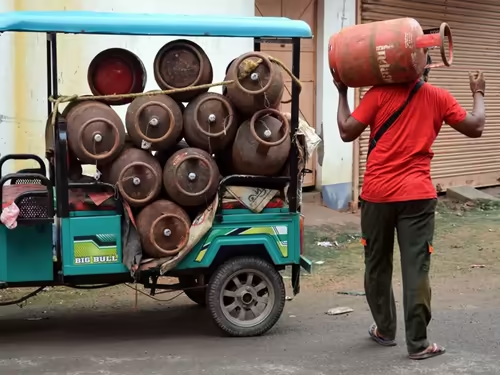
Starting today—February 1, 2026—India’s hospitality and food service sectors are facing a fresh financial pinch. The price of a 19-kg commercial LPG cylinder has been hiked by **₹49**, pushing the cost in Delhi to **₹1,740.50**. This marks the second increase in just a few months, reversing a brief period of relief and reigniting concerns about rising input costs for millions of small and medium enterprises (SMEs) that rely on cooking gas to keep their operations running.
While households using subsidized 14.2-kg domestic cylinders remain unaffected—for now—the latest LPG price hike is a stark reminder of the volatile global energy market and its disproportionate impact on business owners already grappling with inflation, labor shortages, and thin margins. From roadside dhabas to urban cloud kitchens, the ripple effects could be significant. Let’s break down what’s driving this change, who it affects most, and what businesses can do to cope.
Table of Contents
- What Changed in the LPG Price Hike?
- Why Commercial LPG Prices Are Rising
- LPG Price Hike: Who Is Affected Most?
- Domestic vs Commercial LPG: Key Differences
- Historical Trend of LPG Prices in India
- How Businesses Can Mitigate the Impact
- Government Response and Policy Options
- Conclusion: Navigating the Fuel Cost Squeeze
- Sources
What Changed in the LPG Price Hike?
Effective February 1, 2026, oil marketing companies (OMCs) like Indian Oil, Bharat Petroleum, and Hindustan Petroleum have revised the price of non-subsidized commercial LPG cylinders upward by **₹49 per 19-kg unit**. In Delhi, this brings the new price to **₹1,740.50**, up from ₹1,691.50 [[1]].
This follows an earlier hike of **₹111** in late 2025, meaning commercial users have now absorbed a total increase of **₹160** in under three months. Notably, **domestic LPG cylinder prices remain unchanged at ₹903** in Delhi, as they continue to be partially insulated by government subsidies under the PAHAL scheme [[2]].
Why Commercial LPG Prices Are Rising
Unlike domestic cylinders, commercial LPG prices are **market-linked** and revised monthly based on international benchmark rates and currency fluctuations. The recent surge is driven by:
- Rising global crude oil prices: Brent crude has hovered above $85/barrel due to OPEC+ supply cuts and Middle East tensions.
- Stronger import parity pricing (IPP): India imports over 60% of its LPG, making domestic prices sensitive to global trends.
- Weaker rupee: The INR has depreciated against the dollar, increasing import costs.
According to the Petroleum Planning & Analysis Cell (PPAC), the import price of LPG rose by 4.2% in January 2026 alone [[3]].
LPG price hike: Who Is Affected Most?
The burden falls squarely on businesses that depend on LPG for daily operations:
- Restaurants & Hotels: From fine dining to budget eateries, gas is essential for cooking. A mid-sized restaurant using 4–5 cylinders/month now pays nearly ₹200 more monthly—costs often passed to consumers via menu inflation.
- Street Food Vendors: Margins are razor-thin; even a ₹50 increase can force price hikes or reduced portions.
- Catering Services & Cloud Kitchens: High-volume operations face amplified cost pressures.
- <Small Bakeries & Sweet Shops: Many still rely on LPG ovens due to unreliable electricity in semi-urban areas.
Domestic vs Commercial LPG: Key Differences
It’s crucial to understand why only businesses are impacted:
| Feature | Domestic LPG | Commercial LPG |
|---|---|---|
| Subsidy | Yes (under PAHAL) | No |
| Price Control | Government-regulated | Market-determined |
| Cylinder Size | 14.2 kg | 19 kg (or 5 kg/10 kg variants) |
| User Base | Households | Hotels, restaurants, industries |
This dual pricing system shields consumers but leaves businesses exposed to global volatility.
Historical Trend of LPG Prices in India
Over the past decade, commercial LPG prices have seen dramatic swings:
- 2020: Dropped to ₹1,300 during pandemic-induced demand crash.
- 2022: Peaked at ₹2,003 due to Russia-Ukraine war.
- 2024–2025: Gradual decline to ₹1,580 amid stable crude prices.
- 2026: Sharp reversal with back-to-back hikes [[4]].
This volatility makes long-term budgeting difficult for SMEs.
How Businesses Can Mitigate the Impact
Experts recommend several strategies:
- Switch to piped natural gas (PNG): Where available, PNG offers 15–20% cost savings and stable pricing.
- Energy-efficient stoves: Modern burners can reduce gas consumption by up to 30%.
- Bulk procurement deals: Negotiate annual contracts with suppliers for fixed rates.
- Diversify fuel sources: Hybrid systems using solar or induction for certain tasks.
However, infrastructure gaps limit these options in many regions.
Government Response and Policy Options
While the government has not indicated plans to subsidize commercial LPG, industry bodies like the National Restaurant Association of India (NRAI) are urging policy intervention, such as:
- Tax rationalization on commercial LPG (currently taxed at 5% GST plus VAT in some states).
- Interest-free loans for SMEs to adopt cleaner, cheaper alternatives.
- Accelerated rollout of city gas distribution (CGD) networks.
Conclusion: Navigating the Fuel Cost Squeeze
The latest LPG price hike is more than a line item on a ledger—it’s a stress test for India’s entrepreneurial backbone. While households enjoy temporary reprieve, businesses must absorb yet another shock in an already strained economic climate. Without structural solutions, repeated fuel price volatility will continue to erode competitiveness and inflate consumer prices. For now, adaptability, efficiency, and advocacy remain the best tools for survival.
Sources
- Times of India. “LPG gas prices go up: Commercial cylinder to cost Rs 49 more from February 1.” https://timesofindia.indiatimes.com/…
- Ministry of Petroleum and Natural Gas. “PAHAL Scheme – Direct Benefit Transfer for LPG.” https://petroleum.nic.in/…
- Petroleum Planning & Analysis Cell (PPAC). “LPG Import Parity Price – January 2026.” https://ppac.gov.in
- Reserve Bank of India. “Monthly Economic Review – Energy Price Trends.” https://rbi.org.in
- National Restaurant Association of India (NRAI). “Policy Brief: Impact of Fuel Costs on F&B Sector, 2026.” https://www.nrai.org
- [INTERNAL_LINK:lpg-vs-png-for-restaurants]
- [INTERNAL_LINK:how-to-apply-for-commercial-lpg-cylinder]