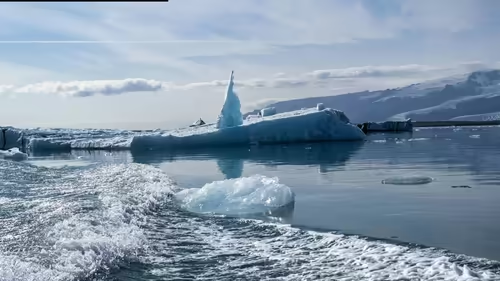
Life Under the Arctic Ice Is Thriving—And Moving in Shocking Ways Scientists Never Predicted
For decades, scientists believed the world beneath the Arctic sea ice was a slow, stable, and largely dormant ecosystem—a frozen desert where life clung to survival in near-total darkness. But groundbreaking new observations are turning that assumption on its head. Researchers have discovered that life under Arctic ice is not just present—it’s highly dynamic, mobile, and responding to climate change in ways no one expected.
Table of Contents
- The Old Assumption: A Frozen Wasteland
- New Discoveries: A Bustling Hidden World
- Why Is This Happening? Climate Change and Thinning Ice
- Surprising Migrations of Arctic Species
- Implications for Global Ocean Health
- How Scientists Are Studying the Ice Edge
- Conclusion: A Wake-Up Call from the Poles
- Sources
The Old Assumption: A Frozen Wasteland
Traditional oceanography textbooks described the underside of Arctic sea ice as a quiet refuge—home to specialized algae, tiny crustaceans like amphipods, and the occasional polar cod. Because sunlight barely penetrates thick ice for much of the year, productivity was thought to be minimal outside the brief summer melt season. Life was assumed to be sparse, slow-moving, and highly localized.
This view shaped decades of polar research, conservation strategies, and climate models. But as the Arctic warms at four times the global average rate, that static picture is crumbling—literally and biologically.
New Discoveries: A Bustling Hidden World
Using advanced underwater drones, sonar mapping, and time-lapse imaging beneath the ice, scientists from institutions like the Alfred Wegener Institute and NASA’s ICESCAPE project have captured astonishing footage: swarms of zooplankton darting through brine channels, schools of fish navigating complex ice labyrinths, and even unexpected visitors like Atlantic krill appearing far north of their historic range.
Most surprisingly, researchers observed coordinated movements of entire communities—entire food webs shifting position over days or weeks, not seasons. “We used to think these ecosystems were glued in place,” said Dr. Anya Petrova, a marine ecologist with the Norwegian Polar Institute. “Now we see they’re fluid, responsive, and far more resilient—or vulnerable—than we imagined.”
Why Is This Happening? Climate Change and Thinning Ice
The driver behind this transformation is clear: rapid Arctic warming. Since 1980, summer sea ice extent has declined by over 40%. The ice that remains is thinner, younger, and more porous—allowing more light to penetrate earlier in the year. This jump-starts photosynthesis, triggering algal blooms under the ice months before scientists previously thought possible.
This early bloom creates a ripple effect:
- Zooplankton populations surge in response to abundant food.
- Fish and seabirds adjust migration timing to exploit this new resource window.
- Species from warmer waters (like Atlantic copepods) move northward, competing with native Arctic species.
What’s emerging isn’t just a changed ecosystem—it’s a reconfigured one, with new winners, losers, and unpredictable interactions.
Surprising Migrations of Arctic Species
One of the most startling findings is the mobility of organisms once thought to be sedentary. Tiny ice-algae, for instance, aren’t just passively drifting—they’re actively colonizing new ice patches via ocean currents. Even benthic (seafloor) creatures like sea cucumbers and brittle stars are showing signs of range shifts as bottom temperatures rise.
Meanwhile, apex predators are taking notice. Bowhead whales—known for their longevity and deep knowledge of Arctic feeding grounds—are altering their routes to follow shifting prey concentrations under the ice. This behavioral flexibility may be key to their survival, but it also signals a system in flux.
Implications for Global Ocean Health
The changes under the Arctic ice don’t stay in the Arctic. The region acts as a climate regulator and a nursery for globally important fish stocks. Disruptions here can cascade through ocean food webs, affecting fisheries as far south as Europe and North America.
Moreover, the Arctic’s role in carbon sequestration is being rewritten. If under-ice algal blooms become more frequent and widespread, they could absorb more CO₂—but if warming outpaces adaptation, the entire system could collapse, releasing stored carbon instead. As the NOAA Arctic Program warns, “The Arctic is the canary in the coal mine for planetary health.”
How Scientists Are Studying the Ice Edge
Studying life under Arctic ice is notoriously difficult. Traditional methods—like drilling holes or using submersibles—are expensive, dangerous, and limited in scope. But new technologies are revolutionizing the field:
- Autonomous Underwater Vehicles (AUVs) equipped with cameras and sensors can map vast areas under the ice for weeks at a time.
- Environmental DNA (eDNA) sampling allows scientists to detect species presence from water samples, even without seeing them.
- Satellite-linked ice buoys now transmit real-time data on temperature, salinity, and biological activity from beneath the ice.
These tools are giving researchers an unprecedented window into one of Earth’s last frontiers.
Conclusion: A Wake-Up Call from the Poles
The revelation that life under Arctic ice is not only alive but actively on the move is more than a scientific curiosity—it’s a profound warning. It shows that even the most remote and seemingly stable ecosystems are responding rapidly to human-driven climate change. What happens in the Arctic doesn’t stay in the Arctic; it echoes across the globe. Understanding these hidden dynamics isn’t just about saving polar bears—it’s about safeguarding the health of our entire planet. For more on climate tipping points, explore our deep dive at [INTERNAL_LINK:arctic-climate-tipping-points].