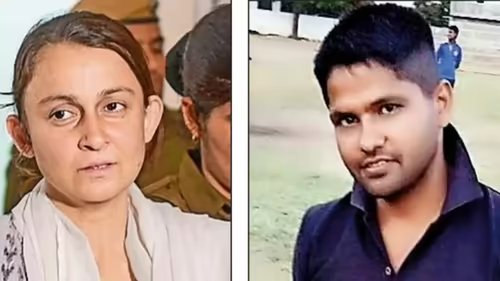
When Love Blooms Behind Bars: A Wedding That’s Dividing a Nation
It sounds like a plot from a gritty crime drama, but it’s real life in Rajasthan. Two people, each convicted of a brutal murder and sentenced to life imprisonment, are preparing to tie the knot. This isn’t just a personal milestone; it’s a seismic event that’s forcing us to confront tough questions about our justice system. How did this happen? And is it just? At the heart of this storm is the unprecedented decision to allow these life-term convicts to marry.
Table of Contents
- Who Are Priya Seth and Hanuman Prasad?
- The Love Story: From Open Jail to Altar
- Legal Framework: Can Convicts Really Get Parole for Marriage?
- The Victim Family’s Plea: A Different Side of Justice
- Public Debate: Rehabilitation vs. Punishment
- Conclusion: A Complex Chapter in Indian Justice
- Sources
Who Are Priya Seth and Hanuman Prasad?
Their crimes are as chilling as their love story is unexpected. Priya Seth (34), also known as Neha Seth, was the central figure in the high-profile 2018 Dushyant Sharma murder case in Jaipur. She was convicted of luring Sharma through a dating app before orchestrating his murder . Her co-accused, Dikshant Kamra and Lakshya Walia, were also sentenced to life imprisonment .
Her fiancé, Hanuman Prasad (29), is serving a life term for a separate 2017 murder in Alwar . Both have been serving their sentences, but not in a traditional, high-security prison. They were transferred to Jaipur’s Sanganer Open-Air Camp, a facility designed for convicts who have shown good conduct and have served a significant portion of their sentence .
The Love Story: From Open Jail to Altar
It was within the relatively liberal confines of the Sanganer Open-Air Camp that Priya Seth and Hanuman Prasad met and developed a relationship . The open jail system in Rajasthan is predicated on trust and rehabilitation, allowing inmates more freedom and responsibility than in closed prisons . This environment, while intended for reform, became the unlikely setting for their romance.
Seeking to formalize their relationship, the couple petitioned the Rajasthan High Court for parole to get married. In a landmark decision, the court granted them a 15-day parole period, with their wedding scheduled for January 23, 2026, in the Baroda Mev area of Alwar . The District Parole Advisory Committee subsequently approved the request based on the court’s order .
Legal Framework: Can Convicts Really Get Parole for Marriage?
This case isn’t pulled from thin air. The Rajasthan High Court has, in previous judgments, recognized the emotional and social needs of prisoners. While the specific rule for marriage isn’t always explicit, the court has held that a convict’s right to a dignified life can extend to such personal milestones under certain circumstances .
The Rajasthan Prisoners Open Air Camp Rules, 1972, govern the functioning of these unique facilities. A six-member committee is responsible for deciding on inmate transfers to these camps, which are generally reserved for those who have shown good behavior . However, the rules also state that unmarried prisoners are typically not permitted to be shifted to these camps, a point that adds another layer of complexity to this case . The court’s decision appears to be a compassionate override of standard procedure, prioritizing a human right over a rigid rule.
The Victim Family’s Plea: A Different Side of Justice
While the state machinery moves forward with the wedding plans, there is a heart-wrenching counter-narrative. The family of Dushyant Sharma, Priya Seth’s victim, is vehemently opposed to the parole decision . For them, this act feels like a fresh wound, a celebration for the person who took their loved one’s life. Their opposition is a stark reminder that justice isn’t just an abstract legal concept; it’s deeply personal and often painful for those left behind. Their plea represents the core tension in this case: the balance between a convict’s path to rehabilitation and a victim’s enduring quest for closure.
Public Debate: Rehabilitation vs. Punishment
This wedding has sparked a national conversation. Proponents of the decision argue that the open jail system’s very purpose is rehabilitation. Allowing a convict to form a family, they say, is a powerful incentive for good behavior and a step towards eventual reintegration into society. It’s a belief that people can change.
On the other hand, critics see this as a dangerous precedent that trivializes the gravity of their crimes. They question whether someone who has taken a life deserves such a privilege, especially when the victim’s family is still suffering. The debate cuts to the core of what we want our prison system to achieve: pure punishment or a chance for redemption?
Conclusion: A Complex Chapter in Indian Justice
The upcoming marriage of these two life-term convicts to marry is far more than a personal event. It’s a complex social experiment playing out in real-time. It forces us to examine our own beliefs about crime, punishment, and the possibility of human transformation. While the law has provided a pathway, the court of public opinion remains deeply divided. As they exchange vows, the nation will be watching, grappling with the uncomfortable, yet essential, questions their story raises. For more on India’s criminal justice system, explore [INTERNAL_LINK:indian-legal-system-overview].
Sources
[1] Times of India: A match made in open jail
[4] Web Search Result on Rajasthan High Court parole order
[9] Web Search Result on Rajasthan Prisoners Open Air Camp Rules, 1972
[12] Web Search Result on Open Air Camp management
[14] Web Search Result on Open prisons policy in Rajasthan
[16] Web Search Result on Rajasthan HC conjugal rights judgment
[20] Web Search Result on Sanganer Open-Air Camp eligibility
[22] Web Search Result on victim family’s opposition
[24] Web Search Result on details of the murder cases
[25] Web Search Result on Dushyant Sharma case sentencing
[26] Web Search Result on Parole Advisory Committee approval
For an authoritative overview of global prison systems and human rights, refer to the United Nations Office on Drugs and Crime (UNODC): https://www.unodc.org/