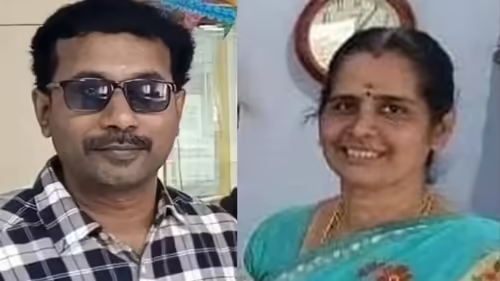
In the heart of Madurai, a routine day at the Life Insurance Corporation (LIC) office turned into a scene of unimaginable horror. Senior Branch Manager A. Kalyani Nambi, a respected 56-year-old professional, was found charred to death in what was initially reported as a devastating fire accident . But the truth was far more sinister. This wasn’t an accident; it was a meticulously planned execution—the LIC murder case that would soon capture national attention.
The story is a grim reminder of the dark corners where professional ambition and personal greed can collide with deadly consequences. Let’s dive deep into how this heinous crime was orchestrated and, more importantly, how the police unraveled a web of lies to expose a murderer.
Table of Contents
- The Tragic Incident: From Fire to Foul Play
- The Motive: A Tangled Web of Death Claim Fraud
- How the Case Unraveled: Inconsistencies and Confessions
- Arson vs. Accident: The Science Behind the Discovery
- Conclusion: A Stark Warning for Corporate India
- Sources
The Tragic Incident: From Fire to Foul Play
On a fateful day in December 2025, a fire broke out in the LIC office in Madurai. While administrative officer D. Ram, 44, managed to escape with burn injuries, his senior colleague, A. Kalyani Nambi, was not so fortunate. She was trapped inside and succumbed to her injuries . The immediate narrative pointed towards a tragic electrical short circuit or an accidental fire. However, seasoned investigators sensed something was off.
The circumstances were suspicious from the start. Reports later confirmed that the main power supply to the building had been cut, and crucially, the exits were locked from the outside . This wasn’t just bad luck; it was a trap. The victim was deliberately isolated, leaving her with no means of escape. This initial red flag prompted a deeper, more forensic investigation that would soon shift the entire case from an accident file to a murder docket.
The Motive: A Tangled Web of Death Claim Fraud
So, why would a colleague commit such a brutal act? The answer lay in the very core of their work: insurance death claims. Kalyani Nambi, a diligent and experienced manager, had reportedly flagged serious irregularities in around 40 death claim files that were being processed by D. Ram . Her scrutiny threatened to expose a significant fraud, potentially implicating Ram in financial misconduct and dereliction of duty.
To understand the gravity of this, it’s important to know how the LIC death claim process works. It involves meticulous verification of documents like the original policy, death certificate, and claim forms . Any attempt to bypass these checks or process fraudulent claims is a serious criminal offense. For Ram, Kalyani Nambi wasn’t just a supervisor; she was an existential threat to his career and freedom. His solution was horrifyingly simple: eliminate the problem permanently.
How the Case Unraveled: Inconsistencies and Confessions
The turning point in the LIC murder case came from the suspect himself. D. Ram’s initial statement to the police was riddled with inconsistencies. His account of the fire’s origin and his own actions during the emergency didn’t add up. Under sustained and intense interrogation, the facade began to crumble .
Investigators then made a critical discovery: multiple bottles filled with petrol were found hidden in Ram’s cabin . This was the smoking gun—a clear indicator of premeditation. Confronted with this irrefutable physical evidence and his own shaky testimony, Ram finally confessed to the crime. He admitted to dousing Kalyani Nambi with petrol and setting her ablaze, all in a desperate bid to destroy the incriminating files and silence her forever .
Key Steps in the Investigation
- Initial Suspicion: Locked exits and a cut power supply raised immediate red flags.
- Forensic Evidence: Discovery of petrol bottles in the suspect’s cabin provided concrete proof of intent.
- Interrogation & Confession: Persistent questioning exposed contradictions in the suspect’s story, leading to a full confession.
Arson vs. Accident: The Science Behind the Discovery
This case is a textbook example of how modern forensic science can differentiate between a tragic accident and a deliberate act of arson. Fire investigators are trained to look for specific indicators that point towards foul play .
One of the most telling signs is the use of accelerants like petrol. These substances cause fires to burn with an unusual intensity and speed, leaving behind distinct chemical residues that can be detected even after the flames are extinguished . The discovery of the petrol bottles in Ram’s cabin was a direct link to this method.
Furthermore, the pattern of the fire’s spread and the point of origin are crucial clues. An accidental fire from an electrical fault would have a different burn pattern compared to a fire intentionally started with a liquid accelerant at a specific location . The fact that Kalyani Nambi was found in a confined space, with no escape route, strongly suggested the fire was set to ensure her death, not as a random event.
Conclusion: A Stark Warning for Corporate India
The LIC murder case is more than just a crime story; it’s a chilling cautionary tale. It underscores the critical importance of robust internal audit systems and whistleblower protections within large organizations. A vigilant employee like A. Kalyani Nambi paid the ultimate price for doing her job with integrity.
For the public, this case also highlights the incredible work of forensic investigators who can see through a carefully staged crime scene. What was meant to look like a simple fire accident was, in reality, a complex murder plot that was meticulously deconstructed by the authorities. The swift resolution of this case serves as a powerful reminder that justice, though sometimes delayed, is rarely denied.
Sources
- Times of India: Bottles filled with petrol, power cut, exits locked: How man trapped senior branch manager in LIC building and set her ablaze
- LIC of India: Death Claim Settlement Guide
- Fire Engineering: Was a Fire Accidental? Or Was It Arson?