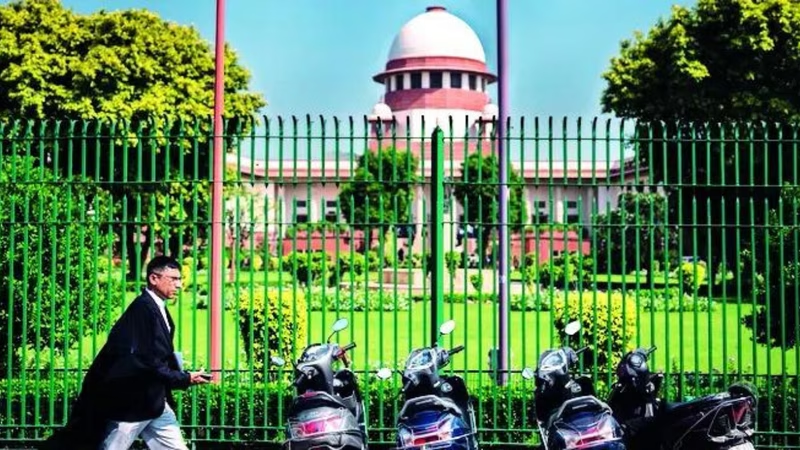
A Landmark Challenge to Electoral Immunity
In a move that could redefine the balance of power in India’s democratic machinery, the Supreme Court has agreed to examine a petition seeking to strip Chief Election Commissioners (CECs) and Election Commissioners (ECs) of their sweeping legal immunity to ECs. The bench, headed by the Chief Justice of India, issued formal notice to the Union Government after hearing arguments that the current shield from prosecution undermines transparency and accountability in one of the world’s largest electoral systems . This development marks the first serious judicial scrutiny of a provision long considered untouchable—and raises urgent questions about who watches the watchers.
Table of Contents
- What Is the Legal Immunity Granted to ECs?
- The Petition Challenging Absolute Protection
- Why This Case Matters for Indian Democracy
- Global Comparisons: How Do Other Countries Handle Electoral Accountability?
- Possible Outcomes and Implications
What Is the Legal Immunity Granted to ECs?
Under Section 28 of the Representation of the People Act, 1951, and reinforced by subsequent rulings, CECs and ECs enjoy near-total immunity from legal proceedings for actions performed in their official capacity. This means:
- They cannot be sued or prosecuted for decisions made during elections—such as voter list revisions, polling booth allocations, or disqualification rulings.
- Courts have historically treated their functions as “sovereign” and thus beyond judicial second-guessing in real time.
- The only recourse for alleged misconduct is removal via parliamentary process—a politically fraught mechanism requiring a two-thirds majority.
While designed to insulate the Election Commission from political pressure, critics argue this immunity has morphed into a cloak of unaccountability.
The Petition Challenging Absolute Protection
The plea before the Supreme Court contends that absolute legal immunity to ECs violates fundamental rights under Articles 14 (equality before law) and 21 (right to fair procedure) of the Indian Constitution. The petitioner—a civil society advocate—argues that no public official, regardless of office, should operate without any check on potential abuse of power .
Specifically, the petition cites instances where EC decisions allegedly lacked transparency or due process, yet affected millions of voters. Without a legal avenue to challenge such actions—even post-election—the system risks becoming arbitrary. The Supreme Court’s decision to issue notice signals it takes these constitutional concerns seriously.
Why This Case Matters for Indian Democracy
The Election Commission isn’t just another bureaucracy—it’s the guardian of India’s electoral integrity. But with great power must come proportionate responsibility. Consider these implications:
- Voter Trust: If citizens believe EC decisions are beyond question, faith in elections erodes.
- Misuse Potential: While rare, unchecked authority can enable partisan behavior disguised as administrative discretion.
- Judicial Oversight: The courts aren’t seeking to micromanage elections—but to ensure a safety valve exists for egregious errors or malice.
As former Chief Election Commissioner S.Y. Quraishi once noted, “Independence without accountability is license.” This case may finally test that balance.
Global Comparisons: How Do Other Countries Handle Electoral Accountability?
India isn’t alone in granting electoral bodies independence—but few offer blanket immunity:
- United States: The Federal Election Commission (FEC) commissioners can be sued for procedural violations; decisions are subject to judicial review.
- United Kingdom: The Electoral Commission is accountable to Parliament and can be investigated by independent ombudsmen.
- Germany: The Federal Returning Officer operates under strict statutory guidelines, with all major rulings open to constitutional challenge.
According to the International Institute for Democracy and Electoral Assistance (International IDEA), effective electoral management requires “independence paired with transparent accountability mechanisms”—not absolute legal shields .
Possible Outcomes and Implications
The Supreme Court has several paths ahead:
- Strike Down Immunity Entirely: Unlikely, as it could paralyze election administration with constant litigation.
- Introduce Qualified Immunity: Allow challenges only in cases of proven mala fide intent or gross negligence—preserving independence while enabling redress.
- Refer to Law Commission: Recommend legislative reform rather than judicial intervention.
Whichever route the Court takes, the mere fact that it’s hearing the case sends a powerful message: no institution, however vital, is above constitutional scrutiny.
Conclusion
The Supreme Court’s willingness to examine the legal immunity to ECs represents a pivotal moment for Indian democracy. It’s not about weakening the Election Commission—it’s about strengthening its legitimacy through balanced accountability. In a time when electoral integrity is under global stress, India has a chance to set a gold standard: an independent, respected, and responsibly answerable electoral authority. The world—and every Indian voter—will be watching closely.
Sources
- Times of India: ‘Will examine’: SC to hear plea against legal immunity to CECs, ECs
- International IDEA: Electoral Management Design: The International IDEA Handbook
- [INTERNAL_LINK:election-commission-of-india-powers-explained]
- [INTERNAL_LINK:constitutional-accountability-public-officials]