Table of Contents
- The Latest Threat: ‘Under the Guise of Jihad’
- Who Is Behind the Video? Lashkar-e-Taiba Exposed
- Pakistan and the Proxy War Doctrine
- How ‘Jihad’ Is Used to Mask Terrorism
- India’s Response and Strategic Challenges
- International Reactions and Diplomatic Fallout
- Conclusion: Breaking the Cycle of Proxy Violence
- Sources
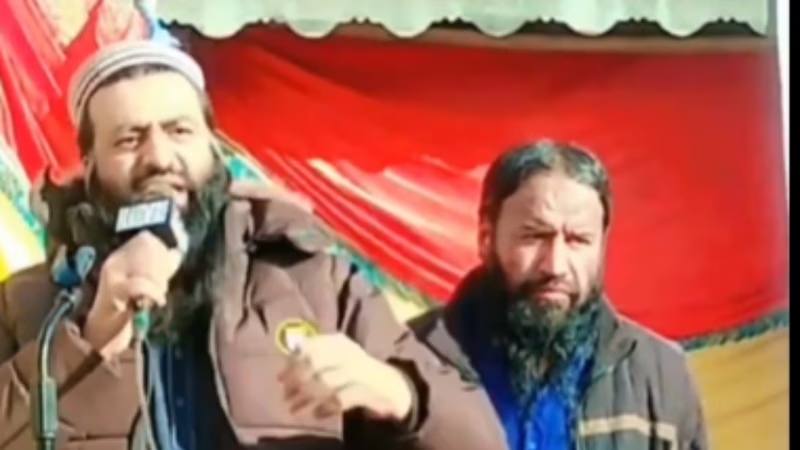
A chilling video has resurfaced, sending shockwaves through India’s national security establishment. In it, a senior leader of the banned terrorist outfit Lashkar-e-Taiba (LeT) declares with cold conviction: “The Kashmir issue can only be resolved through jihad.” The statement, far from being a mere ideological rant, is a stark reminder of a decades-old strategy—Pakistan’s use of militant proxies to wage a low-intensity, deniable war against India under the religious cover of ‘jihad’ . This latest provocation isn’t just rhetoric; it’s evidence of an ongoing campaign that continues to destabilize one of the world’s most volatile regions.
The Latest Threat: ‘Under the Guise of Jihad’
The video, now circulating widely on social media and verified by intelligence sources, features a known LeT commander delivering a speech that blends religious fervor with explicit political objectives. He frames armed insurgency in Jammu and Kashmir not as terrorism, but as a sacred duty—a narrative carefully crafted to recruit disillusioned youth and justify violence to a global audience sympathetic to religious causes.
What makes this particularly alarming is the timing. It comes amid renewed diplomatic tensions between India and Pakistan and follows a series of ceasefire violations along the Line of Control (LoC). Analysts warn that such statements are often precursors to escalated militant activity, designed to test India’s resolve and international patience .
Who Is Behind the Video? Lashkar-e-Taiba Exposed
Lashkar-e-Taiba, founded in the late 1980s with alleged support from Pakistan’s Inter-Services Intelligence (ISI), remains one of the most dangerous terrorist organizations in South Asia. Despite being designated a global terrorist group by the United Nations, the U.S., and the European Union, LeT operates openly in Pakistan under various front names like Jamaat-ud-Dawa (JuD) and Falah-e-Insaniat Foundation (FIF) .
The group is infamous for its role in some of the most audacious attacks on Indian soil, including:
- The 2008 Mumbai attacks (26/11), which killed 166 people.
- The 2001 Indian Parliament attack.
- Numerous fidayeen (suicide) strikes in Jammu and Kashmir over the past two decades.
Its leadership, including founder Hafiz Saeed, has repeatedly evaded meaningful punishment, often released from house arrest after token legal proceedings—a pattern that fuels accusations of state complicity .
Pakistan and the Proxy War Doctrine
Pakistan’s use of non-state actors as instruments of foreign policy is not new. Since the 1990s, it has pursued a deliberate “proxy war” strategy in Kashmir, using groups like LeT, Jaish-e-Mohammed (JeM), and Hizbul Mujahideen to inflict casualties, create fear, and keep the Kashmir dispute alive internationally—all while maintaining plausible deniability .
This doctrine serves multiple purposes for Pakistan’s military establishment:
- It avoids direct conventional war with a militarily superior India.
- It diverts attention from domestic economic and political crises.
- It sustains relevance in global strategic discussions about South Asian security.
However, this strategy has backfired domestically, fueling extremism within Pakistan itself and isolating it diplomatically.
How ‘Jihad’ Is Used to Mask Terrorism
The term “jihad” is central to this deception. In mainstream Islamic theology, jihad primarily refers to an internal spiritual struggle or defensive warfare under strict ethical guidelines. But militant groups like LeT deliberately distort this concept, portraying their violent campaigns as a divine obligation.
This semantic hijacking serves two key functions:
- Recruitment: It appeals to religious sentiment, especially among vulnerable youth seeking purpose.
- Legitimization: It frames terrorism as a righteous cause, muddying the waters for international observers and human rights bodies.
As counter-terrorism expert Dr. Ajai Sahni notes, “Calling cross-border terrorism ‘jihad’ is a strategic lie designed to cloak criminality in piety” .
India’s Response and Strategic Challenges
India has consistently called out Pakistan’s duplicity on the global stage. After the 2019 Pulwama attack, India launched surgical strikes and increased diplomatic pressure, leading to the Financial Action Task Force (FATF) grey-listing Pakistan for terror financing .
Yet challenges remain. While India has strengthened its border fencing and intelligence networks, the ideological battle is harder to win. Countering the narrative of “jihad” requires not just military action but also robust information campaigns, community engagement in Kashmir, and international coalition-building.
International Reactions and Diplomatic Fallout
The international community has grown increasingly wary of Pakistan’s double game. The U.S. State Department has repeatedly cited LeT’s activities in its Country Reports on Terrorism. The European Union has frozen assets linked to JuD fronts. Even China, Pakistan’s closest ally, has supported UN designations of LeT leaders—though it blocks broader moves against Pakistan at the Security Council .
Such video evidence strengthens India’s case for holding Pakistan accountable under international counter-terrorism conventions.
Conclusion: Breaking the Cycle of Proxy Violence
The surfacing of this LeT video is more than a threat—it’s a confession. It confirms that Pakistan’s so-called “peace overtures” are often tactical pauses, not strategic shifts. For lasting peace in Kashmir, the international community must move beyond symbolic condemnations and impose tangible costs on states that harbor and deploy terrorist proxies. Until then, declarations of “jihad” will continue to mask a brutal campaign of violence—one that has claimed thousands of innocent lives and poisoned regional stability for generations.
Sources
- Times of India: ‘Under guise of Jihad’: Pak exposed again; LeT leader speaks on Kashmir
- United Nations Security Council: Al-Qaida and Taliban Sanctions List (includes LeT)
- U.S. Department of State: Country Reports on Terrorism 2025
- South Asia Terrorism Portal (SATP): Lashkar-e-Taiba Profile
- Financial Action Task Force (FATF) Reports on Pakistan