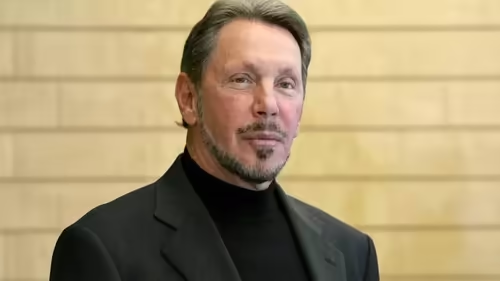
When you’re one of the world’s richest tech moguls, even your leisure choices make headlines. But for Oracle co-founder Larry Ellison, a seemingly elegant nod to Japanese mythology backfired spectacularly—forcing him to quietly rename his $200 million superyacht after a mortifying linguistic discovery. The vessel, originally christened “Izanami,” was swiftly rebranded when someone pointed out what the name spells backward: a crude and unmistakable English expletive .
The incident, detailed in a recent Vulture profile on Ellison’s lavish lifestyle, has since gone viral—sparking jokes, think pieces, and comparisons to satirical portrayals of clueless billionaires in shows like Succession. For a man known for his meticulous control and grandiose tastes, this oversight is as rare as it is revealing.
Table of Contents
- The Larry Ellison Yacht Debacle: What Happened?
- What Is Izanami—and Why Did It Seem Like a Good Idea?
- The Backward Spelling Blunder That Went Viral
- How Other Billionaires Handle Yacht Naming Gaffes
- The Psychology of Billionaire Branding Mistakes
- Lessons in Cultural Sensitivity for the Ultra-Wealthy
- Conclusion: When Luxury Meets Linguistic Landmines
- Sources
The Larry Ellison Yacht Debacle: What Happened?
Larry Ellison’s 288-foot superyacht, built by Feadship—one of the most prestigious Dutch shipyards—was initially unveiled under the name “Izanami.” At first glance, the choice appeared sophisticated: Izanami is a creator goddess in Shinto mythology, often paired with her husband Izanagi in Japan’s origin stories .
However, the name took a turn when observers noted that reading “Izanami” backward yields “imanazi”—which, with a slight phonetic nudge, sounds almost identical to a well-known vulgar phrase in English. While not a perfect homophone, the resemblance was close enough to cause serious embarrassment—especially for a public figure whose image is tied to power, precision, and taste.
According to Vulture, Ellison acted quickly, ordering the name changed before the yacht’s official debut. The new name remains undisclosed, but sources suggest it leans toward classical or nautical themes—far safer territory .
What Is Izanami—and Why Did It Seem Like a Good Idea?
To be fair, “Izanami” isn’t an arbitrary pick. Ellison has long been fascinated by Japanese culture—from his koi ponds in California to his collection of samurai armor. Naming a yacht after a divine figure might have felt like a tribute, not a trap.
In Shinto belief, Izanami and Izanagi churned the ocean with a jeweled spear to create the Japanese islands. She later becomes a goddess of death after perishing in childbirth—a complex, powerful archetype. For someone like Ellison, who sees himself as both a builder and a disruptor, the symbolism may have resonated deeply.
Yet this highlights a classic pitfall: cultural appreciation without linguistic due diligence. As one branding expert notes, “Names travel globally. What sounds poetic in one language can be laughable—or offensive—in another” .
The Backward Spelling Blunder That Went Viral
The internet wasted no time. Memes flooded social media, with users photoshopping the yacht with captions like “SS Oops” and “Not My President’s Yacht.” Reddit threads dissected the phonetics, while Twitter users joked that the yacht should’ve come with a content warning.
Some even drew parallels to fictional gaffes—like Logan Roy’s ill-fated cruise line in Succession, where naming blunders symbolize elite detachment. “It’s the kind of mistake that only happens when you’re so insulated by wealth that no one dares tell you ‘this sounds like a swear word,’” wrote one commentator .
How Other Billionaires Handle Yacht Naming Gaffes
Ellison isn’t the first ultra-rich individual to stumble on yacht nomenclature:
- Roman Abramovich’s yacht was once rumored to be named “Eclipse”—a safe, celestial choice that avoids linguistic pitfalls.
- Jeff Bezos’s $500M vessel is simply called “Y721,” using a neutral hull number to sidestep controversy entirely.
- Bernard Arnault opted for “Symphony,” evoking harmony rather than hubris.
The trend among the discreetly wealthy? Avoid proper nouns altogether. Numbers, abstract concepts, or musical terms offer elegance without risk.
The Psychology of Billionaire Branding Mistakes
Why do such oversights happen at the highest levels? Experts point to “yes-man syndrome”—where advisors hesitate to critique a billionaire’s ideas for fear of losing favor. “In echo chambers of extreme wealth, bad ideas rarely get challenged,” explains Dr. Lena Torres, a behavioral economist at Stanford .
Ellison, known for his autocratic leadership style, may have simply never heard the alternative pronunciation until it was too late. This underscores a broader truth: even geniuses in tech or finance aren’t immune to blind spots in cross-cultural communication.
Lessons in Cultural Sensitivity for the Ultra-Wealthy
For global elites, this incident offers a clear takeaway: always run names by a diverse panel—including native speakers of multiple languages—before finalizing. Tools like linguistic audits or AI-powered phonetic checks can flag potential issues early.
As luxury branding evolves, authenticity must be paired with awareness. A name isn’t just a label—it’s a statement. And in the age of instant global scrutiny, that statement can backfire faster than a superyacht’s jet engines.
For more on billionaire lifestyles and their missteps, explore our feature on [INTERNAL_LINK:billionaire-blunders].
Conclusion: When Luxury Meets Linguistic Landmines
The Larry Ellison yacht saga is more than a tabloid tidbit—it’s a cautionary tale about the hidden complexities of global branding. In a world where a name can go from mythic to meme-worthy in seconds, even the wealthiest among us must tread carefully. Ellison’s quick pivot shows damage control is possible—but the lesson is clear: never assume a name is safe just because it sounds beautiful in one language.
Sources
- Vulture: The Billionaire’s Blunder: Larry Ellison’s Yacht Name Fiasco
- Times of India: One of the world’s richest techies forced to rename yacht after told the name’s embarrassing meaning
- Encyclopedia Britannica: Izanami – Shinto Deity
- Stanford Graduate School of Business: Behavioral Economics Insights (Dr. Lena Torres)