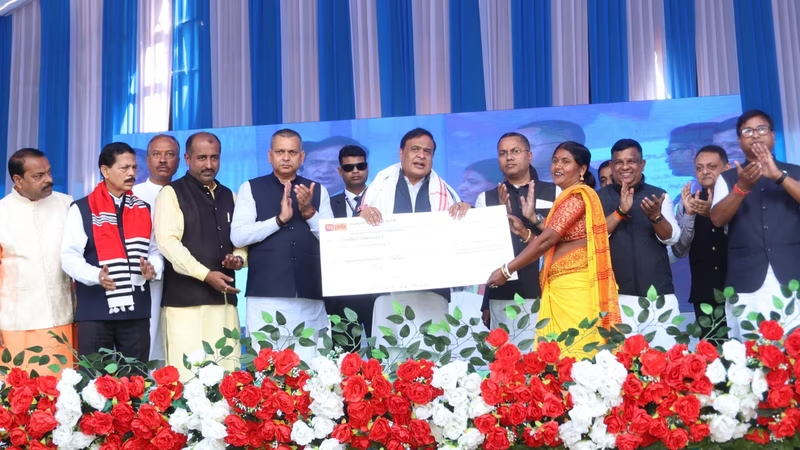
In a quiet village in Nagaon, Assam, 38-year-old Rekha Das used to stitch clothes for neighbors—earning just enough to buy rice and lentils. Today, she runs a small agro-processing unit, packages organic turmeric powder, and earns over ₹15,000 a month. Her secret? A ₹10,000 seed grant from the state government’s Mukhya Mantri Udyami Abhiyan (MMUA)—and the dream of becoming a “Lakhpati Didi.”
Rekha is one of tens of thousands of women now being mobilized under Assam Chief Minister Himanta Biswa Sarma’s flagship initiative—a program that blends economic empowerment with sharp political strategy. With the 2026 state elections on the horizon, the CM has fast-tracked MMUA disbursements, injecting crores into rural micro-enterprises in a bid to turn homemakers into household brand ambassadors of the BJP’s development model.
But is this just welfare—or a masterstroke of electoral engineering? And can the Lakhpati Didi vision truly lift women out of poverty, or will it remain a catchy slogan?
Table of Contents
- What Is the ‘Lakhpati Didi’ Vision?
- MMUA Scheme and Seed Money Mechanics
- Political Timing and the 2026 Assam Elections
- Success Stories and Ground Realities
- Challenges and Criticism
- Conclusion: Empowerment or Electoral Strategy?
- Sources
What Is the ‘Lakhpati Didi’ Vision?
Borrowing from Prime Minister Narendra Modi’s national “Lakhpati Didi” campaign—which aims to make 3 crore women self-help group (SHG) members earn ₹1 lakh+ annually—Assam’s version tailors the idea to local needs. The goal: equip rural women with skills, capital, and market access to build sustainable micro-businesses in sectors like:
- Handloom and handicrafts
- Food processing (pickles, spices, snacks)
- Poultry and dairy farming
- Eco-friendly product manufacturing
Unlike traditional subsidies, the program emphasizes **ownership**—not dependency. “We don’t want beneficiaries; we want entrepreneurs,” CM Sarma declared during the recent fund rollout .
MMUA Scheme and Seed Money Mechanics
The Mukhya Mantri Udyami Abhiyan (MMUA) provides interest-free seed capital ranging from ₹10,000 to ₹50,000 per woman, based on business proposals vetted at the block level. Key features include:
- Direct Benefit Transfer (DBT): Funds go straight to the beneficiary’s bank account, minimizing leakage.
- Cluster-based training: Women receive mentorship in bookkeeping, digital marketing, and quality control.
- Market linkage: Partnerships with platforms like GeM (Government e-Marketplace) and local haats ensure sales channels.
As of January 2026, over 1.2 lakh women have received MMUA grants, with the government aiming to reach 5 lakh by 2027 . Each “Lakhpati Didi” is expected to create 2–3 additional jobs, multiplying the economic ripple effect.
Political Timing and the 2026 Assam Elections
Cynics note the timing: the accelerated MMUA rollout comes just months before the crucial 2026 Assembly polls. With the BJP facing anti-incumbency whispers and a resurgent Congress-AISF alliance, the party needs a compelling narrative beyond infrastructure.
Enter the “Lakhpati Didi”—a relatable, aspirational figure who embodies both economic agency and political gratitude. By targeting women (who constitute over 51% of Assam’s electorate), the BJP is building a loyal voter base at the grassroots. As one BJP strategist admitted anonymously, “A woman who earns won’t forget who gave her the first ₹10,000” .
This mirrors national trends: PM Modi’s “Labharthi to Lakhpati” messaging has proven electorally potent in states like Madhya Pradesh and Chhattisgarh.
Success Stories and Ground Realities
Across Assam, stories like Rekha Das’s are multiplying:
- In Dhubri, a group of 15 women launched a banana fiber bag unit, now supplying to eco-stores in Guwahati.
- In Karbi Anglong, tribal women use MMUA funds to process bamboo shoots—preserving tradition while earning cash.
- In Sivasagar, a former daily wage laborer now runs a poultry farm with 200 hens, funding her children’s education.
Yet challenges persist. Many beneficiaries lack digital literacy, struggle with supply chain logistics, or face family resistance to their newfound financial independence. Without sustained hand-holding, some ventures risk collapsing after the initial grant runs out.
Challenges and Criticism
Opposition parties accuse the government of “tokenism.” Congress leader Rakibul Hussain argues, “Handing out ₹10,000 isn’t empowerment—it’s photo-op economics. Where’s the scale-up capital?”
Others point to implementation gaps:
- Uneven reach: Remote areas like Dima Hasao report delays in fund disbursement.
- Lack of monitoring: No public dashboard tracks business survival rates post-grant.
- Overemphasis on individualism: Critics say collective SHG models (like Kerala’s Kudumbashree) yield more sustainable results.
[INTERNAL_LINK:women-entrepreneurship-india] Still, even skeptics admit the program has sparked conversations about women’s economic roles in conservative households.
Conclusion: Empowerment or Electoral Strategy?
The Lakhpati Didi mission sits at the intersection of social policy and political pragmatism. While its electoral motivations are undeniable, its potential for real change is equally real—if backed by long-term support, not just seed money.
For women like Rekha Das, the ₹10,000 wasn’t just cash—it was permission to dream. Whether Assam’s “Lakhpati Didis” become lasting symbols of empowerment or fleeting campaign props will depend on what happens after the election banners come down.