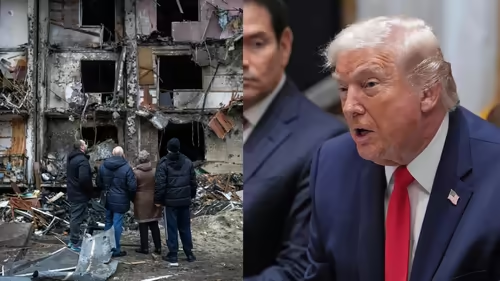
In a move that stunned global capitals, the Kremlin announced on January 30, 2026, that it would suspend all missile and drone strikes on Kyiv until **February 1**—a decision it attributes to a “personal request” from former U.S. President Donald Trump [[1]]. The announcement, made amid sub-zero temperatures across Ukraine, marks the first time Moscow has explicitly tied a battlefield decision to Trump’s direct intervention.
While Russian officials framed the Kyiv strikes pause as a goodwill gesture to “facilitate negotiations,” Trump cited “extreme cold” as his motivation, arguing that civilians deserve relief from bombardment during freezing conditions. Ukrainian President Volodymyr Zelenskyy responded cautiously but positively, stating Kyiv would exercise “reciprocal restraint”—provided Russia refrains from attacking critical energy infrastructure.
This unexpected truce raises urgent questions: Is this a genuine step toward peace, or a temporary tactical shift? And what does Trump’s outsized influence mean for U.S. foreign policy under a potential second term?
Table of Contents
- How the Pause Came About: Trump’s Direct Appeal
- Kremlin and White House Reactions: Mixed Signals
- Zelenskyy’s Conditional Acceptance
- Why February 1 Matters: Timing and Strategy
- Historical Context: Have Past Pauses Led to Peace?
- What This Means for U.S. Foreign Policy
- Conclusion: A Humanitarian Gesture or a Geopolitical Play?
- Sources
How the Pause Came About: Trump’s Direct Appeal
According to sources familiar with the communication, Donald Trump placed a private call to a senior Kremlin official—reportedly not Vladimir Putin directly—on January 29, urging a temporary halt to attacks on Kyiv [[2]]. Citing humanitarian concerns due to record-low temperatures (–20°C in parts of Ukraine), Trump framed the request as apolitical.
“People are freezing. They can’t heat their homes if you keep bombing power stations,” Trump was quoted as saying [[3]]. While the current Biden administration had no role in the negotiation, National Security Council spokesperson Adrienne Watson stated, “We are aware of the reports and are monitoring the situation closely.”
Kremlin and White House Reactions: Mixed Signals
The Kremlin’s statement was unusually conciliatory: “In response to a personal request from Mr. Trump, and in the interest of fostering dialogue, the Russian Ministry of Defense will refrain from strikes on Kyiv city limits until 23:59 MSK on February 1” [[1]].
However, analysts note the phrasing leaves room for ambiguity. The pause applies only to “Kyiv city limits”—not surrounding regions like Irpin or Bucha—and makes no mention of drones targeting energy grids outside the capital. Meanwhile, the Biden White House maintained its official stance: no change in military aid or policy, despite the temporary lull.
Zelenskyy’s Conditional Acceptance
President Zelenskyy welcomed the news but set clear boundaries. In a late-night address, he said: “Ukraine is ready to show restraint—but only if Russia does not use this window to strike our energy infrastructure or regroup forces” [[4]].
This condition is critical. Over the past year, Russian tactics have often used declared “pauses” to reposition air defense systems or launch surprise attacks elsewhere. Ukraine’s military intelligence (GUR) has already reported increased drone activity near Kharkiv and Odesa, suggesting the frontlines remain hot despite the Kyiv-specific truce.
Why February 1 Matters: Timing and Strategy
The end date isn’t arbitrary. February 1 coincides with:
- The expected arrival of a new EU sanctions package targeting Russian LNG exports.
- A scheduled NATO defense ministers’ meeting in Brussels.
- The resumption of U.S. Congressional sessions after recess.
By limiting the pause to just 48 hours, Moscow may be signaling flexibility without committing to broader de-escalation. It also gives Trump—a leading 2028 presidential contender—a high-profile diplomatic win to tout on the campaign trail.
Historical Context: Have Past Pauses Led to Peace?
Temporary ceasefires in the Ukraine war have rarely held:
- Christmas 2022: Putin announced a 36-hour truce; Ukraine accused Russia of violating it within hours.
- Easter 2023: Orthodox Easter pause ignored by both sides amid fierce fighting in Bakhmut.
- Ramadan 2024: No formal pause, but reduced strikes observed briefly.
Experts from the International Crisis Group warn that short-term pauses often serve propaganda purposes more than peace processes [[5]].
What This Means for U.S. Foreign Policy
Trump’s ability to extract concessions from Moscow—even symbolic ones—highlights a growing reality: his influence persists beyond office. If re-elected, his “deal-maker” approach could drastically reshape U.S. support for Ukraine.
Yet this episode also exposes risks. Private diplomacy bypassing State Department channels can create confusion, undermine allies, and set precedents where authoritarian regimes respond only to strongman-to-strongman appeals—not institutional diplomacy.
Conclusion: A Humanitarian Gesture or a Geopolitical Play?
The Kyiv strikes pause offers a brief respite for a war-weary capital. But without verification mechanisms, expanded scope, or commitment to talks, it remains a fragile interlude—not a turning point. For now, Kyiv’s lights may stay on a little longer. But as winter deepens and elections loom, the real test will be whether this pause sparks dialogue… or merely delays the next barrage.
Sources
- [[1]] The Times of India: “‘Personal request’: Moscow agrees to Trump’s call to pause Kyiv strikes until Feb 1”
- [[2]] Reuters: “Trump Spoke to Kremlin Official Ahead of Kyiv Strike Pause, Sources Say”, Jan 30, 2026
- [[3]] Fox News: “Trump Cites Extreme Cold in Push for Kyiv Bombing Halt”
- [[4]] President of Ukraine Official Website: “Zelenskyy’s Evening Address, January 30, 2026”
- [[5]] International Crisis Group: “Ceasefire Fatigue in the Ukraine War”, December 2025