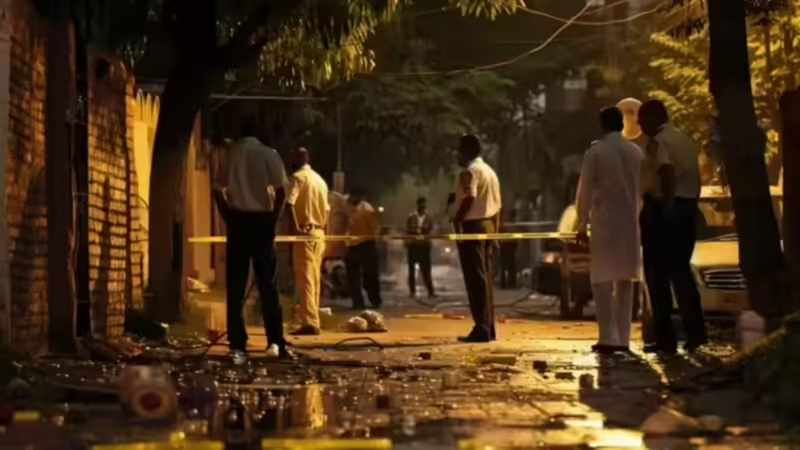
In the quiet village of Kushinagar, Uttar Pradesh, a nightmare unfolded on a rooftop that has since sent shockwaves across the nation. The horrific details are almost too grotesque to comprehend: a 30-year-old man, recently returned from Mumbai, allegedly clubbed his own mother and wife to death before engaging in an act of cannibalism that has left authorities and citizens alike searching for answers. This isn’t just a story of a brutal double murder; it’s a terrifying intersection of potential mental illness, societal failure, and a legal system grappling with the unimaginable.
Table of Contents
- The Kushinagar Cannibalism Incident: A Detailed Account
- The Legal Labyrinth: Is Cannibalism Illegal in India?
- Beyond the Headlines: The Mental Health Crisis in UP
- A Pattern of Violence? Crime in Uttar Pradesh
- Conclusion: Seeking Justice and Prevention
- Sources
The Kushinagar Cannibalism Incident: A Detailed Account
The peace of a Kushinagar village was shattered when neighbors witnessed a scene straight out of a horror film. According to police reports, the accused, whose name has been withheld pending formal charges, attacked his 55-year-old mother and his wife on their shared rooftop . Using a blunt object, he clubbed them to death. But the horror didn’t end there. In a state of apparent frenzy, he then smashed their skulls with bricks and, in an act of unspeakable brutality, consumed flesh from their heads .
Witnesses reported that the man then began hurling body parts at the terrified onlookers who had gathered below, creating a scene of absolute pandemonium. The local police acted swiftly, arresting the man at the scene. He had reportedly returned to his village from Mumbai just a month prior, and authorities are now investigating his recent history and state of mind leading up to the attack . This incident has become the most talked-about case of Kushinagar cannibalism in recent memory, forcing a national conversation about what could drive a person to such extremes.
The Legal Labyrinth: Is Cannibalism Illegal in India?
One of the most immediate questions following such a bizarre and horrific crime is its legal standing. Surprisingly, India does not have a specific law that explicitly criminalizes cannibalism. However, this does not mean the perpetrator can escape justice. The act is covered under a web of existing statutes within the Indian Penal Code (IPC) .
The primary charge will undoubtedly be murder under Section 302 of the IPC, which carries the maximum penalty of death or life imprisonment. Additionally, the desecration of the corpses falls under laws concerning public nuisance and outraging public decency. While there’s no dedicated “cannibalism” clause, the associated acts of murder and corpse desecration are severely punishable offenses . This legal gray area highlights a gap in the legislative framework when confronting such rare but extreme forms of criminal behavior.
Beyond the Headlines: The Mental Health Crisis in UP
While nothing can excuse such a heinous crime, the nature of the attack strongly suggests a severe, untreated psychiatric condition. This tragic event casts a harsh light on India’s, and particularly Uttar Pradesh’s, woefully inadequate mental health infrastructure.
The country suffers from a critical shortage of mental health professionals. With only 0.75 psychiatrists per 100,000 people, access to care is a luxury many cannot afford . In a state as vast and populous as Uttar Pradesh, this gap is even more pronounced. The lifetime prevalence of mental morbidity in the state is estimated at nearly 8% , yet the support systems are either non-existent or inaccessible for a large segment of the population. Could this tragedy have been prevented with proper intervention? It’s a question that haunts this case and underscores an urgent need for [INTERNAL_LINK:mental-health-reform-in-india].
A Pattern of Violence? Crime in Uttar Pradesh
This incident adds to a growing list of violent crimes reported from Kushinagar and Uttar Pradesh at large. From the murder of schoolchildren to honor killings and other brutal assaults, the region has seen its share of headlines .
However, the data on crime rates in UP presents a complex picture. While some reports suggest a high crime rate of over 750 per lakh population , official National Crime Records Bureau (NCRB) figures from late 2025 indicate that UP’s crime rate was actually 25% lower than the national average, at 335.3 cases per lakh population . This discrepancy may point to issues with reporting, categorization, or the specific nature of violent crimes versus overall crime statistics. Regardless of the numbers, the sheer brutality of the Kushinagar cannibalism case has amplified public fear and scrutiny of law and order in the state.
Conclusion: Seeking Justice and Prevention
The Kushinagar cannibalism horror is more than just a singular act of madness. It is a stark, terrifying symptom of deeper societal issues. As the legal process moves forward to deliver justice for the victims, the nation must also confront the uncomfortable truths this case reveals. We need a robust legal framework that can address all forms of extreme criminal behavior, and far more critically, we must invest heavily in building a mental health safety net that can identify, support, and treat individuals before they reach a point of no return. This tragedy should serve as a catalyst for change, ensuring that such a nightmare is never repeated.
Sources
- Times of India: Man kills mother, wife and eats flesh, arrested
- Police Confirmation on Kushinagar Case
- Legal Perspective on Cannibalism in India [[11], [13]]
- Mental Health Infrastructure in India [[21], [26]]
- Crime Statistics for Uttar Pradesh [[25], [27]]