They were laughing. They were safe. They were almost home.
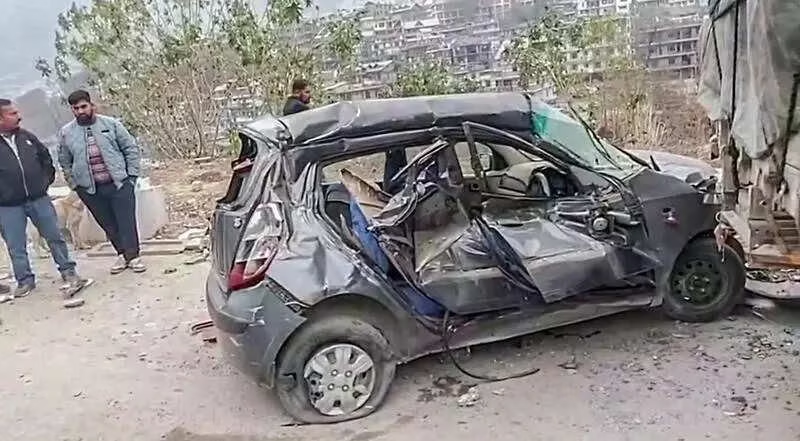
Yet, in a heart-stopping instant on the winding roads near Kullu, a celebration turned into a catastrophe. Four close friends—three women and one man—were killed when their car veered off the road, slammed into a barrier, and collided with a parked truck. They had just left a combined New Year’s Eve and birthday party, their lives ahead of them, their futures bright. They were barely a kilometer from their doorstep.
This isn’t just another accident. It’s a gut-wrenching reminder of how quickly joy can turn to grief on India’s mountain roads—especially when speed overrides caution. The tragedy has shaken the local community and reignited urgent conversations about road safety in hilly regions during peak holiday seasons.
Table of Contents
- The Night That Turned Tragic: A Timeline of Events
- Who Were the Victims? Friends Celebrating Life
- The Kullu Car Crash: What We Know So Far
- Why Hilly Roads Demand Extra Caution—Especially at Night
- Alarming Trends: New Year’s Eve and Road Fatalities in India
- What Can Be Done? Immediate Safety Recommendations
- Conclusion: A Call for Mindful Travel
- Sources
The Night That Turned Tragic: A Timeline of Events
According to local police reports , the group had been celebrating a dual occasion—a birthday and New Year’s Eve—at a private gathering in the Kullu Valley. The festivities wrapped up in the early hours of January 1, 2026. They got into their car, likely tired but happy, and began the short journey home.
But near the Bajaura area—just 1 km from their destination—the car lost control. Investigators believe the vehicle was traveling at a high speed on a sharp, downhill curve. It first struck a roadside barrier, then ricocheted into a stationary truck parked along the shoulder. The impact was catastrophic. All four occupants died on the spot.
Who Were the Victims? Friends Celebrating Life
While authorities have withheld full names pending family notification, local sources confirm the victims were in their mid-to-late 20s. Three were women, close friends since college, and the fourth was a male companion. They were described as responsible, ambitious, and deeply connected to their community. Their loss has left a void not just in their families, but among dozens of friends who shared photos and tributes online, calling them “souls full of light” .
This wasn’t reckless behavior—it was a momentary lapse in judgment on a road that forgives no errors.
The Kullu Car Crash: What We Know So Far
The Kullu car crash is under active investigation by Himachal Pradesh Police. Key preliminary findings include:
- Speed as a factor: Skid marks and vehicle damage suggest the car was significantly over the safe speed limit for that stretch.
- Road conditions: The area is known for sharp bends, steep drops, and limited lighting—especially dangerous at night.
- Parked vehicle: While the truck was legally parked, its presence on a narrow shoulder reduced margin for error.
- No alcohol detected: Initial toxicology reports (as per police sources) indicate alcohol was not a factor .
This shifts the focus from impairment to pure speed and situational awareness—a sobering distinction.
Why Hilly Roads Demand Extra Caution—Especially at Night
Driving in the Himalayas isn’t like driving on a highway. It requires a different mindset—one that respects the terrain. Consider these realities:
- Blind curves: Many turns offer zero visibility of oncoming traffic or road conditions ahead.
- Gravel and loose soil: Common on mountain roads, reducing tire grip dramatically.
- Altitude and fatigue: Travelers often underestimate how altitude and late-night driving impair reaction time.
- Limited emergency response: Help can take much longer to arrive in remote hilly areas .
The Ministry of Road Transport and Highways has repeatedly flagged hilly states like Himachal Pradesh as high-risk zones . Yet, during holidays, roads swell with tourists and locals alike, many unfamiliar with these unique challenges.
Alarming Trends: New Year’s Eve and Road Fatalities in India
This tragedy isn’t isolated. Data from the National Crime Records Bureau (NCRB) shows a consistent spike in road accidents during festive periods—especially New Year’s Eve and Diwali . In 2024 alone, over 1,200 deaths were reported across India on December 31 and January 1 combined.
Why? A mix of factors:
- Late-night driving when alertness is lowest.
- Celebratory fatigue after long parties.
- Increased traffic on roads not built for volume.
- Risk-taking behavior, even among normally cautious drivers.
The Kullu crash is a chilling case study in how these elements converge with deadly precision.
What Can Be Done? Immediate Safety Recommendations
While policy changes take time, individual actions can save lives tonight, tomorrow, and every holiday season:
- Slow down: On mountain roads, 40 km/h is often safer than 60 km/h—even if the car feels stable.
- Use headlights always: Even during dawn or dusk, visibility is limited in valleys.
- Avoid night driving post-celebration: If you’ve been up all night, rest before driving. Use taxis or designated drivers.
- Check road conditions: Apps like [INTERNAL_LINK:himalayan-road-safety-tips] or local police advisories can warn of hazards.
Additionally, authorities must install better signage, reflective barriers, and speed calming measures on known black spots like the Bajaura stretch.
Conclusion: A Call for Mindful Travel
The Kullu car crash is more than a news headline—it’s a mirror. It reflects the fragility of life and the heavy cost of a single moment of inattention. As we honor the memory of these four young friends, let their story be a catalyst for change: to drive slower, to plan smarter, and to never assume “it won’t happen to me.” Because sometimes, home is just one kilometer away—but one decision can make all the difference.
Sources
- Times of India. (2026, January 1). Car crash kills 4 friends returning from NY-bday party. Retrieved from https://timesofindia.indiatimes.com/city/chandigarh/car-crash-kills-4-friends-returning-from-ny-bday-party/articleshow/126291771.cms
- Hindustan Times. (2026, January 2). Kullu tragedy: Community mourns four young lives lost in New Year crash.
- Ministry of Road Transport and Highways, India. (2023). Guidelines for Road Safety in Hilly Areas. Retrieved from https://morth.nic.in
- National Crime Records Bureau (NCRB). (2024). Accidental Deaths & Suicides in India Report. Retrieved from https://ncrb.gov.in
- World Health Organization (WHO). (2023). Global Status Report on Road Safety. Retrieved from https://www.who.int/publications/i/item/9789240037154