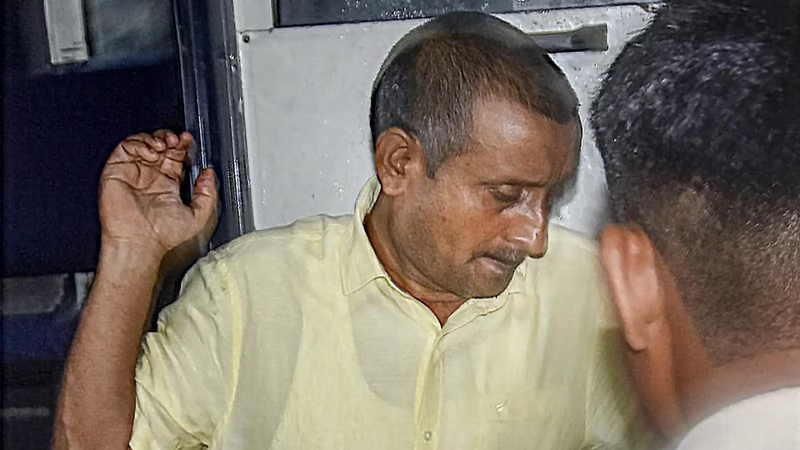
The long, harrowing shadow of the Unnao rape case just got a little longer for its central figure, Kuldeep Singh Sengar. In a decisive move that has kept the nation’s attention, the Supreme Court of India has stayed the Delhi High Court’s order granting bail to the former BJP MLA. This means Sengar, a man whose name has become synonymous with a horrific abuse of power, will remain behind bars—at least for now.
Table of Contents
- Supreme Court Stays Bail in Unnao Rape Case
- Why Did the CBI Appeal the Bail Order?
- A Brief History of the Unnao Rape Case
- What Does This Mean for Justice?
- Conclusion
- Sources
Supreme Court Stays Bail in Unnao Rape Case
On a crucial Monday, the apex court stepped in to block the release of Kuldeep Sengar, effectively halting the Delhi High Court’s December 23, 2025, decision that had suspended his life sentence and granted him conditional bail . The Supreme Court’s vacation bench, after hearing the Central Bureau of Investigation’s (CBI) urgent plea, stated it was “inclined to stay” the lower court’s order, a stance it has now formally adopted .
This development is significant not just legally, but symbolically. It signals the highest court’s serious concerns about the nature of the crime and the circumstances under which a bail order for such a heinous offense was granted. It’s worth noting that even if bail had been granted, Sengar was unlikely to walk free immediately, as he is already serving a separate sentence in other cases related to the same survivor and her family .
Why Did the CBI Appeal the Bail Order?
The CBI, acting as the prosecuting agency, moved swiftly to the Supreme Court to challenge the Delhi High Court’s decision. Their core argument, as highlighted in their appeal, revolves around the “horrific nature of the crime” committed against a minor girl in 2017 .
The agency contended that the High Court may not have given sufficient weight to the gravity of the offense and the potential threat Sengar could pose. The CBI’s appeal underscores a critical principle in such sensitive cases: that bail for a crime of such magnitude, especially against a minor, should be an exception, not a rule. The Supreme Court’s decision to stay the bail order suggests it is leaning towards this perspective.
A Brief History of the Unnao Rape Case
To fully grasp the weight of the Supreme Court’s recent action, it’s essential to revisit the timeline of this infamous case, which has shaken the foundations of public trust and highlighted the vulnerabilities of the justice system.
Key Events in the Unnao Case Timeline
- June 2017: A 17-year-old minor girl from Unnao, Uttar Pradesh, alleges that she was gang-raped by Kuldeep Sengar, then a powerful BJP MLA, along with his associates .
- Initial Inaction: Despite her repeated pleas to local authorities, a formal case was not registered for months, showcasing a failure of the local police and administration .
- July 2019: In a dramatic turn, the survivor attempted to immolate herself outside the Chief Minister’s residence, bringing national attention to her plight and the cover-up.
- August 2019: The Supreme Court, taking suo motu cognizance of the case, transferred all related matters from Lucknow to Delhi for a fair trial, a rare and powerful intervention .
- December 2019: A Delhi court convicted Kuldeep Sengar for rape under the POCSO Act and for criminal conspiracy, sentencing him to life imprisonment. He was also expelled from the BJP.
- December 23, 2025: The Delhi High Court grants Sengar interim bail, suspending his life sentence while his appeal is pending .
- December 29, 2025: The Supreme Court stays the bail order, ensuring Sengar remains in prison .
What Does This Mean for Justice?
The Supreme Court’s decision is a crucial moment for the survivor and for India’s justice system. It demonstrates a judicial willingness to re-examine decisions that may undermine the severity of crimes against minors and women in positions of extreme vulnerability.
This case has always been about more than just one man’s guilt or innocence. It’s about the immense power imbalance between a sitting MLA and a young girl from a small town. It’s about the terrifying lengths to which the survivor’s family was targeted, including a fatal car crash that many believe was a planned assassination attempt . By staying the bail, the Supreme Court is sending a strong message that the pursuit of justice in such cases requires the utmost caution and a deep respect for the victim’s trauma.
For a deeper look at the legal framework protecting minors, see our explainer on the POCSO Act and its real-world implications.
Conclusion
The legal saga of the Unnao rape case is far from over, but the Supreme Court’s latest intervention is a significant victory for the principles of justice and victim protection. By keeping Kuldeep Sengar in jail, the court has acknowledged the extraordinary circumstances of this case and the need to ensure that the legal process serves as a shield for the vulnerable, not a tool for the powerful. The nation will now wait for the final verdict on his appeal, but for now, a sense of cautious relief prevails among those who have followed this case from its darkest beginnings.
Sources
- Times of India: Unnao rape case: SC stays Delhi HC order granting bail to Kuldeep Sengar
- The Hindu: Unnao rape case: Supreme Court stays Delhi HC order granting bail to Kuldeep Sengar
- Supreme Court of India: Official Website
- Ministry of Women and Child Development: POCSO Act Information