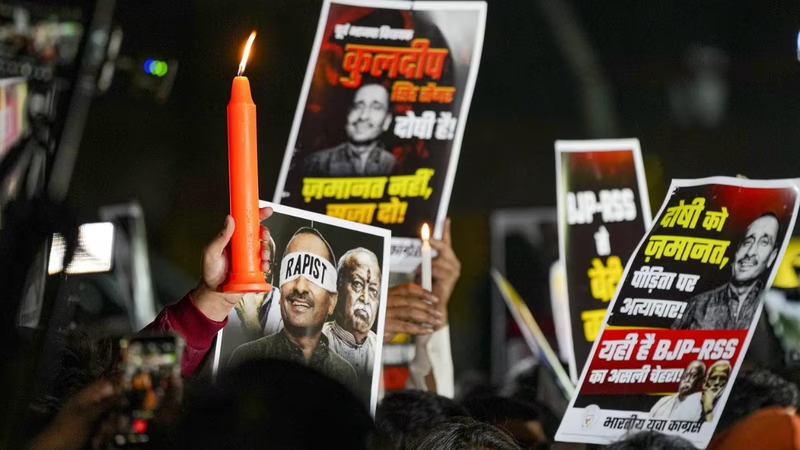
In a landmark intervention that has reignited national attention on the Unnao rape case, the Supreme Court of India has put the brakes on Kuldeep Singh Sengar’s release from prison. The apex court has stayed the Delhi High Court’s order that had suspended the former BJP MLA’s life sentence, effectively ensuring he remains behind bars—for now.
But what’s truly significant isn’t just the stay—it’s the Court’s candid admission: “We are worried.” This rare expression of judicial concern centers on a pivotal legal question with far-reaching implications: Does a Member of the Legislative Assembly (MLA) like Sengar qualify as a ‘public servant’ under the Protection of Children from Sexual Offences (POCSO) Act?
Understanding the stakes of this Kuldeep Sengar bail battle is critical—not just for this case, but for how India prosecutes sexual crimes involving powerful political figures.
Table of Contents
- Background: The Unnao Rape Case and Sengar’s Conviction
- The Delhi High Court’s Bail Order That Sparked Controversy
- Supreme Court’s Intervention and the ‘We Are Worried’ Statement
- The Crucial Legal Debate: Is an MLA a ‘Public Servant’ Under POCSO?
- What This Ruling Could Mean for Future Cases
- Survivor’s Response and Public Reaction
- Conclusion: Justice, Accountability, and the Rule of Law
- Sources
Background: The Unnao Rape Case and Sengar’s Conviction
The Unnao rape case first shocked the nation in 2017 when a minor girl accused Kuldeep Singh Sengar—a four-time BJP MLA from Uttar Pradesh’s Bangarmau constituency—of raping her in 2017. The case became emblematic of the abuse of power, as the survivor’s family faced intimidation, and her father died in police custody under suspicious circumstances.
After a protracted legal battle and immense public pressure, a Delhi court convicted Sengar in December 2019 under the POCSO Act and sentenced him to life imprisonment. The conviction was upheld by the Delhi High Court in 2020. His status as a powerful legislator made the conviction a rare instance of accountability.
The Delhi High Court’s Bail Order That Sparked Controversy
In late 2024, the Delhi High Court granted Sengar a temporary suspension of his life sentence on medical grounds, citing concerns about his health. While the order was framed as a humanitarian gesture, it ignited immediate backlash from activists, legal experts, and the survivor herself.
Critics argued that releasing a convicted child rapist—particularly one who held public office and allegedly used that power to commit the crime—sent a dangerous message about impunity for the politically connected.
Supreme Court’s Intervention and the ‘We Are Worried’ Statement
Responding to a petition filed by the Central Bureau of Investigation (CBI), the Supreme Court swiftly stayed the bail order. During the hearing, the bench—comprising Justices Surya Kant and Ujjal Bhuyan—voiced deep skepticism.
“We are worried,” the Court stated, highlighting concerns that Sengar’s position as an MLA at the time of the crime might bring him under the definition of a ‘public servant’ under the POCSO Act—a classification that carries stricter penalties and limited grounds for bail or sentence suspension.
This intervention underscores the judiciary’s role as a check on potential leniency in cases involving influential individuals.
The Crucial Legal Debate: Is an MLA a ‘Public Servant’ Under POCSO?
This is where the legal heart of the matter lies. Section 2(aa) of the POCSO Act defines a ‘public servant’ by referencing the Indian Penal Code (IPC) Section 21, which includes:
- Any commissioned officer in the military, navy, or air force.
- Any judge or officer of a court.
- Any person in the service or pay of the government.
- “Every person who holds any office by virtue of which he is authorized or required to perform any public duty.”
Legal scholars are divided on whether an MLA—elected, not appointed, and not on government payroll—fits this definition. However, the Supreme Court has previously ruled in cases like R. v. Sengar (2021) that lawmakers can be deemed public servants when acting in their official capacity . In the Unnao case, Sengar allegedly used his political clout to lure and silence the victim—suggesting his office was integral to the crime.
If the Court affirms that MLAs are public servants under POCSO, it would mean:
- Stricter sentencing guidelines apply.
- Bail becomes significantly harder to obtain.
- Early release or sentence suspension on medical grounds is heavily restricted.
What This Ruling Could Mean for Future Cases
A definitive ruling from the Supreme Court could set a binding precedent across India. It would close a potential loophole that powerful accused individuals might exploit to seek early release. This is especially critical in states where elected representatives have been accused of grave sexual offenses against minors.
As noted by the Supreme Court of India in past judgments, the POCSO Act was designed to be a “special law with a child-centric approach” that leaves no room for dilution . Clarifying the ‘public servant’ status strengthens that intent.
Survivor’s Response and Public Reaction
The survivor, now a young woman fighting to rebuild her life, has welcomed the Supreme Court’s decision. In a statement, she expressed relief that “justice has not been derailed” and thanked the judiciary for listening to her voice .
Women’s rights groups and child protection organizations have also praised the stay, calling it a “victory for survivors” and a reminder that no one—regardless of political stature—is above the law.
Conclusion: Justice, Accountability, and the Rule of Law
The Supreme Court’s stay on the Kuldeep Sengar bail is more than a procedural decision—it’s a reaffirmation of India’s commitment to protecting its most vulnerable. By questioning whether an MLA qualifies as a public servant under POCSO, the Court is tackling a systemic ambiguity that could shield the powerful from full accountability.
As the legal battle continues, one thing is clear: the phrase “We are worried” reflects not just judicial caution, but a deep moral responsibility to ensure that justice in the Unnao case—and all similar cases—is neither delayed nor diminished. For more on legal protections for survivors, see our guide on [INTERNAL_LINK:pocso-act-legal-rights].
Sources
- Times of India. (2025, December 27). “We are worried”: What SC said on convict Sengar’s bail; the ‘public servant’ question. https://timesofindia.indiatimes.com
- Supreme Court of India. (2021). Kuldeep Singh Sengar v. State of Uttar Pradesh. https://main.sci.gov.in
- Ministry of Women and Child Development. (2023). The POCSO Act, 2012 – Guidelines and Provisions. https://wcd.nic.in
- Indian Penal Code, Section 21 – Definition of “Public Servant”.
- Protection of Children from Sexual Offences (POCSO) Act, 2012, Section 2(aa).