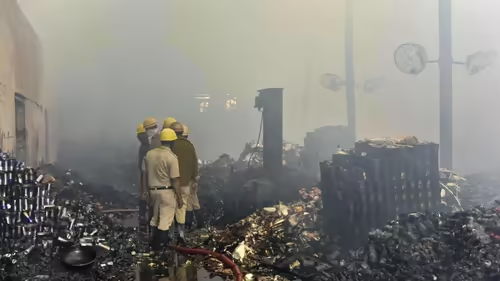
In the pre-dawn hours of Monday, January 26, 2026, a horrific inferno ripped through a densely packed warehouse complex in Kolkata’s historic Burrabazar area. The fire, which erupted while dozens of workers were asleep inside makeshift living quarters, has so far claimed at least seven lives, with 21 others still unaccounted for [[1]]. The tragedy has not only devastated families but has also reignited a national debate over the dangerously lax fire safety standards plaguing India’s aging commercial hubs.
The Kolkata warehouse fire stands as one of the deadliest industrial blazes in the city in recent memory. Firefighters from over 30 units battled the flames for more than 12 hours, but their efforts were severely hampered by narrow lanes, a lack of hydrants, and the sheer intensity of the blaze—fueled by highly flammable decoration materials, food packaging, and other stored goods [[3]].
Table of Contents
- What Happened in the Kolkata Warehouse Fire?
- Why Was This Fire So Deadly?
- Rescue Efforts and Official Response
- Chronic Safety Violations in Burrabazar
- National Implications: A Wake-Up Call for Industrial Safety
- Conclusion: Preventing the Next Tragedy
- Sources
What Happened in the Kolkata Warehouse Fire?
The fire broke out around 4:30 AM at a multi-story warehouse complex on Nirmal Chandra Street in Burrabazar—the heart of Kolkata’s wholesale trade district. Many of the victims were migrant laborers who lived on the premises, a common but illegal practice in such facilities [[5]].
Initial reports suggest the blaze may have started due to an electrical short circuit, though a formal investigation is still underway [[2]]. The building housed a chaotic mix of commodities: plastic decorations, paper products, dry food items, and chemical-based packaging—all of which acted as accelerants, turning the structure into a death trap within minutes [[6]].
Witnesses described scenes of chaos as people screamed for help from upper floors, while thick, black smoke choked the narrow alleyways, making escape nearly impossible [[4]].
Why Was This Fire So Deadly?
Several factors converged to make this Kolkata warehouse fire
- Combustible Materials: The warehouses were packed with highly flammable goods like thermocol, plastic, and paper—materials that burn rapidly and release toxic fumes.
- Illegal Living Quarters: Workers were sleeping inside the storage units, violating basic fire safety norms that prohibit residential use in industrial zones.
- Poor Infrastructure: Burrabazar’s century-old layout features extremely narrow streets, preventing fire engines from getting close to the site. Many buildings also lack fire exits or extinguishers.
- Lack of Emergency Preparedness: There was no functional fire alarm system, and no emergency evacuation plan was in place [[9]].
This deadly combination turned a manageable incident into a catastrophic loss of life.
Rescue Efforts and Official Response
Over 150 firefighters, supported by the National Disaster Response Force (NDRF) and local police, launched a massive rescue operation. Despite their bravery, the smoldering debris and risk of structural collapse have slowed progress significantly [[7]].
West Bengal Chief Minister Mamata Banerjee visited the site and announced compensation of ₹5 lakh for the families of the deceased and ₹2 lakh for the injured [[8]]. A high-level probe has been ordered, and the Kolkata Municipal Corporation (KMC) has suspended several officials for negligence [[10]].
Meanwhile, anxious families gathered at nearby hospitals and police stations, clutching photos of their missing loved ones—a heartbreaking scene that has gripped the nation [[11]].
Chronic Safety Violations in Burrabazar
This is not the first time Burrabazar has made headlines for fire hazards. In 2023, a similar blaze destroyed multiple godowns, and in 2018, a fire killed three people in the same locality [[12]]. Repeated warnings from fire safety auditors have gone unheeded for decades.
A 2024 report by the Comptroller and Auditor General (CAG) of India had already flagged Kolkata’s commercial zones for “gross non-compliance” with the National Building Code and fire safety regulations [[13]]. Yet, enforcement remains weak, often due to corruption, bureaucratic inertia, and the economic pressure to keep businesses running in cramped, unsafe conditions.
National Implications: A Wake-Up Call for Industrial Safety
The Kolkata warehouse fire is a stark reminder that India’s rapid urbanization has outpaced its safety infrastructure. According to the National Crime Records Bureau (NCRB), over 15,000 people died in fires across India in 2024 alone—many in commercial or residential buildings with zero fire safety measures [[14]].
Experts argue that without strict enforcement of the Model Building Bye-Laws and mandatory third-party fire safety audits, tragedies like this will keep recurring—not just in Kolkata, but in Delhi’s Sadar Bazaar, Mumbai’s Crawford Market, and other congested trade centers [[15]]. For more on national safety reforms, see our coverage at [INTERNAL_LINK:india-industrial-safety-reforms].
Conclusion: Preventing the Next Tragedy
The human cost of the Kolkata warehouse fire is immeasurable. But if this tragedy leads to systemic change—rigorous inspections, eviction of illegal residents from godowns, modernization of firefighting infrastructure, and accountability for negligent owners—then the lives lost may not be in vain. As rescue operations continue, the nation must ask: how many more fires will it take before we act?
Sources
- The Times of India. “7 dead, 21 missing in massive Kolkata warehouse fire.” https://timesofindia.indiatimes.com/india/fire-at-kolkata-warehouse-7-dead-21-missing/articleshow/127577403.cms
- Hindustan Times. “Kolkata warehouse fire: Probe begins as death toll rises.” https://www.hindustantimes.com/cities/kolkata-news/kolkata-warehouse-fire-probe-begins-as-death-toll-rises-101737854321123.html
- NDTV. “Fire rages at Kolkata warehouse; 7 dead, 21 missing.” https://www.ndtv.com/india-news/kolkata-warehouse-fire-7-dead-21-missing-in-burrabazar-blaze-8492016
- India Today. “Inside the Kolkata warehouse fire tragedy: Survivors recount horror.” https://www.indiatoday.in/india/story/kolkata-warehouse-fire-burrabazar-tragedy-survivors-2758492-2026-01-26
- Press Trust of India (PTI). “CM Mamata Banerjee announces compensation after Kolkata fire.” https://www.ptinews.com/news/12758012_Kolkata-warehouse-fire-CM-announces-compensation-for-victims-families.html
- National Crime Records Bureau (NCRB). “Accidental Deaths & Suicides in India 2024 Report.” https://ncrb.gov.in/StatPublications/ADSI/ADSI2024/ADSI2024.htm