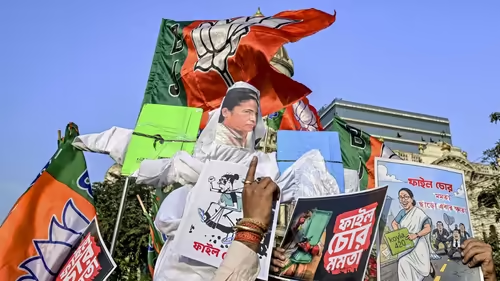
The fragile peace in West Bengal’s capital was shattered on a Sunday evening when a seemingly minor dispute over loudspeakers ignited a major conflagration between supporters of the ruling Trinamool Congress (TMC) and the opposition Bharatiya Janata Party (BJP). The incident, which took place in the Sakherbazar area of Kolkata, quickly spiraled out of control, resulting in a makeshift public meeting stage being set on fire and raising serious concerns about the state’s political climate .
This isn’t just another street brawl; it’s a stark reminder of the deep-seated animosity and high-voltage tension that characterizes the TMC-BJP rivalry in West Bengal. With assembly elections on the horizon, every local event, every public gathering, seems to be a potential flashpoint. But what exactly happened in Sakherbazar, and why did it escalate so violently?
Table of Contents
- The Sakherbazar Incident: A Chronology of Chaos
- Why Loudspeakers Are a Political Flashpoint in West Bengal
- The Kolkata TMC BJP Clash and its Electoral Ramifications
- Police Response and Public Order Challenges
- Conclusion: A State on the Brink?
- Sources
The Sakherbazar Incident: A Chronology of Chaos
According to initial reports, the trouble began during a public meeting organized by a local club affiliated with one of the two major parties . The core of the dispute was the use of microphones and loudspeakers for the event. In a city where sound is a primary tool for political messaging, control over amplification is often seen as a symbol of dominance and territorial claim.
Supporters from the opposing camp arrived at the scene, objecting to the noise levels or the very act of holding the meeting. What started as verbal altercations soon turned physical. Stones were reportedly thrown, and the situation deteriorated rapidly . The most alarming moment came when the temporary stage erected for the meeting was set ablaze, sending plumes of smoke into the sky and forcing residents to flee their homes .
Such incidents are not isolated. Just days before, on January 19, 2026, fresh clashes had already broken out between TMC and BJP workers in Asansol over a similar issue, indicating a worrying pattern of politically motivated violence across the state .
Why Loudspeakers Are a Political Flashpoint in West Bengal
To an outsider, a fight over loudspeakers might seem trivial. But in the context of West Bengal’s hyper-competitive political landscape, it’s anything but. Loudspeakers are the lifeblood of political communication here. They are used for everything from announcing local events to blasting party anthems and delivering fiery speeches.
Controlling a loudspeaker is about more than just volume; it’s about asserting presence, claiming public space, and demonstrating organizational strength. When one party’s supporters feel their right to use this tool is being challenged by their rivals, it’s perceived as a direct provocation—a challenge to their authority in that locality. This dynamic turns a simple piece of audio equipment into a potent symbol of political power, making it a frequent catalyst for violence.
The Kolkata TMC BJP Clash and its Electoral Ramifications
The timing of this Kolkata TMC BJP clash is particularly significant. West Bengal is in the throes of intense election preparation. TMC leader Abhishek Banerjee has already directed all party MPs and MLAs to activate their election war rooms immediately to counter the BJP’s agenda . This directive sets a combative tone, and on the ground, this translates into a fierce battle for every street, every neighbourhood, and every voter.
Incidents like the one in Sakherbazar serve multiple purposes for both parties. They can be used to mobilize their own cadre by portraying the other side as aggressors, and they can also be leveraged to highlight law and order failures to the electorate. However, the primary victim in this entire saga is the common citizen, who is left to navigate a landscape of fear and uncertainty.
Police Response and Public Order Challenges
In the aftermath of the violence, the Kolkata Police have a critical role to play. Their immediate task is to restore order, file necessary charges, and prevent retaliatory attacks. However, their long-term challenge is far more complex: how to de-escalate the pervasive political tension that fuels such incidents.
There are growing calls for stricter enforcement of laws governing public gatherings and the use of sound amplifiers. Some political analysts have even described such clashes as part of an “organized playbook” of provocation, suggesting that masked attackers are sometimes deployed to instigate violence . For the police to be effective, they must move beyond reactive measures and develop a proactive strategy to manage these recurring flashpoints. For more on civic safety and governance, you can explore resources from the National Crime Records Bureau. You can also read about other major national events on [INTERNAL_LINK:india-national-news].
Conclusion: A State on the Brink?
The violent clash in Sakherbazar is a microcosm of the larger political struggle engulfing West Bengal. The Kolkata TMC BJP clash over something as mundane as loudspeakers underscores a dangerous reality: the state’s political discourse has become so toxic that even minor disagreements can explode into major acts of violence. Until the leadership of both parties commits to a more peaceful and democratic mode of competition, citizens of Kolkata and across West Bengal will continue to pay the price for this relentless political warfare.
Sources
- Times of India. “Kolkata: TMC-BJP supporters come to blows over loudspeakers; stage set on fire.” https://timesofindia.indiatimes.com/india/kolkata-tmc-bjp-supporters-come-to-blows-over-loudspeakers-stage-set-on-fire/articleshow/127488433.cms
- ANI. “SIR row: TMC, BJP workers clash over objections to…” (January 19, 2026)
- Various news reports on the Sakherbazar incident and political tensions in West Bengal [[2], [3], [4], [6], [7]].
- National Crime Records Bureau. https://www.ncrb.gov.in/