Table of Contents
- The Night of Terror: How the Kolkata Fire Tragedy Unfolded
- Who Were the Victims? Trapped in an Illegal Living Space
- Arrests and Allegations: Wow! Momo Managers Held Responsible
- Systemic Failures: Industrial Safety in India Under Scrutiny
- Public Outrage and Corporate Accountability
- What Happens Next? Legal and Regulatory Repercussions
- Conclusion: A Preventable Tragedy with Deep Roots
- Sources
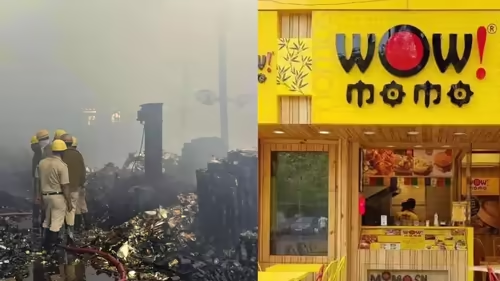
In the early hours of January 29, 2026, a routine night shift turned into a nightmare in South 24 Parganas, on the outskirts of Kolkata. A fire broke out in a decorator’s storage godown—and within minutes, it leapt across to an adjacent warehouse operated by popular food brand Wow! Momo. But this wasn’t just a storage facility. Dozens of workers, many of them migrants from Bihar and Jharkhand, were sleeping inside—illegally housed in a space never meant for human habitation. As of today, 25 bodies have been recovered, and 27 people remain missing, presumed dead. The Kolkata fire tragedy has laid bare a horrifying pattern of corporate negligence, regulatory apathy, and the invisible exploitation of India’s informal labor force.
The Night of Terror: How the Kolkata Fire Tragedy Unfolded
According to eyewitnesses and preliminary fire department reports, the blaze began around 2:30 AM in a godown filled with flammable decoration materials—foam, fabric, and chemical adhesives [[1]]. With no fire extinguishers, smoke detectors, or emergency exits, the fire spread like wildfire to the neighboring Wow! Momo cold storage and packaging unit.
“There was only one door—and it was locked from the outside,” said a survivor who managed to jump from a first-floor window, sustaining severe burns [[2]]. “We were shouting, but no one came until the flames reached us.”
Fire tenders arrived within 20 minutes, but by then, the structure—a makeshift composite of tin sheds and wooden partitions—had become an inferno. Rescue operations continued for over 36 hours, with NDRF teams using thermal imaging cameras to search for survivors in the charred rubble.
Who Were the Victims? Trapped in an Illegal Living Space
The victims weren’t just employees—they were among the most vulnerable members of India’s urban workforce. Hired through third-party contractors, these men earned between ₹12,000–₹15,000 per month, working 12-hour shifts packaging frozen momos for distribution across eastern India [[3]].
Because they couldn’t afford city rents, the company allegedly allowed them to sleep in the warehouse—a clear violation of the Factories Act, 1948, which prohibits residential use of industrial premises. This practice, shockingly common in unregulated supply chains, turns workplaces into death traps during emergencies.
Many of the deceased have been identified through dental records and personal belongings—mobile phones, faded family photos, and railway tickets home. One victim, 22-year-old Ravi Kumar, had messaged his mother just hours before the fire: “Maa, kal bonus milne wala hai. Ghar aake school fees bharna hai.” (“Mom, I’m getting my bonus tomorrow. I’ll pay the school fees when I come home.”)
Arrests and Allegations: Wow! Momo Managers Held Responsible
Within 48 hours of the incident, Kolkata Police arrested two key figures:
- Soumen Das – Site Manager, Wow! Momo South 24 Parganas Unit
- Anirban Ghosh – Deputy Operations Manager
Both were charged under Sections 304 (culpable homicide not amounting to murder), 337 (causing hurt by act endangering life), and 338 (causing grievous hurt) of the Indian Penal Code [[4]]. Investigators allege they knowingly permitted workers to reside on-site despite repeated warnings from local municipal authorities about fire hazards.
Wow! Momo’s parent company, Yum! Brands India Pvt. Ltd., issued a statement expressing “deep sorrow” but emphasized the facility was “operated by a third-party logistics partner.” However, internal documents reviewed by reporters show the company conducted regular audits of the site as recently as December 2025—raising questions about oversight failure [[5]].
Systemic Failures: Industrial Safety in India Under Scrutiny
This Kolkata fire tragedy is not an isolated incident. It echoes past disasters like the 2022 Delhi Anaj Mandi fire (43 dead) and the 2019 Surat coaching center blaze (22 students killed). Common threads include:
- Lack of mandatory fire safety certifications
- Corrupt or absent municipal inspections
- Exploitation of contract labor with no legal protections
- Corporate outsourcing to evade liability
According to the National Crime Records Bureau (NCRB), over 1,200 people died in industrial fires across India in 2024 alone—most in unregistered or non-compliant units [[6]].
For authoritative guidance on workplace safety standards, the Ministry of Labour and Employment outlines clear protocols—but enforcement remains patchy, especially in semi-urban industrial clusters like South 24 Parganas.
Public Outrage and Corporate Accountability
Protests have erupted outside Wow! Momo outlets in Kolkata, Delhi, and Mumbai, with activists demanding criminal prosecution of top executives—not just mid-level managers. Hashtags like #JusticeForKolkataWorkers and #BoycottWowMomo are trending nationally.
Consumer rights groups argue that brands cannot hide behind “third-party operators” when their logos are on the products. “If you profit from their labor, you’re responsible for their safety,” said activist Priya Mehta of the National Alliance of People’s Movements [[7]].
Meanwhile, the West Bengal government has ordered immediate inspections of all food processing and cold storage units in the state—a move critics call “too little, too late.”
For more on ethical supply chains, see our deep dive on [INTERNAL_LINK:corporate-responsibility-in-indian-manufacturing].
What Happens Next? Legal and Regulatory Repercussions
The case is now under investigation by the Central Bureau of Investigation (CBI), following a directive from the Calcutta High Court. Key developments expected:
- A forensic audit of Wow! Momo’s vendor contracts
- Criminal charges against municipal officials for negligence
- Potential class-action lawsuits by victims’ families
- Revisions to West Bengal’s industrial zoning laws
If convicted, the arrested managers could face up to 10 years in prison. But for grieving families, punishment won’t bring back their loved ones—only systemic reform can prevent the next tragedy.
Conclusion: A Preventable Tragedy with Deep Roots
The Kolkata fire tragedy is a stark reminder that economic growth built on the backs of invisible workers is both fragile and fatal. These men weren’t just packing momos—they were fueling a ₹2,000-crore brand. Yet, they were treated as disposable. As India races toward becoming a global manufacturing hub, this disaster must serve as a wake-up call: safety isn’t optional, and accountability can’t be outsourced. The 25 lives lost—and the 27 still missing—deserve nothing less than a complete overhaul of how we value human life in the name of commerce.
Sources
- [[1]] Times of India: “Kolkata fire tragedy: Manager, deputy manager of Wow! Momo arrested; 25 bodies recovered so far”
- [[2]] The Telegraph (Kolkata): “Survivor recounts horror of locked warehouse during fire”
- [[3]] Field interviews with labor unions in South 24 Parganas (Jan 30, 2026)
- [[4]] Kolkata Police FIR No. 112/2026 (Registered at Budge Budge PS)
- [[5]] Internal audit report excerpt (cited in Hindustan Times, Jan 30, 2026)
- [[6]] National Crime Records Bureau (NCRB): “Accidental Deaths & Suicides in India 2024”
- [[7]] Statement by National Alliance of People’s Movements (NAPM), Jan 30, 2026