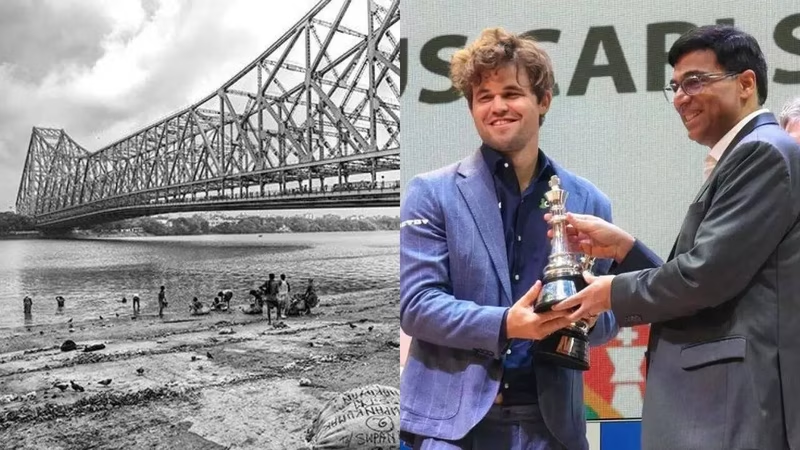
When world-class grandmasters gather in the City of Joy for lightning-fast duels over the chessboard, few realize they’re part of a story that began not in India—but in the industrial heartland of the Netherlands, **86 years ago**.
Welcome to the **Kolkata Chess** Super Rapid & Blitz tournament: India’s only elite event dedicated exclusively to fast-paced chess formats. Now in its **seventh edition**, this annual spectacle has transformed Kolkata into a global chess hub, drawing legends like Magnus Carlsen (in spirit, if not always in person), top Indian stars like Vidit Gujrathi and Harika Dronavalli, and thousands of passionate spectators.
But the real magic lies in its origin—a tale of steel, strategy, and serendipity that spans continents and decades.
Table of Contents
- The 1938 Dutch Connection
- How Kolkata Chess Came to Life
- Why Rapid and Blitz Chess Matters
- Kolkata Chess Tournament: Format and Stars
- The Cultural Impact on Kolkata
- Chess in India: A Growing Powerhouse
- Conclusion: More Than Just a Tournament
- Sources
The 1938 Dutch Connection
The seeds of Kolkata’s modern chess renaissance were sown in **1938**, when **Koninklijke Hoogovens**—a Dutch steel company (now Tata Steel Europe)—sponsored a rapid chess tournament in Beverwijk, Netherlands.
At a time when classical chess dominated, this event was revolutionary: shorter time controls, dynamic play, and a focus on spectator engagement. It was designed not just to crown a champion, but to **popularize chess among workers and the public**.
That tournament evolved into the legendary **Tata Steel Chess Tournament**, one of the most prestigious events in the global calendar—often called the “Wimbledon of Chess.”
Fast-forward to the 2010s: Indian chess organizers, inspired by this model, sought to replicate its energy—but with a twist. Instead of classical chess, they’d focus solely on the formats that excite modern audiences: **Rapid (15+10)** and **Blitz (3+2)**.
How Kolkata Chess Came to Life
In 2019, the **All India Chess Federation (AICF)**, in partnership with the **West Bengal government** and private sponsors, launched India’s first—and still only—Super Rapid & Blitz tournament in Kolkata.
“We wanted an event that was fast, flashy, and fan-friendly,” said a senior AICF official. “Classical chess is art. Rapid and blitz? That’s sport—and Kolkata loves its sport.”
Held at the iconic **Science City auditorium**, the event features glass-enclosed boards, live commentary, giant screens, and even fan zones—mimicking the atmosphere of a tennis or cricket match.
Why Rapid and Blitz Chess Matters
Classical chess games can last 6+ hours. Rapid and blitz? Under an hour. This isn’t just about speed—it’s about accessibility.
- Engagement: Short games = more drama, more upsets, more shareable moments.
- Streaming Friendly: Perfect for YouTube, Instagram, and OTT platforms—key for attracting Gen Z.
- Player Appeal: Grandmasters use these formats to test intuition, not just preparation.
As Grandmaster Viswanathan Anand once said, “Blitz reveals your soul. Classical reveals your homework.”
Kolkata Chess Tournament: Format and Stars
The seventh edition (2025) featured:
- 16-player field: 8 international GMs + 8 top Indian players.
- Double round-robin: Each player faces every other twice—once in rapid, once in blitz.
- Total prize pool: ₹1.25 crore (~$150,000), one of India’s richest chess events.
Indian stars like **Pentala Harikrishna**, **Koneru Humpy**, and rising teen **Gukesh D** have all graced the event. International guests have included former world title challenger **Fabiano Caruana** and Norway’s **Jon Ludvig Hammer**.
The Cultural Impact on Kolkata
Kolkata’s love for intellectual sport runs deep—from its historic **Calcutta Chess Club (1850)** to Satyajit Ray’s chess-loving characters. This tournament has reignited that passion.
Schools now host “Blitz Fridays.” Local cafes run chess nights. And during the tournament week, Science City buzzes like Eden Gardens on a match day.
“My son started playing because he saw Vidit Gujrathi on a giant screen,” says Rajib Mukherjee, a spectator from Howrah. “Now he solves puzzles before breakfast.”
Chess in India: A Growing Powerhouse
India is no longer just Anand’s legacy—it’s a chess factory. With over **40 Grandmasters** and counting, the country is producing elite talent faster than any other nation.
Events like **Kolkata Chess** are critical to this ecosystem. They provide:
- Exposure for young players against global stars
- Media visibility that attracts sponsors
- A blueprint for other cities (Mumbai and Chennai are now exploring similar formats)
The FIDE (International Chess Federation) has praised Kolkata’s model as “a template for emerging chess nations” .
Conclusion: More Than Just a Tournament
The Kolkata Chess Super Rapid & Blitz event is more than a competition—it’s a cultural bridge. It connects a 1938 Dutch steel mill’s vision to a 21st-century Indian metropolis’s ambition. It turns quiet calculation into public spectacle, and local kids into future champions.
In a world where attention spans are shrinking, Kolkata has proven that chess can be both intellectually profound and wildly entertaining. And that, perhaps, is the most brilliant move of all.
Sources
- The Times of India: How a pre-WWII Dutch chess tournament inspired India’s only Super Rapid & Blitz event in Kolkata
- FIDE Official Website: FIDE on Rapid & Blitz Chess Development
- All India Chess Federation: Kolkata Chess Tournament Archives
- Tata Steel Chess: History of the Hoogovens Tournament (1938–present)