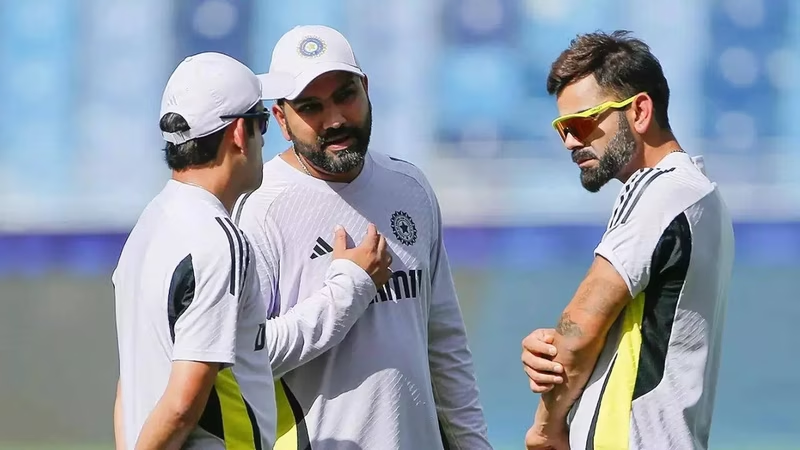
The cricketing world is abuzz with a revelation that could reshape India’s next two years. Forget retirement rumors and farewell tours—Virat Kohli and Rohit Sharma are reportedly in deep strategic talks with head coach Gautam Gambhir about a singular, all-consuming goal: winning the 2027 ODI World Cup in South Africa.
This isn’t just idle chatter in the dressing room. According to India’s batting coach, Sitanshu Kotak, this is a deliberate, focused campaign by the two veteran superstars who have chosen to concentrate their legendary careers on a single format. “They definitely make plans. Now that they’re playing only one format, they want India to win everywhere when they are there,” Kotak stated on the eve of a recent ODI against New Zealand .
Table of Contents
- The One-Format Strategy: A Masterstroke or a Gamble?
- Inside the 2027 ODI World Cup Planning Room
- The Challenge of Age and Excellence
- What This Means for India’s Future
- Conclusion: A Legacy in the Making
- Sources
The One-Format Strategy: A Masterstroke or a Gamble?
Kohli and Sharma’s decision to step away from Test cricket and focus solely on white-ball formats was seismic. But their current laser focus appears to be on the 50-over game, specifically targeting the 2027 ODI World Cup. By shedding the physical and mental burden of multi-format cricket, they’ve created a unique scenario: two of the game’s greatest players, operating at peak tactical awareness, with all their energy directed towards one trophy.
This strategy allows them to manage their workload meticulously, ensuring they are fresh and firing for every crucial ODI series in the lead-up to South Africa. It’s a calculated move that prioritizes legacy over longevity across formats. As former captain Ravi Shastri noted, the pair are keen to “make a mark with the bat in the countdown to the ICC Men’s Cricket World Cup 2027” .
Inside the 2027 ODI World Cup Planning Room
The most intriguing aspect of Kotak’s revelation is the collaborative nature of this planning. It’s not just the players or just the coach; it’s a joint war room. “They discuss with Gautam (Gambhir) about ODI formats, about the matches we have, and our plans going (ahead) to South Africa (World Cup in 2027),” Kotak elaborated .
This paints a picture of a highly engaged dressing room where experience meets a new, aggressive coaching philosophy under Gambhir. The head coach, known for his no-nonsense approach, seems to have found common ground with his senior-most players. This alignment between leadership and star power is a critical ingredient for any successful World Cup campaign. Kotak himself has echoed Gambhir’s stance on various team matters, indicating a unified coaching front .
Key Elements of Their Roadmap
- Strategic Workload Management: Carefully planned rest periods to avoid burnout before major tournaments.
- Mentorship Pipeline: Actively guiding the next generation of batters like Ruturaj Gaikwad and Yashasvi Jaiswal, who have already impressed under this new regime .
- Tactical Evolution: Adapting their own games and team strategies to the evolving ODI landscape, moving away from the template that failed in 2023.
The Challenge of Age and Excellence
Let’s address the elephant in the room. By the time the 2027 ODI World Cup rolls around, Rohit Sharma will be 40, and Virat Kohli will be 38 . History is littered with greats whose powers waned in their late 30s. Sustaining world-class performance at that age is a monumental challenge.
However, both players have shown an almost obsessive commitment to fitness and preparation. Their ability to dominate T20 leagues and perform in high-stakes ODIs suggests they are defying conventional timelines. The question isn’t just about their skill, but their durability. Can their bodies withstand the rigors of international cricket for two more grueling years? The entire plan hinges on a ‘yes’.
What This Means for India’s Future
This dual-track approach creates a fascinating dynamic for Indian cricket. On one hand, you have a proven, champion core aiming for one last dance on the biggest stage. On the other, the BCCI and selectors must simultaneously build a team capable of thriving in the post-Kohli, post-Rohit era.
Their active involvement in the 2027 ODI World Cup planning provides a stable bridge. They can pass on invaluable experience while the likes of Shubman Gill, Gaikwad, and Jaiswal are integrated into high-pressure situations. It’s a delicate balancing act—leaning on legends while preparing for a future without them. As one report suggests, the buzz in some circles is skeptical, questioning if they’ll truly be part of the 2027 vision , making their current commitment all the more significant.
Conclusion: A Legacy in the Making
The news from Sitanshu Kotak isn’t just a minor update; it’s a declaration of intent. Virat Kohli and Rohit Sharma, alongside Gautam Gambhir, are scripting a final, ambitious chapter in their storied careers. Their eyes are firmly fixed on the 2027 ODI World Cup, and they’re leaving nothing to chance. For fans, it promises two more years of witnessing greatness, driven by a clear, shared purpose. For Indian cricket, it’s a high-stakes gamble that could end in ultimate glory or signal the definitive end of an era. Either way, the journey to South Africa just got a lot more interesting.
For more on India’s current form, check out our analysis on [INTERNAL_LINK:india-vs-new-zealand-odi-series]. You can also read the ICC’s official tournament page for historical context on the World Cup’s global impact .
Sources
- Times of India: Original Article
- Various reports on Gautam Gambhir’s roadmap and player involvement [[1], [2], [3], [4], [6], [7], [9], [10], [17], [25]]
- Analysis on player ages and future prospects [[11], [13], [14]]
- ICC Economic Impact Report on the 2023 World Cup