Table of Contents
- Kohli Century in a Losing Cause
- Gill’s Honest Take on the Defeat
- Bright Spots Amidst the Loss
- What Went Wrong for India?
- Looking Ahead to the World Cup
- Conclusion: Is This a Turning Point?
- Sources
Kohli Century in a Losing Cause: A Bittersweet Masterclass
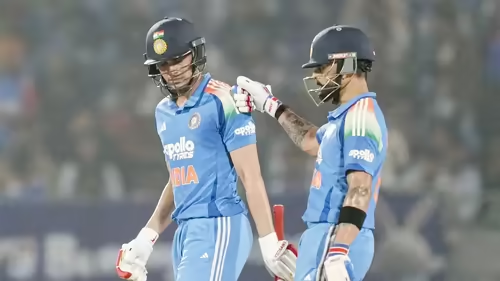
In a performance that reminded the world why he’s considered one of the greats, Virat Kohli notched his 54th ODI century against New Zealand—but it wasn’t enough. India fell short by 41 runs in the series-deciding match, ending their campaign on a frustrating note .
Batting with trademark intensity and elegance, Kohli’s knock was a beacon of stability in an otherwise shaky chase. He anchored the innings with 113 runs off just 117 balls, mixing caution with calculated aggression. Yet, the lack of support from the other end meant his efforts were in vain—a scenario all too familiar in recent Indian ODI outings.
This Kohli century wasn’t just another milestone; it was a statement of resilience from a player who continues to deliver under pressure, even as debates about his role in the future setup persist. For fans and analysts alike, it raised a critical question: can individual brilliance compensate for systemic gaps in a team sport?
Gill’s Honest Take on the Defeat: “We Need to Be Better”
Newly appointed captain Shubman Gill didn’t sugarcoat the loss. In his post-match remarks, the 26-year-old leader acknowledged Kohli’s contribution but emphasized the need for collective improvement. “Virat bhai is always a plus,” Gill said, “but we’ve got areas where we need to get better” .
Gill’s maturity in handling both victory and defeat has been widely praised since he took over the ODI reins. His call for introspection signals a leadership style rooted in accountability—a welcome shift from deflection. With the ICC Men’s Cricket World Cup 2027 on the horizon, these early stumbles under his captaincy could prove invaluable if they lead to meaningful course correction.
Bright Spots Amidst the Loss: Emerging Talent Shines
While the result was disappointing, the series wasn’t without promise. Two young players—Harshit Rana and Nitish Kumar Reddy—delivered standout performances that hint at a deeper bench strength.
Harshit Rana, the pace-bowling sensation from Delhi, showed remarkable composure in high-pressure situations, consistently hitting the right lengths and extracting movement. Nitish Kumar Reddy, primarily known for his all-round prowess in domestic cricket, impressed with his clean striking and handy medium pace.
These glimpses of potential are crucial as India experiments with combinations. As Gill noted, “We’re looking at the bigger picture… building a side that can peak at the right time” . This approach aligns with global trends in white-ball cricket, where squad depth and adaptability often trump star power alone.
What Went Wrong for India? A Tactical Breakdown
Beyond the scoreboard, several tactical issues plagued India’s performance:
- Middle-order fragility: Once Kohli departed, the batting collapsed. The No. 4 to No. 7 positions remain a work in progress.
- Bowling inconsistency: While spinners held their own, the pace attack lacked penetration on a flat track, failing to break key partnerships.
- Fielding lapses: Two dropped catches in the first 10 overs gifted New Zealand crucial momentum.
- Over-reliance on seniors: Despite rotation, the core still leans heavily on veterans, limiting opportunities for newer players to cement roles.
These aren’t new problems—but in a high-stakes series against a top-tier side like New Zealand, they become magnified. The Kiwis, led by a resurgent Rachin Ravindra and disciplined bowling from Matt Henry, executed their plans with clinical precision.
Looking Ahead to the World Cup: Building a Cohesive Unit
The 2027 World Cup may seem distant, but the clock is ticking. Unlike the T20 format, ODI success demands balance across all departments—batting depth, versatile bowling, and sharp fielding. India’s current squad shows flashes of that balance but lacks consistency.
Gill’s leadership will be pivotal in shaping this identity. His emphasis on “future combinations” suggests a long-term vision—one that prioritizes sustainable success over short-term wins . This philosophy echoes strategies employed by successful teams like Australia and England in recent World Cup cycles.
[INTERNAL_LINK:india-odi-squad-evolution] Could this series loss be the catalyst India needs to accelerate its transition? Only time will tell—but the foundation must be laid now.
Conclusion: Is This a Turning Point?
A Kohli century in defeat is both inspiring and alarming. It showcases enduring class but also exposes a team still searching for its identity in the post-Dhoni, post-Kohli-captaincy era. Shubman Gill’s candid reflection is a step in the right direction. If India uses this loss as a learning opportunity—not just a footnote—it could emerge stronger, sharper, and truly ready for 2027.
For now, fans must temper disappointment with hope. Because in cricket, as in life, setbacks often pave the way for comebacks.