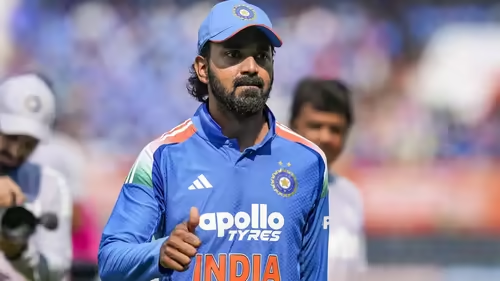
Cricket fans are used to seeing grace under pressure—but rarely do they witness raw, unfiltered honesty from one of India’s most stylish batters. In a recent interview that has sent ripples through the cricketing world, KL Rahul dropped a bombshell not with a retirement announcement, but with a philosophy so simple it stings: “Just quit… when the time comes.”
This isn’t despair—it’s clarity. After years of battling injuries, managing sky-high expectations, and navigating the emotional rollercoaster of international sport, Rahul has arrived at a place of peace. And in doing so, he’s redefined what resilience really looks like in modern cricket.
Table of Contents
- KL Rahul Retirement: A Mindset, Not a Date
- The Hidden Cost of Greatness: Mental Health and Injuries
- Finding Stability as India’s ODI No. 5
- Fatherhood and a Life Beyond the Boundary
- Returning to Roots: Karnataka and Domestic Cricket
- Why Rahul’s Honesty Matters for Cricket
KL Rahul Retirement: A Mindset, Not a Date
Rahul’s comments on KL Rahul retirement aren’t about giving up—they’re about self-awareness. “There’s no point dragging it,” he said plainly, emphasizing that joy should be the benchmark, not legacy or statistics [[1]].
This pragmatic stance is revolutionary in a sport where athletes often cling to their careers long after passion fades. For Rahul, retirement isn’t a dramatic exit—it’s a quiet acknowledgment that life exists beyond the crease. This mindset, forged through pain and reflection, may be his most valuable contribution yet to Indian cricket culture.
The Hidden Cost of Greatness: Mental Health and Injuries
While fans track runs and strike rates, few see the silent toll of chronic injury. Rahul revealed that the physical setbacks were tough—but the mental battles were far worse. “The toughest part was the mental side,” he admitted, describing periods of isolation and self-doubt during recovery [[1]].
His openness about anxiety and emotional fatigue is a powerful step toward destigmatizing mental health in elite sports. According to the BBC’s reporting on athlete mental health, nearly 35% of elite cricketers experience symptoms of depression or anxiety—yet few speak openly. Rahul’s candor could inspire others to seek help without shame.
Key Challenges Rahul Faced:
- Multiple surgeries (including a sports hernia in 2022)
- Extended absences from international duty
- Public scrutiny over inconsistent performances
- Mental exhaustion from constant comebacks
Finding Stability as India’s ODI No. 5
Despite the turbulence, Rahul has found remarkable consistency in a role many thought unsuited for him: batting at No. 5 in ODIs. Since settling into this position, he’s averaged over 60, transforming from a flashy opener into a dependable middle-order anchor [[2]].
This evolution shows his adaptability—a trait often overlooked in discussions about his “unfulfilled potential.” Rather than chasing past glory, he’s embraced a new identity that serves both team and self. It’s a masterclass in reinvention under pressure.
Fatherhood and a Life Beyond the Boundary
Becoming a father has been a game-changer for Rahul. “I tell myself I’m not that important,” he shared—a humbling statement from a man who once carried the hopes of a nation on his shoulders [[1]].
This shift in perspective has freed him from the crushing weight of expectation. Cricket is no longer his entire identity; it’s one part of a fuller life. That balance, he suggests, is what allows him to play with less fear and more presence.
Returning to Roots: Karnataka and Domestic Cricket
In a symbolic move, Rahul is set to don the Karnataka jersey again after a six-year hiatus. His inclusion in the Ranji Trophy squad for the crucial match against Punjab marks a homecoming—and perhaps a recalibration [[3]].
Playing domestic cricket offers more than match practice. It’s a return to simplicity: local crowds, familiar teammates, and the pure love of the game. For fans, it’s a chance to see a global star reconnect with his origins. Follow all domestic updates on our [INTERNAL_LINK:indian-domestic-cricket] page.
Why Rahul’s Honesty Matters for Cricket
In an era of curated social media personas and scripted press conferences, Rahul’s vulnerability is refreshing. He’s not selling a brand—he’s sharing a truth. By normalizing conversations around mental health, career uncertainty, and life after sport, he’s helping reshape cricket’s culture from within.
His journey reminds us that success isn’t just about trophies—it’s about integrity, self-knowledge, and the courage to walk away when the music stops.
Conclusion
KL Rahul retirement may not be imminent, but his mindset offers a blueprint for every athlete: prioritize well-being over longevity, joy over obligation. Whether he plays one more match or fifty, Rahul has already won something far more enduring—peace. And in today’s high-pressure sporting world, that might be the ultimate victory.
Sources
- Times of India: ‘Just quit when the time comes’: KL Rahul opens up on injuries, mental battles and cricket’s next chapter
- ESPNcricinfo Statsguru: KL Rahul ODI Batting Performance by Position
- The Hindu: KL Rahul returns to Karnataka squad for Ranji Trophy
- BBC Sport: Mental health in cricket: The unseen struggle