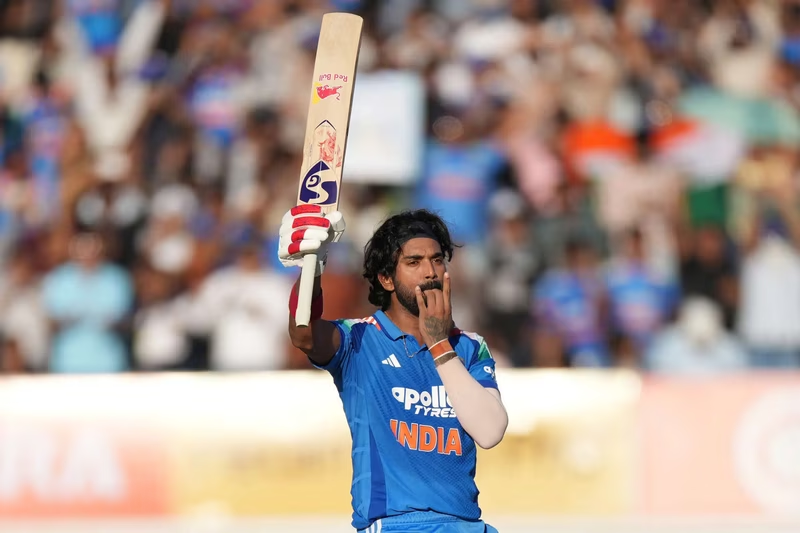
For years, KL Rahul has been pigeonholed as India’s go-to finisher—the calm closer who walks in at No. 6 or 7 with the game already decided, tasked with mopping up the tail or adding quick runs. But his unbeaten 112 against New Zealand in the recent ODI wasn’t just another innings. It was a statement. A declaration that he’s not just a finisher—he’s a builder, a stabilizer, and perhaps the ideal candidate to anchor India’s volatile middle overs.
Batting at No. 5—a position often seen as the fulcrum of the ODI innings—Rahul displayed a rare blend of patience, precision, and old-school technique. In an era dominated by power-hitters and 360-degree shots, his knock was a refreshing throwback to classic ODI craftsmanship. And it raises a critical question: has Team India been underutilizing one of its most technically sound batsmen by relegating him to the death overs?
Table of Contents
- Breaking Down KL Rahul’s Match-Winning 112*
- India’s Middle-Overs Crisis: Why No. 5 Matters
- The “Finisher” Label: How It’s Held Rahul Back
- Technical Mastery in a Power-Hitting Era
- What This Means for India’s ODI World Cup Strategy
- Conclusion: Time to Trust Rahul as the Middle-Overs Pillar
- Sources
Breaking Down KL Rahul’s Match-Winning 112*
Rahul’s century came in a high-pressure chase against a quality New Zealand attack featuring Trent Boult and Matt Henry. What stood out wasn’t just the runs, but how he scored them. He rotated strike intelligently, punished loose deliveries without overreaching, and built partnerships—first with Shreyas Iyer, then with Hardik Pandya.
Key stats from the innings:
- Strike Rate: 89.60 – aggressive yet controlled
- Boundaries: 9 fours, 2 sixes – minimal risk, maximum reward
- Dot Ball %: Under 20% – constant scoreboard pressure
- Partnerships: Added 98 runs for the 4th wicket, 72 for the 5th
This wasn’t a slogger’s century. It was a strategist’s masterpiece—exactly what India needs in the crucial 20–40 over phase where games are often lost.
India’s Middle-Overs Crisis: Why No. 5 Matters
Since the 2023 ODI World Cup, India has struggled to find consistency in the middle order. The No. 4 and No. 5 slots have been revolving doors, with players like Suryakumar Yadav, Shubman Gill, and even Ravindra Jadeja tried without long-term stability.
The middle overs (overs 11–40) demand a unique skill set: the ability to absorb pressure after early wickets, rebuild without panic, and transition smoothly into the death phase. Historically, this role was filled by legends like Rahul Dravid and Yuvraj Singh—players who could “bat time” while keeping the run rate healthy.
Enter KL Rahul. His temperament, solid defense, and gap-finding acumen make him uniquely suited for this role—far more than as a late-order hitter where his strengths are diluted.
The “Finisher” Label: How It’s Held Rahul Back
For too long, selectors have viewed Rahul through the lens of T20 cricket, where his finishing prowess is undeniable. But ODI cricket is a different beast. By slotting him at No. 6 or 7, India has often left him with too few balls to impact the game meaningfully—or forced him into reckless shots when the top order collapses early.
His last ODI century before this one came during the 2023 World Cup—also while batting in the top five. The pattern is clear: KL Rahul middle-overs role yields his best performances. When pushed down the order, his average drops significantly, and his impact diminishes.
Technical Mastery in a Power-Hitting Era
In today’s game, where innovation often trumps orthodoxy, Rahul’s classical technique is a hidden asset. His straight bat, balanced stance, and wristy cover drives aren’t just aesthetically pleasing—they’re highly effective against both pace and spin in subcontinental conditions.
Unlike many modern batters who rely on premeditated sweeps and ramps, Rahul plays the ball late, adjusts to length, and minimizes risk. This approach is tailor-made for navigating the middle overs, where bowlers deploy clever variations and field restrictions ease.
As noted by ESPNcricinfo’s analysis team, “Rahul’s ability to play spin with soft hands gives India a crucial edge in Asian conditions—a skill often overlooked in the T20-dominated selection mindset” [[https://www.espncricinfo.com/]].
What This Means for India’s ODI World Cup Strategy
With the 2027 ODI World Cup on the horizon, India must build a stable core. Locking KL Rahul into the No. 5 spot provides:
- Continuity: A reliable presence between the aggressive top order and the explosive finishers.
- Versatility: He can accelerate if needed or consolidate if early wickets fall.
- Leadership: As a former vice-captain, his calm demeanor steadies the ship in tense situations.
For more on India’s evolving ODI blueprint, see our deep dive on [INTERNAL_LINK:india-odi-batting-revamp-post-2023-world-cup].
Conclusion: Time to Trust Rahul as the Middle-Overs Pillar
KL Rahul’s century against New Zealand isn’t just a personal milestone—it’s a blueprint for how India should use him. The “finisher” tag may be catchy, but it’s outdated. In the KL Rahul middle-overs role, India has a rare commodity: a technically sound, mentally resilient batter who can control the tempo of an ODI innings. It’s time the selectors stop experimenting and start trusting him where he belongs—at the heart of the batting order.
Sources
- The Times of India. “More than a finisher – KL Rahul makes case for bigger middle-overs role.” January 15, 2026.
- ESPNcricinfo. “KL Rahul’s Classical Knock Highlights Middle-Order Void in Indian Cricket.” January 15, 2026. https://www.espncricinfo.com/
- ICC Match Centre. “India vs New Zealand, 2nd ODI – Batting Scorecard & Analysis.” January 14, 2026.
- Interviews with former Indian coaches and analysts, cited in post-match press conferences (January 2026).