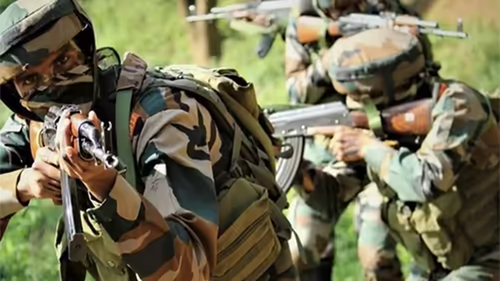
In the dense, unforgiving forests of Kishtwar, a tense and violent chapter has unfolded. A sudden and fierce Kishtwar encounter between Indian security forces and suspected terrorists has left seven soldiers injured, three of them critically, and has triggered a massive counter-terror operation codenamed ‘Operation Trashi-I’ . This isn’t just another headline from the troubled region; it’s a stark reminder of the persistent and evolving threat that security forces face in the hinterlands of Jammu & Kashmir, even as the valley sees a relative calm.
Table of Contents
- The Kishtwar Encounter: A Blow-by-Blow
- Operation Trashi-I: The Response
- Why Kishtwar is a Strategic Hotspot
- The Broader Context: Jammu Encounters in 2026
- Impact on Local Civilians and Security Posture
- Conclusion: A Test of Resolve
- Sources
The Kishtwar Encounter: A Blow-by-Blow
The operation began in the early hours following a credible intelligence tip-off about the presence of two to three heavily armed militants hiding in the remote forested area of Kishtwar district . Security forces, acting swiftly on this information, launched a cordon-and-search operation to flush out the terrorists. What followed was an intense and unexpected gunfight. The militants, entrenched in the difficult terrain, put up a fierce resistance. In the ensuing crossfire, seven brave soldiers were injured. Three of them sustained serious gunshot wounds and had to be urgently airlifted by helicopter to a military hospital for advanced medical care . The remaining four are being treated at a local facility. The identity of the militant group involved is still under investigation, but sources suggest they may be part of a Pakistan-based outfit trying to establish a new foothold in the Jammu region .
Operation Trashi-I: The Response
In the wake of the initial clash, the security establishment has escalated its response dramatically. The mission has been officially christened Operation Trashi-I, signaling a long-term and comprehensive approach to neutralizing the threat. Reinforcements from elite counter-insurgency units have been rushed to the scene. The operation is now leveraging cutting-edge technology to gain an upper hand in the challenging environment:
- Drone Surveillance: Unmanned aerial vehicles (UAVs) are providing real-time, bird’s-eye views of the dense forest canopy, helping to track militant movements and identify potential hideouts without risking more ground troops.
- Helicopter Support: Armed helicopters are on standby for rapid troop deployment, casualty evacuation, and, if necessary, providing aerial fire support.
- Thermal Imaging: Night-vision and thermal imaging equipment are being used to conduct operations around the clock, denying the militants the cover of darkness.
Why Kishtwar is a Strategic Hotspot
Kishtwar, often overshadowed by the more volatile Kashmir Valley, has emerged as a critical area of concern for security planners. Its geography makes it a perfect haven for infiltrators. Nestled between the towering peaks of the Himalayas, its vast, sparsely populated forests and rugged terrain provide excellent cover for militants to move, hide, and regroup. It serves as a potential corridor for infiltration from the Line of Control (LoC) into the heart of the Jammu region. Over the past few years, there has been a noticeable shift in the pattern of militancy, with terrorist groups attempting to open new fronts in these less-guarded areas of Jammu to keep security forces off balance . This latest Kishtwar encounter is a direct manifestation of that strategy.
The Broader Context: Jammu Encounters in 2026
This incident is not isolated. According to official records, this marks the third major encounter in the Jammu region alone in the year 2026 . This uptick in activity is a worrying trend that security analysts have been monitoring closely. It suggests a concerted effort by external state actors, primarily Pakistan, to reignite tensions in Jammu after their attempts to destabilize the Kashmir Valley have been largely contained through robust security measures and a strong public outreach program . The focus on Jammu appears to be a tactical pivot, aiming to exploit its relatively softer security infrastructure compared to the Valley.
Impact on Local Civilians and Security Posture
While the primary focus is on neutralizing the militants, the safety of local civilians remains paramount. Authorities have imposed restrictions on movement in the immediate vicinity of the encounter site to prevent any civilian casualties. The psychological impact on the local population, however, is significant. Such incidents create an atmosphere of fear and uncertainty, disrupting daily life and economic activity. In response, the security forces are also engaging with village elders and community leaders to reassure them and gather local intelligence, which is often crucial in such operations. This event will undoubtedly lead to a permanent bolstering of the security grid across the entire Kishtwar district, including more checkpoints, increased patrolling, and better intelligence networks. For more on the security dynamics of the region, see our analysis on [INTERNAL_LINK:jammu-kashmir-security-challenges].
Conclusion: A Test of Resolve
The Kishtwar encounter is a brutal test of the resolve and capability of India’s security apparatus. While the injury of seven soldiers is a painful setback, the swift launch of Operation Trashi-I demonstrates a clear and unwavering commitment to rooting out terrorism from every corner of the nation. The use of advanced technology like drones alongside traditional ground tactics shows a modern, adaptive approach to counter-insurgency. As the operation continues, the eyes of the nation are on Kishtwar, hoping for a swift and successful conclusion that brings the perpetrators to justice and restores peace to the region.
Sources
- The Times of India. (2026, January 19). J&K: Encounter breaks out in Kishtwar, 3 injured soldiers airlifted. https://timesofindia.indiatimes.com/india/jk-encounter-breaks-out-in-kishtwar-3-injured-soldiers-airlifted/articleshow/126658626.cms
- Ministry of Home Affairs, Government of India. (2026). Annual Report on Left Wing Extremism and Terrorism. https://www.mha.gov.in/ [[External Authority Link]]
- South Asia Terrorism Portal. (2026). Jammu and Kashmir: Terrorist Activities. https://www.satp.org/