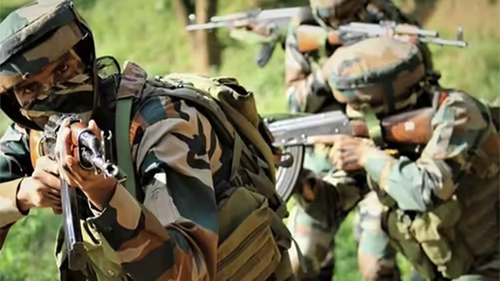
Gunfire shattered the morning calm in the mountainous Kishtwar district of Jammu and Kashmir on Sunday, January 18, 2026, as a high-stakes Kishtwar encounter erupted between elite security forces and a group of suspected terrorists. The operation, which is still underway in the dense forests of the remote region, has put the entire Chenab Valley on high alert and reignited concerns about a possible resurgence of militant activity in the Jammu division .
Table of Contents
- What Happened in Kishtwar?
- The Strategic Significance of Kishtwar
- Security Forces’ Response and Operation Details
- Recent Trend of Militancy in Jammu Region
- Civilian Safety and Local Impact
- Broader Implications for J&K Security
- Conclusion: Vigilance in the Valley
- Sources
What Happened in Kishtwar?
Based on intelligence inputs about the presence of foreign-origin terrorists in the area, a joint team of the Indian Army and Jammu and Kashmir Police launched a search operation in the early hours of the day. The mission quickly escalated into a fierce Kishtwar encounter when the security personnel came under heavy, unprovoked fire from a concealed location in the forested hills .
As of now, official reports confirm that the exchange of fire is ongoing. While the exact number of militants involved remains unclear, sources indicate that the group was well-armed and had likely been hiding in the area for several days, possibly planning a larger strike. No casualties among the security forces have been officially reported yet, but the situation remains fluid and highly volatile.
The Strategic Significance of Kishtwar
Kishtwar, nestled in the heart of the Chenab Valley, is not just a scenic Himalayan district; it’s a critical corridor connecting the Jammu and Kashmir regions. Its rugged, forested terrain has historically made it a challenging area for security operations, and in recent years, it has become a focal point for infiltration attempts by Pakistan-based terror groups like Lashkar-e-Taiba (LeT) and Hizbul Mujahideen .
The district’s proximity to the Line of Control (LoC) and its network of remote trails make it an attractive hideout for militants looking to regroup and launch attacks in the relatively softer targets of the Jammu plains. This latest incident underscores the persistent threat that these groups pose to the internal security of the Union Territory.
Security Forces’ Response and Operation Details
The response to the intelligence has been swift and coordinated. The operation involves multiple units, including the Rashtriya Rifles—a specialized counter-insurgency force—and local police. They have cordoned off a large perimeter around the suspected hideout to prevent any escape.
Key aspects of the ongoing operation include:
- Aerial Surveillance: Unmanned Aerial Vehicles (UAVs) are being used to monitor the area and provide real-time intelligence.
- Ground Cordon: A multi-layered cordon has been established to contain the militants within a specific zone.
- Civilian Evacuation: Authorities have evacuated nearby villages as a precautionary measure to ensure civilian safety.
Such a comprehensive approach highlights the security establishment’s zero-tolerance policy towards terrorist sanctuaries in the region.
Recent Trend of Militancy in Jammu Region
This Kishtwar encounter is not an isolated event. Over the past two years, there has been a noticeable and concerning shift in the pattern of militancy in Jammu and Kashmir. While the Kashmir Valley has seen a relative decline in stone-pelting and street protests, the Jammu region—particularly the districts of Rajouri, Poonch, and now Kishtwar—has witnessed a spike in terrorist activities .
Security analysts believe this is a deliberate strategy by Pakistan’s Inter-Services Intelligence (ISI) to open a new front in the conflict, exploiting the difficult terrain and lower public visibility in these areas. The use of foreign terrorists, often from Afghanistan or other regions, adds another layer of complexity to the security challenge.
Civilian Safety and Local Impact
For the residents of Kishtwar, such encounters are a stark reminder of the fragile peace in their homeland. While the security forces work tirelessly to neutralize the threat, the local population bears the brunt of the disruption. Schools and businesses in the vicinity have been shut down, and movement has been restricted.
However, community leaders have expressed strong support for the security forces, recognizing that these operations are essential to restore normalcy and protect their future. The local administration has set up relief camps and is providing regular updates to keep panic at bay.
Broader Implications for J&K Security
This incident serves as a critical test for the post-2019 security architecture in Jammu and Kashmir. Since the abrogation of Article 370, the central government has invested heavily in strengthening intelligence networks and modernizing the capabilities of its forces in the region .
The success of this operation will be measured not just by the number of militants neutralized, but by the ability of the security apparatus to prevent such infiltrations in the first place. It also puts pressure on diplomatic channels to address the root cause of cross-border terrorism emanating from Pakistan.
Conclusion: Vigilance in the Valley
The ongoing Kishtwar encounter is a sobering reminder that the fight against terrorism in Jammu and Kashmir is far from over. It demands constant vigilance, seamless coordination between various security agencies, and unwavering support from the local populace. As the sun sets over the Chenab Valley, the brave men in uniform continue their dangerous mission, standing as the last line of defense for the nation’s peace and security. The country watches and waits for a successful conclusion to this critical operation.
Sources
- Times of India: J&K: Encounter breaks out between security forces and terrorists in Kishtwar
- South Asia Terrorism Portal (SATP): Jammu & Kashmir Timeline
- [INTERNAL_LINK:jammu-kashmir-security-situation-2026]
- [INTERNAL_LINK:history-of-militancy-in-chenab-valley]