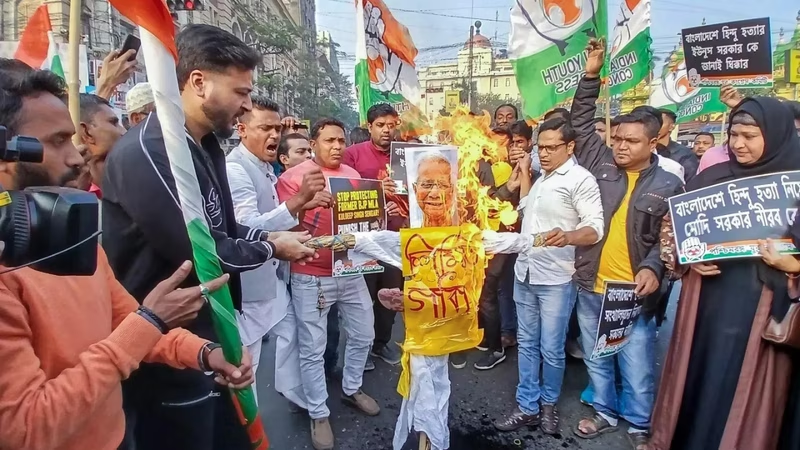
Bangladesh is grappling with a wave of anxiety and anger following the brutal murder of prominent Hindu businessman Khokon Das in Dhaka—a killing that has reignited long-standing fears about the safety of religious minorities in the country. In a swift response, Dhaka Metropolitan Police have arrested three individuals in connection with the crime, as national and international human rights groups call for a transparent and urgent investigation .
The incident, which occurred in the heart of the capital, has not only devastated the local Hindu community but also drawn sharp condemnation from political leaders, civil society, and diaspora groups. With communal tensions simmering beneath the surface in recent months, the Khokon Das murder threatens to deepen existing fault lines in a nation already navigating complex political and social challenges.
Table of Contents
- Who Was Khokon Das?
- Details of the Murder and Police Response
- Khokon Das Murder: Investigation Update
- Broader Context: Minority Safety in Bangladesh
- Political and Diplomatic Reactions
- What This Means for Bangladesh’s Social Fabric
- Conclusion: A Test for Bangladesh’s Secular Identity
- Sources
Who Was Khokon Das?
Khokon Das, 52, was a well-known garment businessman in Dhaka’s Motijheel commercial district. He ran a mid-sized export firm and was active in local Hindu community affairs, often supporting temple festivals and youth programs. Described by neighbors as “soft-spoken, generous, and deeply rooted in his faith,” Das was not known to have enemies or business disputes .
His family confirmed he received no threats prior to the attack. This lack of motive has fueled speculation that the killing may have been motivated by religious identity—a terrifying prospect for Bangladesh’s 12 million Hindus, who make up nearly 8% of the population but have historically faced targeted violence during periods of political instability.
Details of the Murder and Police Response
According to police reports, Das was ambushed near his office late Saturday evening as he was leaving work. Unidentified assailants attacked him with sharp weapons before fleeing the scene. He was rushed to Dhaka Medical College Hospital but succumbed to his injuries en route .
Within 24 hours, the Detective Branch (DB) of Dhaka Metropolitan Police announced the arrest of three suspects—identified as local residents with alleged links to extremist networks. While authorities have not disclosed a confirmed motive, sources within the investigation say initial interrogations point toward a “possible ideological angle,” though financial or personal motives haven’t been ruled out .
Khokon Das Murder: Investigation Update
The case is now under the direct supervision of Bangladesh’s Rapid Action Battalion (RAB), an elite counter-terrorism unit. Key developments include:
- CCTV Footage: Authorities have recovered surveillance video from nearby shops showing the suspects’ movements.
- Weapon Recovery: Police claim to be close to recovering the murder weapon, believed to be a locally made machete.
- Community Outreach: Police have increased patrols in Dhaka’s Hindu-majority neighborhoods like Shankhari Bazar and Lalbagh to prevent retaliatory violence.
Home Minister Asaduzzaman Khan has publicly vowed that “no stone will be left unturned” and promised justice “within days, not weeks.”
Broader Context: Minority Safety in Bangladesh
This murder cannot be viewed in isolation. Over the past decade, Bangladesh’s religious minorities—Hindus, Christians, Buddhists, and Ahmadiyyas—have faced increasing threats:
- 2016: Over 20 people killed in an attack on a Dhaka café, followed by targeted killings of secular bloggers and minority activists.
- 2021: Widespread attacks on Hindu temples and homes during Durga Puja celebrations triggered national outrage.
- 2024–2025: Rising reports of land-grabbing from Hindu families under the guise of “illegal occupation” laws.
According to Human Rights Watch, impunity for crimes against minorities remains a systemic issue, with convictions in such cases being “rare and delayed” .
Political and Diplomatic Reactions
The killing has triggered a wave of responses:
- Opposition Parties: The Bangladesh Nationalist Party (BNP) accused the government of “failing to protect minorities.”
- Civil Society: The Bangladesh Hindu Buddhist Christian Unity Council (BHBCUC) held a silent protest in Dhaka, demanding justice.
- International: The US State Department expressed “deep concern,” while India’s Ministry of External Affairs said it was “closely monitoring the situation” .
What This Means for Bangladesh’s Social Fabric
The Khokon Das murder comes at a fragile time. Bangladesh is preparing for local elections in early 2026, and extremist rhetoric often escalates during election cycles. If this case is not handled with full transparency and speed, it could embolden hate actors and trigger further violence.
Moreover, the incident risks damaging Bangladesh’s international image as a “moderate Muslim democracy.” Investors, diplomats, and diaspora communities are watching closely. For deeper insights, see our analysis on [INTERNAL_LINK:religious-minorities-in-south-asia].
Conclusion: A Test for Bangladesh’s Secular Identity
The murder of Khokon Das is more than a crime—it’s a stress test for Bangladesh’s commitment to its constitutional promise of secularism and equality. The arrest of three suspects is a necessary first step, but true justice will only be served if the investigation exposes the full truth, holds all perpetrators accountable, and sends a clear message that violence against minorities will not be tolerated. In the days ahead, Bangladesh’s response will define not just its legal integrity, but its moral character.