Table of Contents
- What Is the New Khelo India Mission?
- Why Coaches Are the Real Game-Changers
- Beyond the Track: Building a Sports Ecosystem
- The 10-Year Vision and Its Challenges
- Conclusion: From Talent to Titles
- Sources
For decades, India has been a land of raw, untapped sporting talent. We’ve seen flashes of brilliance—Neeraj Chopra’s javelin gold, PV Sindhu’s badminton silver—but turning those sparks into a sustained flame has been our Achilles’ heel. The problem? A system that finds talent but fails to nurture it. That’s all about to change—or at least, that’s the promise of the new Khelo India mission announced in Budget 2026.
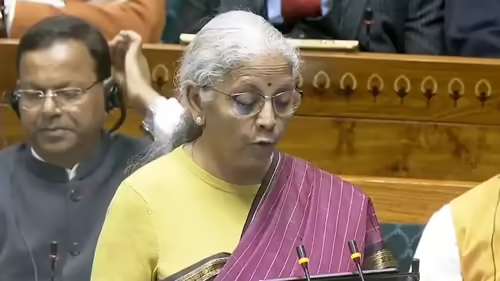
Finance Minister Nirmala Sitharaman didn’t just allocate funds; she declared a full-scale overhaul of India’s sports pipeline. The focus is no longer just on the athlete at the finish line, but on everyone who gets them there: the coaches, the scientists, and the very grounds they train on [[1]].
What Is the New Khelo India Mission?
This isn’t a simple extension of the existing Khelo India program. It’s a strategic, integrated, and long-term (10-year) national mission with a laser focus on the foundational elements of sporting success. The core pillars of this new Khelo India mission are:
- Integrated Talent Development Framework: A seamless pathway from school-level discovery to elite international competition.
- National Coach Development Program: Professionalizing coaching with world-class certification and continuous upskilling.
- Modern Training Centres: Establishing state-of-the-art facilities equipped for multiple disciplines across the country.
- Sports Science Integration: Embedding nutritionists, physiotherapists, biomechanics experts, and psychologists directly into athlete support teams.
- Infrastructure Enhancement: Upgrading existing stadiums and building new ones in tier-2 and tier-3 cities to democratize access.
The goal is clear: to create a self-sustaining ecosystem where talent is identified early, nurtured scientifically, and guided by expert mentors—all within India’s borders [[5]].
Why Coaches Are the Real Game-Changers
India has produced phenomenal athletes, often in spite of the system, not because of it. A key missing link has always been the quality and availability of high-level coaching. Too often, our best athletes have had to seek foreign coaches or train abroad to reach their potential.
The new mission directly tackles this. By launching a dedicated national program for coach development, the government aims to create a large pool of certified, specialized coaches in every Olympic sport. Imagine a young sprinter in Patna having access to a coach trained in the latest biomechanical techniques, or a swimmer in Guwahati learning from someone who’s studied under global best practices.
This is where the real transformation begins. A great coach doesn’t just teach technique; they build champions mentally and physically. Investing in them is the highest-leverage investment India can make in its sporting future [INTERNAL_LINK:indian-olympic-medal-prospects].
Beyond the Track: Building a Sports Ecosystem
The genius of this new initiative is its holistic approach. It understands that a world-class athlete is the product of a world-class system.
Sports Science is No Longer Optional
Gone are the days when hard work alone was enough. Today’s elite sports are a blend of art and science. The integration of sports science means Indian athletes will finally get the same level of support as their international peers—personalized nutrition plans, injury prevention protocols, and data-driven performance analysis [[12]].
Democratizing Access Through Infrastructure
By focusing on building and upgrading training centres outside the major metros, the mission aims to tap into the vast reservoir of talent in rural and semi-urban India. This is crucial for sports like athletics, wrestling, and boxing, where the next generation of champions often comes from villages with minimal facilities.
For a global perspective on how nations build successful sports systems, the World Anti-Doping Agency (WADA) and other international bodies often highlight the importance of a strong domestic coaching and scientific support structure [[https://www.wada-ama.org/]].
The 10-Year Vision and Its Challenges
A 10-year horizon is both the mission’s strength and its biggest risk. It provides the necessary time to see results, but it also requires unwavering political will and bureaucratic efficiency across multiple election cycles.
Potential Pitfalls to Watch:
- Implementation Gap: India’s history is littered with brilliant policies that failed at the ground level due to poor execution and corruption.
- Funding Consistency: Will future budgets continue to prioritize this mission, or will it become another underfunded scheme?
- Measuring Success: The mission needs clear, quantifiable KPIs beyond just medals—like the number of certified coaches, athlete retention rates, and facility utilization.
The success of this Khelo India mission will be judged not in 2026, but in 2036, at the Los Angeles Olympics. That’s the real deadline.
Conclusion: From Talent to Titles
Budget 2026’s announcement of the new Khelo India mission is more than a policy; it’s a statement of belief in India’s sporting potential. By shifting the focus from short-term medal hunts to long-term system building, the government has finally acknowledged the root cause of our underperformance.
If executed with the same ambition as it was announced, this mission could be the catalyst that transforms India from a nation of sporadic heroes into a consistent sporting powerhouse. The baton has been passed. Now, it’s up to the administrators, coaches, and athletes to run the race.
Sources
- Times of India. “Budget 2026: Nirmala Sitharaman announces Khelo India mission to develop coaches, training centres.” https://timesofindia.indiatimes.com/… [[1]]
- NDTV Sports. “Budget 2026: FM Announces New Khelo India Mission Focused on Coaches & Infrastructure.” https://sports.ndtv.com/… [[5]]
- India Today. “Budget 2026: New Khelo India mission to be launched for integrated sports development.” https://www.indiatoday.in/… [[12]]
- Business Standard. “Budget 2026: Govt announces 10-year Khelo India mission to boost grassroots sports.” https://www.business-standard.com/…
- World Anti-Doping Agency (WADA). “Building Clean Sport Systems.” https://www.wada-ama.org/