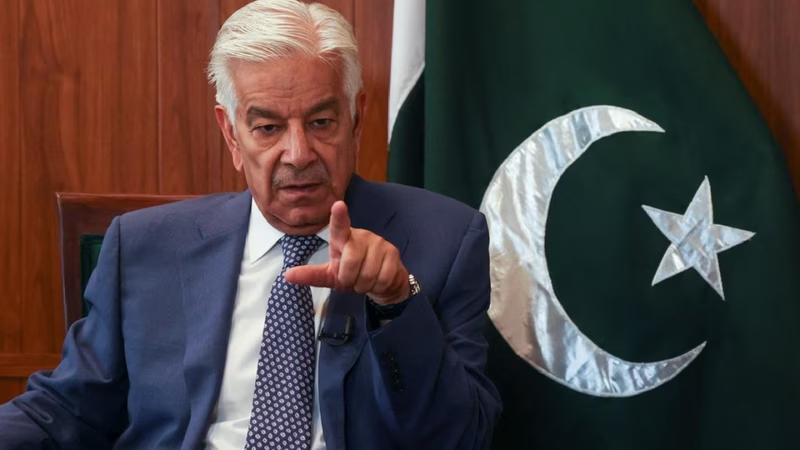
In a move that has ignited a fierce international debate, Pakistan’s Defence Minister, Khawaja Asif, has made an extraordinary and highly controversial appeal. During a televised interview, Asif urged the United States and Turkey to “kidnap” Israeli Prime Minister Benjamin Netanyahu, calling him the “worst criminal of humanity” in the context of the ongoing conflict in Gaza .
This incendiary statement, which directly references the recent International Criminal Court (ICC) actions against Netanyahu, has thrust Pakistan’s foreign policy into the global spotlight and raised serious questions about the boundaries of political rhetoric .
Table of Contents
- The Explosive Statement: What Did Khawaja Asif Say?
- The ICC Warrant: The Legal Context Behind the Call
- Pakistan’s Official Stance on Israel and Gaza
- Global and Diplomatic Fallout from Asif’s Remarks
- Conclusion: A Dangerous Rhetoric or a Frustrated Ally?
- Sources
The Explosive Statement: What Did Khawaja Asif Say?
Khawaja Asif’s comments were unambiguous and deliberately provocative. He stated that if the United States truly believes in its own principles of justice, it should take direct action against Netanyahu. He even drew a parallel with other international figures, suggesting a precedent for such an act .
“The United States should ‘kidnap’ Netanyahu… Turkey should also do it,” Asif was quoted as saying, adding that the Israeli leader is responsible for unparalleled atrocities against the Palestinian people . His remarks were framed within the context of widespread public sentiment in Pakistan, where he claimed citizens pray for Netanyahu’s apprehension.
The use of the word “kidnap” was a deliberate choice, designed to grab attention and convey the depth of his condemnation. While he later clarified that his intent was to highlight the need for accountability, the initial phrasing has been widely condemned as inflammatory and a potential incitement to violence.
The ICC Warrant: The Legal Context Behind the Call
Asif’s statement did not occur in a vacuum. It was a direct reaction to a landmark decision by the International Criminal Court. On November 21, 2024, the ICC issued formal arrest warrants for Benjamin Netanyahu and his former Defence Minister, Yoav Gallant .
The court found reasonable grounds to believe they bear criminal responsibility for war crimes and crimes against humanity committed on the territory of Palestine, specifically during the military operations in Gaza . The charges include acts of extermination, murder, and persecution as crimes against humanity .
While the ICC warrant is a significant legal development, its enforcement relies entirely on the 124 member states of the court. Neither the United States, Israel, nor Turkey are members, which means they have no legal obligation to arrest Netanyahu. Asif’s call, therefore, was a political appeal to these powerful non-member states to act on moral, rather than legal, grounds—a request that sits far outside the bounds of conventional diplomacy.
Pakistan’s Official Stance on Israel and Gaza
Pakistan has a long-standing and unwavering official position on the Israel-Palestine conflict. The country does not recognize Israel and has consistently been one of the most vocal supporters of the Palestinian cause on the international stage .
This stance is deeply rooted in both principle and public opinion. In November 2023, Pakistan’s Senate unanimously passed a resolution condemning Israel’s actions in Gaza as “crimes against humanity” and calling for an immediate ceasefire . The government has repeatedly issued strong condemnations of Israeli military operations, describing them as clear violations of international law .
However, Asif’s personal remarks go significantly further than the standard diplomatic language used in official press releases from the Ministry of Foreign Affairs . While the government’s position is one of principled opposition, the Defence Minister’s call for a kidnapping represents a dramatic and personal escalation that may not reflect the entirety of the state’s strategic calculus, especially given the complex geopolitical relationships Pakistan maintains with both the US and Turkey .
Global and Diplomatic Fallout from Asif’s Remarks
The international reaction to Asif’s comments has been swift and largely negative. The suggestion of kidnapping a sitting head of government is a severe breach of international norms and diplomatic protocol. Such rhetoric is typically associated with non-state actors or pariah regimes, not a cabinet minister from a nuclear-armed state.
It is highly likely that the remarks have caused significant embarrassment for the Pakistani government, which will now be under pressure to either distance itself from its Defence Minister or face serious diplomatic consequences. The United States, in particular, is expected to seek clarifications, as the comment directly challenges its role and responsibilities in the region.
For more on the complexities of Middle Eastern diplomacy, see our analysis on [INTERNAL_LINK:pakistan-role-in-middle-east-peace-process].
Conclusion: A Dangerous Rhetoric or a Frustrated Ally?
Khawaja Asif’s call to “kidnap” Benjamin Netanyahu is a stark reflection of the intense frustration felt by many nations over the perceived lack of accountability for actions in Gaza. While the ICC warrant provides a legal framework for justice, the political will to enforce it remains absent among the world’s most powerful nations.
However, resorting to calls for extrajudicial actions like kidnapping is a dangerous path that undermines the very rule of law Asif claims to champion. It risks isolating Pakistan diplomatically and shifts the focus away from the substantive issues of the Gaza conflict towards a controversy of its own making. The incident serves as a potent reminder that in the high-stakes world of international relations, words carry immense weight and can have far-reaching, unintended consequences.
Sources
- Times of India: Pakistan wants Netanyahu kidnapped? Khawaja Asif’s controversial appeal to US, Turkey – watch
- International Criminal Court: Statement of the ICC Prosecutor on the Situation in the State of Palestine
- Ministry of Foreign Affairs, Pakistan: Official Press Releases on Gaza
- Council on Foreign Relations: Pakistan’s Evolving Role in the Middle East