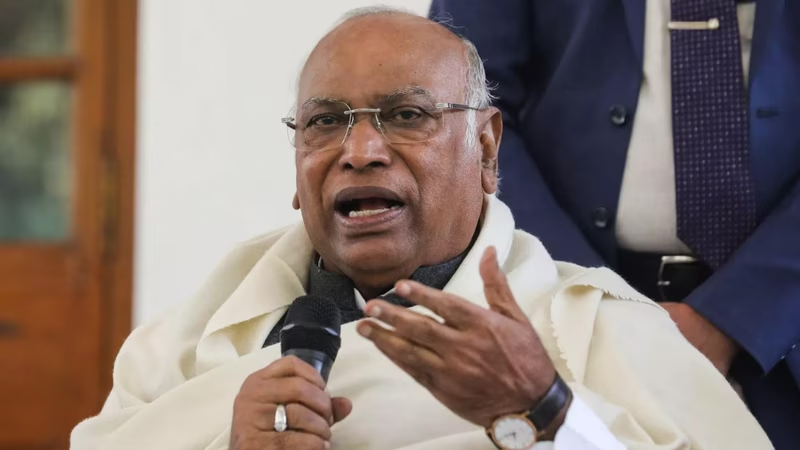
In a blistering critique that has reignited the political debate, Congress President Mallikarjun Kharge has accused the Modi government of steering India’s foreign policy with all the steadiness of a “wild pendulum.” His core argument? That New Delhi is compromising its long-term strategic interests for short-term gains, particularly in its dealings with China and its response to international pressure from the United States .
This isn’t just political point-scoring; it strikes at the heart of how India presents itself on the world stage. For a nation aspiring to be a leading global power, consistency and clarity in its foreign engagements are paramount. So, what exactly is Kharge objecting to, and does his criticism hold water?
Table of Contents
- Kharge’s Two-Pronged Attack on the Modi Govt’s Foreign Policy
- The China Conundrum: Lifting Bans and Strategic Dilemmas
- The Trump Factor: Modi’s Silence on Russian Oil
- Beyond the Headlines: Is There a ‘Modi Doctrine’?
- Conclusion: Navigating a Complex Global Landscape
- Sources
Kharge’s Two-Pronged Attack on the Modi Govt’s Foreign Policy
Kharge’s criticism is built on two specific, high-stakes pillars of India’s current foreign policy. First, he points to reports suggesting the government is considering lifting a five-year-old ban on Chinese firms bidding for critical government infrastructure and technology contracts . Second, he highlights Prime Minister Modi’s conspicuous silence in the face of pointed criticism from former US President Donald Trump regarding India’s continued purchase of Russian oil .
For Kharge, these two issues are not isolated incidents but symptoms of a deeper malaise: an inconsistent and reactive Modi govt foreign policy that lacks a coherent strategic framework. He argues that this approach is leaving India vulnerable and eroding its hard-won diplomatic capital.
The China Conundrum: Lifting Bans and Strategic Dilemmas
The potential reversal on Chinese companies is perhaps the most sensitive issue. The original ban, imposed after the deadly Galwan Valley clash in 2020, was a clear signal of India’s intent to decouple its critical supply chains from a strategic adversary. Kharge alleges that rolling back this restriction is akin to “rolling out a red carpet” for Beijing, directly contradicting the government’s own tough public stance on national security .
This move, if confirmed, presents a classic dilemma for any Indian administration:
- Economic Pragmatism vs. National Security: Chinese firms often offer competitive pricing and technical expertise, which can be attractive for large-scale projects. However, reliance on them for critical infrastructure poses significant data security and strategic risks.
- Diplomatic Signaling: Lifting the ban could be interpreted by Beijing as a sign of weakness or a willingness to de-prioritize the border dispute, potentially emboldening further aggressive posturing.
Kharge’s fear is that the government is prioritizing immediate economic convenience over the long-term goal of Atmanirbhar Bharat (self-reliant India) and strategic autonomy. This, he claims, is a fundamental compromise of India’s interests .
The Trump Factor: Modi’s Silence on Russian Oil
The second prong of Kharge’s attack involves India’s balancing act between Russia and the West. While India has maintained its historic ties with Moscow, including purchasing discounted Russian oil, this has drawn sharp criticism from Western allies, particularly the United States.
Former President Donald Trump has been especially vocal, recently stating that PM Modi “knew I was not happy” about the oil purchases and even threatening new tariffs if the imports continue [[10], [15]]. Despite this direct and public challenge from a key ally, the Prime Minister’s office has remained largely silent, offering no strong public rebuttal or clarification of its position.
Kharge sees this silence as a failure of leadership and a missed opportunity to articulate India’s independent foreign policy stance. He questions why the government, which is usually quick to defend its decisions, has not publicly addressed Trump’s remarks, leaving a vacuum that can be filled with speculation and misinterpretation .
Beyond the Headlines: Is There a ‘Modi Doctrine’?
While Kharge paints a picture of chaos, some foreign policy analysts argue that the Modi govt foreign policy is more nuanced than it appears. A 2024 study notes that while a single, monolithic “Modi Doctrine” may be hard to define, the government’s actions consistently revolve around three core aims: enhancing India’s global stature, securing its economic interests, and managing complex regional relationships .
The government would likely argue that its engagement with China, even on economic terms, is part of a calibrated strategy to manage a difficult relationship without escalating tensions unnecessarily. Similarly, its continued trade with Russia is framed as an assertion of strategic autonomy, a right of a sovereign nation that maintains balanced ties with multiple powers .
However, the challenge lies in effectively communicating this complex calculus to both domestic and international audiences. The perception of inconsistency, whether real or manufactured for political effect, can be just as damaging as actual policy shifts. For readers interested in the broader context of India’s strategic choices, our deep dive into [INTERNAL_LINK:india-us-russia-triangle] offers valuable insights.
Conclusion: Navigating a Complex Global Landscape
Mallikarjun Kharge’s critique of the Modi govt foreign policy as a “wild pendulum” has successfully thrown a spotlight on two of India’s most delicate diplomatic challenges. Whether one agrees with his assessment or not, his questions about the rationale behind potential policy reversals on China and the strategic silence on Trump’s comments are valid and demand a transparent response.
In an increasingly multipolar and volatile world, India’s foreign policy must be both strategically sound and clearly communicated. The government’s ability to articulate a consistent vision that balances economic needs with national security imperatives will be crucial in determining its success on the global stage. The opposition’s role, as demonstrated here, is to hold the government accountable for every swing of that pendulum.
Sources
- Times of India: ‘Swings like a wild pendulum’: Kharge targets Modi govt’s foreign policy
- The Hindu: “PM Modi knew I was not happy”: Trump warns of more tariffs if India continues Russian oil import
- Ogden, C. (2024). Tone Shift: India’s Dominant Foreign Policy Aims Under Modi. Journal of Asian Security.