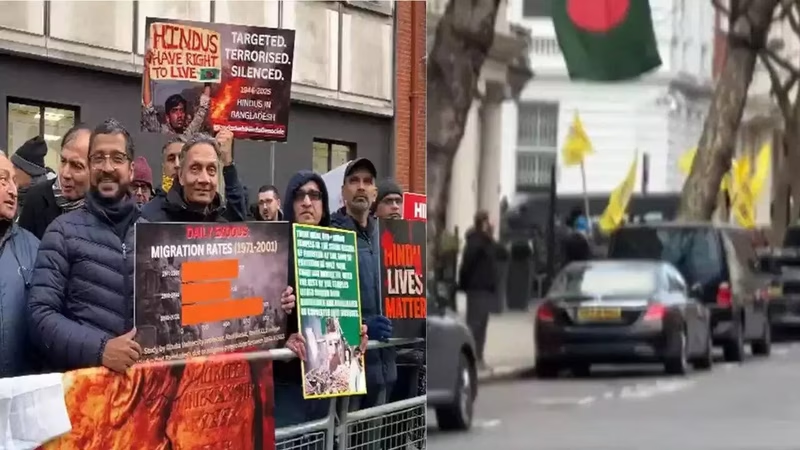
Khalistani Disruption in London: When a Peaceful Protest Turns Confrontational
What began as a solemn demonstration by members of the Hindu diaspora outside the Bangladesh High Commission in London on Saturday quickly escalated into a charged standoff—thanks to the unexpected and provocative arrival of Khalistani separatists. The protest, organized in response to the brutal lynchings of two Hindu men—Dipu Chandra Das and Amrit Mondal—in Bangladesh, was meant to be a unified cry for help from a persecuted minority. Instead, it became a flashpoint in the complex web of South Asian diaspora politics.
This dramatic scene encapsulates the heart of the Khalistani disruption London protest: a moment where grief was met with ideological interference, and the plight of Bangladeshi Hindus was co-opted by unrelated separatist agendas. The incident has since ignited fierce debate across social media and diplomatic circles about solidarity, exploitation, and the politicization of minority suffering.
Table of Contents
- Why Were Hindus Protesting in London?
- Who Are the Khalistanis—and Why Did They Show Up?
- The Standoff: What Actually Happened?
- The Worsening Crisis for Hindus in Bangladesh
- Global Reactions and India’s Dilemma
- Conclusion: Solidarity or Exploitation?
- Sources
Why Were Hindus Protesting in London?
The protest was organized by a coalition of UK-based Indian and Bangladeshi Hindu groups in response to two horrific incidents in Bangladesh:
- Dipu Chandra Das: A Hindu grocery shop owner in Cumilla, brutally beaten to death by a mob over alleged blasphemy—a claim later debunked by local authorities.
- Amrit Mondal: A Hindu fisherman lynched in Noakhali amid growing communal tensions.
These killings are part of a disturbing pattern. According to human rights monitors, attacks on religious minorities in Bangladesh have surged since late 2024, with temples vandalized and families forced to flee their ancestral homes. Protesters outside the High Commission held signs reading “SOS India: Open the Borders” and “Save Hindus of Bangladesh,” pleading for humanitarian intervention .
Who Are the Khalistanis—and Why Did They Show Up?
In a baffling twist, a small group of Khalistani activists—advocates for a separate Sikh homeland called “Khalistan”—arrived at the protest site carrying placards in support of the Bangladeshi government. Their banners read messages like “Bangladesh Zindabad” and accused the Hindu protesters of being “agents of Hindutva.”
Experts say this isn’t coincidental. Some Khalistani groups have long sought alliances with anti-India regimes and movements, viewing any Indian-aligned cause—religious or political—as an enemy. Their appearance in London appears to be a deliberate attempt to delegitimize the Hindu protest by framing it as part of a broader “Hindutva agenda,” rather than a humanitarian appeal .
The Standoff: What Actually Happened?
Eyewitnesses and video footage from the scene show tense verbal exchanges between the two groups. The Hindu demonstrators, many of them elderly or women, remained nonviolent but visibly distraught. Meanwhile, the Khalistani contingent—estimated at fewer than 10 people—attempted to disrupt chants and drown out speeches with loud slogans.
London police were called to maintain order, though no arrests were reported. Still, the symbolic violence of the moment was clear: a community begging for global attention to its existential crisis was interrupted by actors with no connection to Bangladesh—only a vested interest in opposing anything perceived as “pro-India” .
The Worsening Crisis for Hindus in Bangladesh
The lynchings of Das and Mondal are not isolated. Data from the Human Rights Watch and Bangladesh Minority Lawyers’ Association shows a 60% increase in attacks on religious minorities in 2024–2025. With a Hindu population that has dwindled from 22% at independence to under 8% today, many fear a point of no return.
“We are not asking for special treatment—just safety,” said Rajib Saha, a London-based organizer whose family fled Sylhet last year. “When our SOS is interrupted by people who’ve never set foot in Bangladesh, it feels like a betrayal.”
Global Reactions and India’s Dilemma
The incident has drawn mixed responses:
- India’s Ministry of External Affairs issued a statement expressing “deep concern” over the lynchings but stopped short of calling for border openings, citing diplomatic protocols .
- UK Parliamentarians, including members of the All-Party Parliamentary Group on Bangladesh, have urged the British government to raise the issue with Dhaka.
- Diaspora Organizations like the Global Hindu Alliance are now pushing for asylum pathways for Bangladeshi Hindus, similar to those created for Afghan Sikhs and Christians.
Meanwhile, critics warn that the Khalistani disruption London protest risks overshadowing the very real humanitarian emergency unfolding in Bangladesh—a tragedy that demands urgent, focused attention, not geopolitical theater.
Conclusion: Solidarity or Exploitation?
At its core, the London protest was a desperate plea from a vulnerable community facing existential threat. The Khalistani disruption London protest did more than cause a scene—it exposed how minority suffering can be hijacked for unrelated political ends. As Bangladeshi Hindus continue to send out SOS messages, the world must decide: will we listen to their pain, or let their voices be drowned out by those with ulterior motives?
For now, the images from outside the Bangladesh High Commission in London serve as a stark reminder: in the diaspora, even grief is not immune to politicization.
Sources
- Times of India: Watch: Khalistanis in UK disrupt protest by Hindus over killings in Bangladesh
- BBC News (UK): Tensions flare at Bangladesh mission protest in London
- Ministry of External Affairs, India: Official Statements on Bangladesh Situation (Dec 2025)
- Human Rights Watch – Bangladesh: Attacks on Religious Minorities in Bangladesh