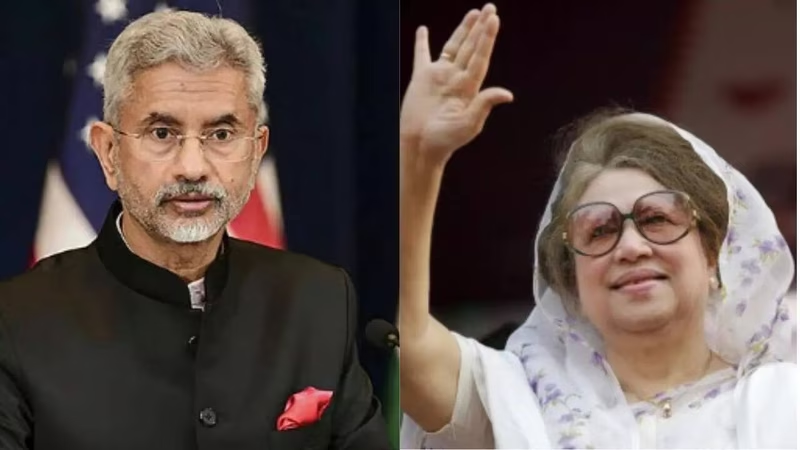
The political landscape of South Asia has shifted with the passing of a colossus. On the morning of December 30, 2025, Begum Khaleda Zia, Bangladesh’s first female Prime Minister and a central figure in its democratic journey for over four decades, breathed her last at Dhaka’s Evercare Hospital . She was 80 years old . Her death, the culmination of a prolonged and complex illness involving her liver, heart, and lungs, marks the end of an era defined by fierce rivalry, unwavering principle, and a relentless fight for power .
In a powerful signal of respect and the deep, albeit complex, ties between the two nations, India has decided to send its highest-ranking diplomat to her final rites. External Affairs Minister Dr. S. Jaishankar will represent India at the funeral in Dhaka . This move, coupled with a heartfelt tribute from Prime Minister Narendra Modi, underscores the significance of Khaleda Zia’s role not just in Bangladesh, but in the history of India-Bangladesh relations.
Table of Contents
- Who Was Khaleda Zia? A Legacy of Power and Resistance
- The Details of Khaleda Zia Death and Long Illness
- India’s Diplomatic Response: Jaishankar and Modi Lead the Tribute
- The 2015 Meeting: A Pivotal Moment in Bilateral Ties
- Khaleda Zia Death and the Future of India-Bangladesh Relations
Who Was Khaleda Zia? A Legacy of Power and Resistance
Born on August 15, 1945, in Dinajpur, Khaleda Zia was thrust into politics following the 1981 assassination of her husband, President Ziaur Rahman. From that tragedy, she emerged as the leader of the Bangladesh Nationalist Party (BNP) and became a formidable opponent of the rival Awami League, led by Sheikh Hasina.
Her career was a testament to resilience. She served as Prime Minister for two non-consecutive terms (1991-1996 and 2001-2006), becoming the first woman to hold the office. Her tenure was marked by efforts to strengthen the private sector and maintain a balance in foreign policy. However, her later years were overshadowed by a bitter and often violent political feud with Sheikh Hasina, which led to her long house arrest and a conviction on corruption charges she and her supporters claimed were politically motivated.
The Details of Khaleda Zia Death and Long Illness
Khaleda Zia’s health had been a matter of public concern for several years. She was admitted to Evercare Hospital on November 23, 2025, with a severe lung infection . This condition quickly deteriorated into pneumonia, leading to respiratory failure . Her medical team’s reports indicated that her death was the result of a combination of these severe infections, compounded by pre-existing advanced liver cirrhosis and heart issues [[2], [8]]. Her passing at 6 a.m. on December 30, 2025, was confirmed by her BNP party .
India’s Diplomatic Response: Jaishankar and Modi Lead the Tribute
The decision for EAM S. Jaishankar to attend the funeral is a major diplomatic gesture. It signifies that, regardless of the political complexities of recent years, India recognizes Khaleda Zia’s immense historical stature. Her role in Bangladesh’s democratic restoration and her position as a key player during crucial phases of bilateral engagement cannot be ignored . Jaishankar’s presence in Dhaka is a mark of respect from the Government and people of India .
The 2015 Meeting: A Pivotal Moment in Bilateral Ties
In his condolence message, Prime Minister Narendra Modi chose to highlight a specific, warm memory: their meeting in Dhaka in 2015 . This was a landmark year for India-Bangladesh relations. PM Modi had become the first Indian Prime Minister in decades to be the chief guest at Bangladesh’s Independence Day celebrations. It was a period of significant hope and forward momentum in the bilateral relationship.
“I recall my warm meeting with her in Dhaka in 2015. We hope that her vision and legacy will continue to guide our partnership,” PM Modi stated . This reference is poignant. It harks back to a time when the political atmosphere was less fraught, and it serves as a subtle reminder of the potential for cooperation that exists between the two nations, a potential Khaleda Zia herself had once helped to foster.
Khaleda Zia Death and the Future of India-Bangladesh Relations
Khaleda Zia’s passing leaves a massive void in Bangladesh’s opposition politics. For India, it presents a moment of reflection on its own diplomatic history with its eastern neighbor. The relationship has often been described as complex, especially during her tenures, which saw a more balanced, and at times, China-leaning foreign policy .
Her death could potentially lead to a period of political recalibration in Bangladesh. For India, maintaining stable and constructive ties with Dhaka is of paramount strategic importance. The respectful manner in which India has acknowledged her passing, through Jaishankar’s attendance and Modi’s personal tribute, is a crucial step in that direction. It shows an understanding that honoring a nation’s history is key to building its future.
For more context on South Asian political history, the Encyclopaedia Britannica’s entry on Bangladesh offers a comprehensive overview.
Conclusion
The Khaleda Zia death is not just a national event for Bangladesh; it’s a regional one. She was a figure who, through her triumphs and tribulations, shaped the very fabric of her country’s democracy. India’s dignified and respectful response, led by EAM Jaishankar’s attendance at her funeral and PM Modi’s personal recollection of their 2015 meeting, is a masterclass in diplomatic statecraft. It acknowledges her immense contribution while looking towards a future of continued partnership between two intertwined nations.
Sources
- Times of India: Khalida Zia death: EAM Jaishankar to attend funeral in Dhaka; PM Modi pays tribute
- Web Search Results on Khaleda Zia’s cause of death [[1], [2], [4], [5], [6], [7], [8], [9]]
- Web Search Results on S. Jaishankar’s attendance [[10], [12], [13], [16]]
- Web Search Results on PM Modi’s tribute [[17], [18], [19], [22], [23]]
- Encyclopaedia Britannica: Bangladesh